The Dawn of High-Power Fiber Lasers in Heavy Infrastructure
For decades, the structural steel industry relied on oxygen-fuel or plasma cutting to manage the sheer thickness of materials required for power towers and infrastructure. However, as the global demand for energy transmission increases, the limitations of these legacy methods—specifically regarding precision, secondary processing, and speed—have become bottlenecks. Enter the 20kW fiber laser.
As a fiber laser expert, I have witnessed the evolution of power density. A 20kW system isn’t just “twice as fast” as a 10kW system; it represents a fundamental shift in the physics of the cut. At 20,000 watts, the laser achieves a power density that allows it to vaporize thick-walled carbon steel almost instantly. In the context of Power Tower fabrication, where H-beams, I-beams, and thick-walled tubes are the primary building blocks, this wattage allows for clean, dross-free cuts on materials up to 50mm thick, with a precision that was previously reserved for thin-sheet aerospace applications.
The Engineering Marvel: The Infinite Rotation 3D Head
The true “brain” of the 20kW Processing Center is the 3D cutting head featuring infinite rotation. Traditional 3D heads often suffer from “cable wrap,” where the internal fiber optic cable and gas lines limit the rotation to 360 or 720 degrees before the head must “unwind.” In a high-volume fabrication environment like Charlotte’s industrial sector, these seconds of “unwinding” translate to hours of lost productivity over a month.
The infinite rotation head utilizes advanced rotary joints and slip-ring technology for gas and cooling, allowing the head to spin indefinitely. When processing complex structural shapes—such as the hexagonal or octagonal tapered poles used in monopoles—the head can transition from a vertical cut to a complex 45-degree bevel without ever stopping. This fluid motion is critical for “Weld Prep” (welding preparation). By cutting the bevel directly into the part with the laser, we eliminate the need for manual grinding, which is the most labor-intensive part of power tower assembly.
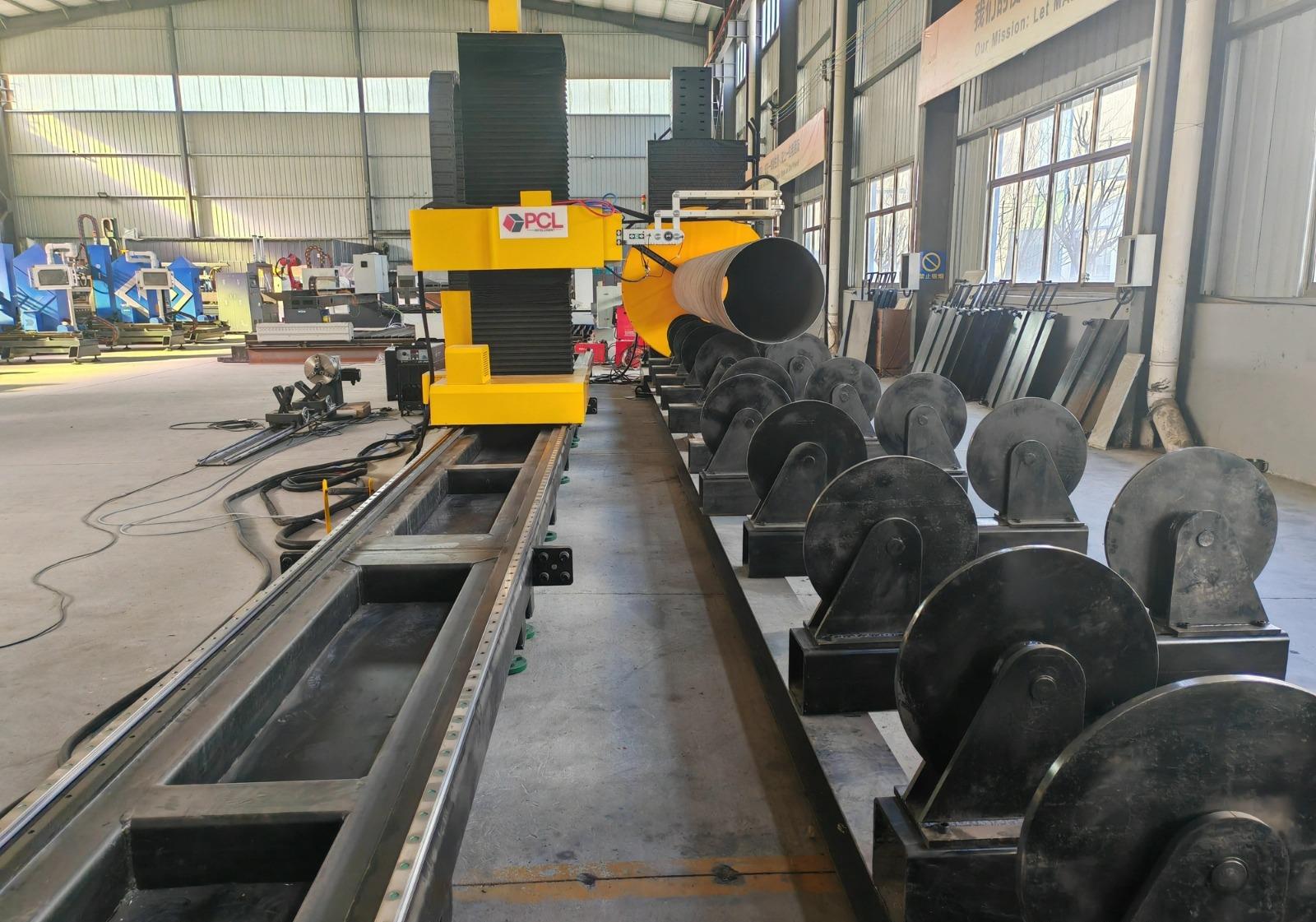
Strategic Application: Power Tower Fabrication
Power towers are the backbone of the electrical grid. Whether they are lattice towers or large-diameter monopoles, they share a common requirement: structural integrity under extreme wind and ice loads. The 20kW fiber laser addresses this through three specific advantages:
- Reduced Heat Affected Zone (HAZ): High-power lasers move so quickly that the heat does not have time to dissipate into the surrounding metal. This preserves the metallurgical properties of the high-strength low-alloy (HSLA) steel commonly used in tower construction.
- Bolt Hole Precision: Towers are often bolted together in the field. If a hole is even 1mm out of alignment due to thermal distortion, the entire assembly process grinds to a halt. The 20kW laser produces holes with a taper-free finish and aerospace-grade tolerance.
- Complex Geometry: Power towers require intricate “fish-mouth” cuts for bracing pipes and precise notches for interlocking lattice members. The 5-axis 3D head handles these geometries in a single pass, whereas traditional methods would require multiple setups on different machines.
Why Charlotte? The Geographic and Industrial Context
Charlotte, North Carolina, has emerged as a primary hub for this technology for several strategic reasons. First, the region is a nexus for energy companies and engineering firms, such as Duke Energy and Siemens Energy. Proximity to the end-users of power towers makes Charlotte an ideal location for a high-capacity processing center.
Furthermore, the manufacturing corridor along I-85 provides the logistical infrastructure necessary to move the massive raw steel sections into the facility and the finished tower components out to site. By housing a 20kW 3D Structural Steel Processing Center in Charlotte, fabricators can drastically reduce “miles-per-part,” lowering the carbon footprint of infrastructure projects and providing “Just-In-Time” delivery to utility projects across the Southeast.
The Physics of 20kW: Speed vs. Quality
In the world of fiber lasers, there is a concept known as “the sweet spot.” For 12mm to 25mm steel (the standard thickness for many tower components), a 20kW laser operates in a high-speed nitrogen or air-assist mode that produces a “shiny” cut surface. This surface is free of the oxide layer produced by oxygen cutting.
For the fabricator, this means the part can go straight from the laser bed to the paint or galvanizing booth. In traditional fabrication, the oxide layer left by a plasma cutter must be sandblasted or chemically removed, or the protective coating will not adhere. By eliminating this secondary cleaning step, the 20kW system in Charlotte can effectively double the throughput of a traditional shop without adding a single square foot of floor space.
Software Integration and Digital Twin Manufacturing
Operating a 20kW 3D head requires more than just raw power; it requires sophisticated software. Modern processing centers utilize “Digital Twin” technology, where the 3D model of the power tower is imported directly into the laser’s NC (Numerical Control) system. The software automatically calculates the optimal path for the infinite rotation head, ensuring that the laser maintains a constant standoff distance even as it maneuvers around the flanges of an H-beam.
This “Smart Manufacturing” approach allows for nesting optimization. Steel is expensive, and in the fabrication of massive towers, material waste can cost thousands of dollars per day. The 20kW center’s software can nest complex 3D parts closer together than manual layout ever could, often increasing material utilization by 15-20%.
Safety and Environmental Impact in Fiber Laser Technology
As an expert, I must emphasize that a 20kW laser is an extremely high-energy device. The Charlotte facility housing this machine is equipped with Class 1 laser-safe enclosures, utilizing specialized laser-rated glass to protect operators from reflected infrared radiation.
From an environmental standpoint, the fiber laser is significantly more efficient than the CO2 lasers of the past. It converts electrical energy into light with an efficiency of about 40%, compared to the 10% efficiency of older technologies. Additionally, because it uses no mirrors or delicate bellows, the maintenance-related waste is nearly zero. For the city of Charlotte, which is increasingly focused on green manufacturing, the 20kW fiber laser represents a sustainable path forward for heavy industry.
Conclusion: Strengthening the Grid with Light
The 20kW 3D Structural Steel Processing Center with Infinite Rotation in Charlotte is not just a piece of machinery; it is a critical infrastructure asset. As we move toward a more electrified future, the demand for robust, precision-engineered power towers will only grow.
By harnessing the power of 20,000 watts and the geometric freedom of 5-axis infinite rotation, fabricators can now produce the “bones” of our energy grid faster, stronger, and more efficiently than at any point in history. The precision of the laser, combined with the strategic industrial advantages of the Charlotte region, ensures that the next generation of power towers will be built to the highest possible standards, literalizing the idea of “strengthening the grid with light.”













