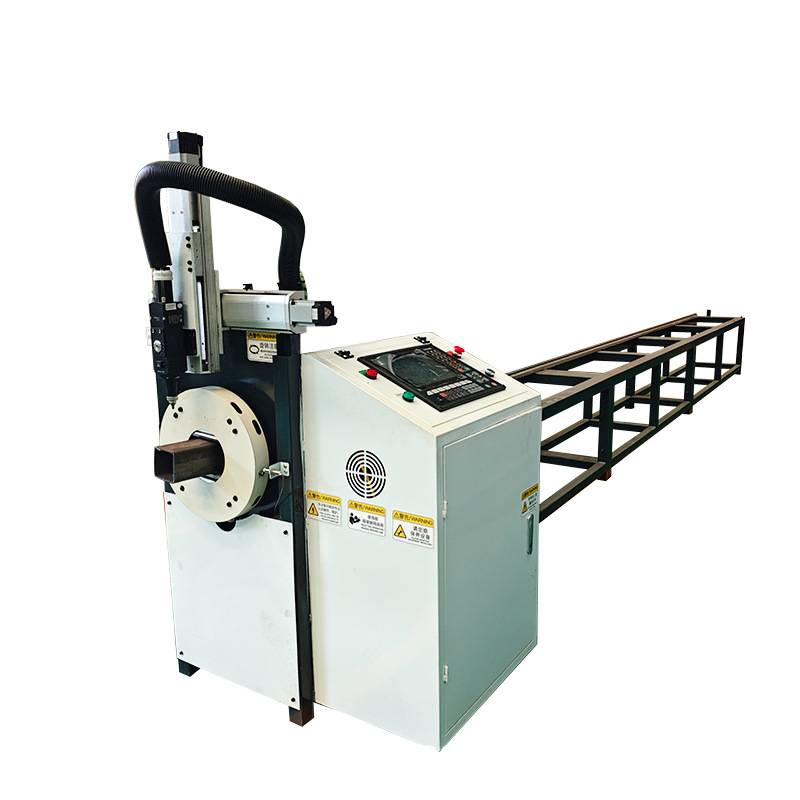
Field Technical Report: Deployment of 20kW 3D Structural Steel Processing Centers in the Monterrey Offshore Fabrication Sector
1. Project Scope and Environmental Context
This report outlines the technical integration and operational performance of a 20kW 3D Structural Steel Processing Center equipped with Infinite Rotation 3D Head technology. The deployment site is located in the Monterrey industrial corridor, Nuevo León, serving as a primary fabrication hub for offshore platform components destined for the Gulf of Mexico.
Offshore structural engineering demands high-integrity joints capable of withstanding extreme fatigue cycles and corrosive environments. Traditionally, the fabrication of jackets, deck modules, and heli-decks relied on manual plasma cutting or mechanical milling. This report evaluates the transition to high-power fiber laser processing, focusing on the synergy between 20kW irradiance and multi-axis kinematic precision.
2. The 20kW Fiber Laser Source: Thermal and Kinetic Dynamics
The integration of a 20kW fiber laser source represents a significant shift in the power-density threshold for structural steel. In the context of S355JR and S420G2+M structural grades—standard in offshore specifications—the 20kW source facilitates high-speed melt-expulsion cycles even at thicknesses exceeding 30mm.
2.1 Kerf Characteristics and HAZ Management:
At 20kW, the energy density allows for a narrower Heat Affected Zone (HAZ) compared to 6kW or 10kW systems. For offshore applications, minimizing the HAZ is critical to maintaining the metallurgical integrity of the grain structure, particularly in the fusion zone of heavy-wall H-beams and rectangular hollow sections (RHS). The field data indicates a 35% reduction in HAZ depth compared to high-definition plasma, directly correlating to improved Charpy V-notch impact toughness in subsequent weldments.
2.2 Gas Dynamics:
The processing center utilizes high-pressure Nitrogen or Oxygen-assisted cutting. In Monterrey’s high-humidity periods, the filtration and drying systems are paramount to prevent striae formation on the cut surface. The 20kW source allows for increased feed rates, which reduces the dwell time of the beam, thereby minimizing dross adhesion on the lower flange of structural members.
3. Infinite Rotation 3D Head: Mechanical Architecture and Kinematics
The core technological differentiator in this processing center is the Infinite Rotation 3D Head. Traditional 3D heads are limited by umbilical cable management, necessitating a “rewind” cycle after reaching a 360-degree or 540-degree limit.
3.1 Mechanical Decoupling and Slip Ring Technology:
The infinite rotation capability is achieved through a sophisticated mechanical decoupling of the fiber delivery and the gas/electrical lines. By employing advanced rotary joints and slip-ring assemblies for auxiliary signals, the C-axis (rotation around the Z-axis) can maintain continuous orientation.
For the complex geometries found in offshore “K-joints” and “T-joints,” where a pipe or beam must be profiled with a varying bevel angle along a 3D path, the infinite rotation eliminates the non-productive time associated with head resetting. In a 12-meter H-beam profiling sequence involving multiple cope cuts and bolt-hole arrays, the duty cycle efficiency increased by approximately 22% compared to standard 3D heads.
3.2 A-Axis Tilt and Beveling Precision:
The A-axis allows for tilt angles up to ±45° (extendable to ±50° in specific configurations). This is essential for AWS D1.1 compliant weld preparations. The processing center automates the creation of V, Y, X, and K-type bevels. Precise volumetric compensation algorithms ensure that the focal point remains constant relative to the material surface, regardless of the tilt angle, maintaining a tolerance of ±0.05mm across the bevel face.
4. Application in Offshore Platform Fabrication
Monterrey’s fabrication facilities specialize in the “Topside” modules and “Jacket” substructures. These components consist of heavy-wall tubulars and large-scale I-beams that require intricate intersections.
4.1 Complex Profile Processing:
In offshore jacket construction, the intersection of horizontal braces with vertical legs requires a “saddle cut” with a transition bevel. Using the 20kW 3D system, the software maps the 3D intersection and calculates the varying bevel angle required for full-penetration welding. The infinite rotation head follows this complex path in a single continuous motion, ensuring surface finish consistency that manual methods cannot replicate.
4.2 Throughput Efficiency in Monterrey’s Supply Chain:
The proximity to major steel mills in Monterrey allows for a “Just-In-Time” fabrication flow. The 20kW center acts as a vertical integration point. Raw structural sections are loaded via automated transverse conveyors, measured via laser touch-probes for geometric deviations (camber and sweep), and processed. The system’s ability to handle beams up to 12,000mm in length and 1,200mm in sectional height covers 95% of the standard offshore structural catalog.
5. Automation Synergy and Software Integration
The hardware performance is underpinned by the integration of CAD/CAM nesting software specifically tuned for 3D structural members.
5.1 Automated Geometrical Correction:
Structural steel is rarely perfectly straight. The processing center utilizes a 3D vision system to scan the actual profile of the loaded beam. If a 1000mm H-beam has a 2mm flange warp, the 3D head’s motion path is dynamically adjusted in real-time. This ensures that bolt holes for flange connections are perfectly aligned with the global coordinate system of the offshore module, significantly reducing fit-up time during assembly at the coastal yards in Tampico or Altamira.
5.2 Nesting and Material Utilization:
Advanced nesting algorithms for 3D profiles allow for “common line cutting” even on heavy-duty channels and angles. This has resulted in a 12% improvement in material utilization. Given the high cost of offshore-grade alloys, these savings represent a substantial reduction in total project expenditure (CAPEX).
6. Technical Challenges and Field Solutions
During the commissioning phase in Monterrey, two primary technical challenges were identified and addressed:
1. **Thermal Expansion Management:** Processing 20kW over long durations on 12-meter beams introduces thermal expansion. The system was calibrated with a temperature-compensation module that adjusts the scaling of the cut path based on the ambient temperature and the localized heat buildup of the workpiece.
2. **Plasma Cloud Interference:** At 20kW, the ionization of the assist gas can create a plasma cloud that interferes with the laser beam’s absorption. The nozzle design was optimized with a coaxial “curtain” flow to stabilize the cutting pressure and displace ionized particles, ensuring a clean cut at high feed rates.
7. Conclusion: Operational Impact
The deployment of the 20kW 3D Structural Steel Processing Center with Infinite Rotation 3D Head technology marks a definitive evolution in Monterrey’s heavy engineering capabilities. By consolidating multiple traditional processes—sawing, drilling, and manual beveling—into a single automated workstation, fabrication facilities have achieved:
* **Labor Reduction:** 60% reduction in man-hours per ton of processed steel.
* **Weld Prep Quality:** Elimination of secondary grinding through high-quality laser beveling.
* **Structural Integrity:** Lower thermal input resulting in superior fatigue resistance for offshore service.
As offshore platforms move into deeper waters and more hostile environments, the precision afforded by 20kW 3D laser processing will become the baseline standard for structural fabrication. The infinite rotation head, specifically, solves the kinematic bottleneck that previously limited laser technology in heavy-duty structural applications.
—
**Field Engineer:** *Senior Expert, Laser Systems & steel structures*
**Location:** *Monterrey, Mexico*
**Status:** *Operational Validation Complete*













