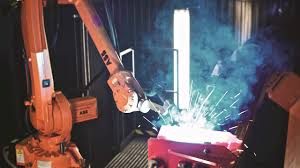
The Dawn of 20kW Power in Structural Fabrication
The transition from traditional CO2 lasers to fiber laser technology was the first revolution; the jump to 20kW power is the second. In the context of structural steel—the backbone of any airport infrastructure—mass and thickness are the primary challenges. A 20kW fiber laser source provides the photon density required to pierce and cut through carbon steel thicknesses exceeding 50mm with surgical precision.
For the massive structural skeletons required in airport terminals, where wind loads and seismic requirements demand thick-walled sections, the 20kW output ensures that the heat-affected zone (HAZ) is minimized. Traditional plasma or oxy-fuel cutting often leaves a significant thermal footprint, requiring secondary grinding processes. The 20kW fiber laser, however, moves so rapidly that the thermal transfer to the surrounding material is negligible, preserving the metallurgical integrity of the structural steel—a non-negotiable requirement for aviation-grade safety standards.
Strategic Placement: Why Queretaro?
Queretaro has established itself as the “Aerospace Valley” of Mexico. Its strategic location in the Bajío region makes it a logistical nexus, connecting the industrial corridors of the north with the high-demand construction zones of central and southern Mexico. By housing a 20kW 3D Structural Steel Processing Center here, the industry minimizes the “logistical friction” of transporting oversized structural members.
Furthermore, Queretaro’s existing ecosystem of highly skilled engineers and technicians provides the human capital necessary to operate such sophisticated machinery. Airport construction is not merely about bulk steel; it is about high-tolerance engineering. The proximity to aerospace manufacturing plants means the quality control standards (QC) applied to structural steel in this facility often mirror the rigorous documentation and precision found in aircraft component manufacturing.
The Engineering Marvel of the Infinite Rotation 3D Head
The centerpiece of this processing center is the 3D cutting head featuring infinite rotation. Traditional 3D laser heads are often limited by “cable wind-up,” meaning they must eventually rotate back to a zero point after a 360-degree turn to prevent damaging internal fiber optics and gas lines. In a high-volume structural environment, this “unwinding” time is dead air—it wastes minutes that aggregate into hours over a project’s lifespan.
Infinite rotation technology utilizes advanced slip-ring assemblies and specialized fiber delivery systems that allow the head to rotate indefinitely on the C-axis. When processing complex architectural trusses or multi-sided beam joints for an airport’s grand canopy, the laser can transition from a top-face cut to a side-face bevel in one continuous motion.
The 3D capability (A/B axis tilting) is equally vital. Most structural joints in modern airports are not simple 90-degree welds. They require complex bevels (K, V, X, or Y profiles) for full-penetration welding. The 3D head can create these bevels automatically during the initial cut, eliminating the need for manual torching or secondary machining. This ensures that when the steel arrives at the airport construction site, it fits perfectly, like a high-stakes jigsaw puzzle.
Meeting the Demands of Modern Airport Architecture
Contemporary airport design, exemplified by projects like the expansion of Mexico City’s aerial gateways or the new regional hubs, favors organic, sweeping curves and expansive glass-and-steel facades. These designs require “Complex Geometry Steel Work.”
The 20kW 3D laser center is uniquely suited for this because it treats a 12-meter I-beam not as a static object, but as a three-dimensional canvas. Whether it is cutting decorative apertures for aesthetic lighting, precise holes for HVAC and electrical routing, or the complex miters needed for intersecting tubular trusses in a hangar roof, the laser handles it all in a single pass.
In airport construction, time-to-market is everything. The ability to program a CAD file (often exported from TEKLA or specialized structural software) and have the machine execute every hole, notch, and bevel in a fraction of the time of a drill line and saw system is a massive competitive advantage.
Software Integration and the Digital Twin
The hardware is only as capable as the software driving it. The Queretaro facility utilizes advanced CAM (Computer-Aided Manufacturing) suites that create a “Digital Twin” of the structural member. Before the 20kW laser even touches the steel, the entire cutting path is simulated to optimize nesting and minimize scrap.
In airport projects, traceability is paramount. Each beam processed by the 20kW laser can be laser-etched with QR codes or tracking numbers. This ensures that every component of the terminal’s skeleton is documented—from the mill heat number of the steel to the specific date and technician responsible for its fabrication. This level of digitalization ensures that if a design change occurs mid-construction (a common occurrence in massive infrastructure projects), the facility can pivot almost instantly, updating the digital models and producing new, modified components within hours.
Environmental and Economic Impact
Sustainability is increasingly a metric for airport certification (such as LEED standards). The 20kW fiber laser is significantly more energy-efficient than older CO2 technology. Furthermore, the precision of laser cutting significantly reduces material waste. In a project requiring thousands of tons of steel, a 5% increase in nesting efficiency translates to hundreds of thousands of dollars in savings and a reduced carbon footprint.
Additionally, by performing all operations—cutting, drilling, and beveling—on a single machine, the “shop floor footprint” is reduced. This consolidation of processes reduces the amount of heavy lifting and crane movement required within the factory, enhancing worker safety and reducing the energy consumption of internal logistics.
Transforming the Construction Workflow
Traditionally, structural steel fabrication involved a “linear” workflow: a beam would move from a saw to a drill line, then to a manual layout station, and finally to a welding prep area. Each move introduced a margin of error and potential damage.
The 20kW 3D Structural Steel Processing Center in Queretaro creates a “Cellular” workflow. The raw beam enters the machine, and a finished, weld-ready component exits. For airport contractors, this means the “Trial Assembly” phase—where builders traditionally check if parts fit together before shipping to the site—is virtually eliminated. The laser’s tolerance (often within +/- 0.1mm) is far tighter than what is required for civil engineering, ensuring that on-site assembly is a matter of bolting and welding, not field-adjusting.
Conclusion: The Future of Mexican Infrastructure
The deployment of a 20kW 3D Structural Steel Processing Center with Infinite Rotation in Queretaro is more than a capital investment; it is a statement of intent for the Mexican construction industry. As airports continue to evolve into complex “aerotropolises” requiring sophisticated structural solutions, the ability to process heavy steel with this level of speed and precision becomes a foundational necessity.
By leveraging high-power fiber optics, 5-axis robotic precision, and the strategic advantages of the Queretaro industrial corridor, this facility is set to redefine how we build the gateways of the future. The synergy of power, rotation, and location ensures that the next generation of airport infrastructure will be stronger, more complex, and delivered faster than ever before.