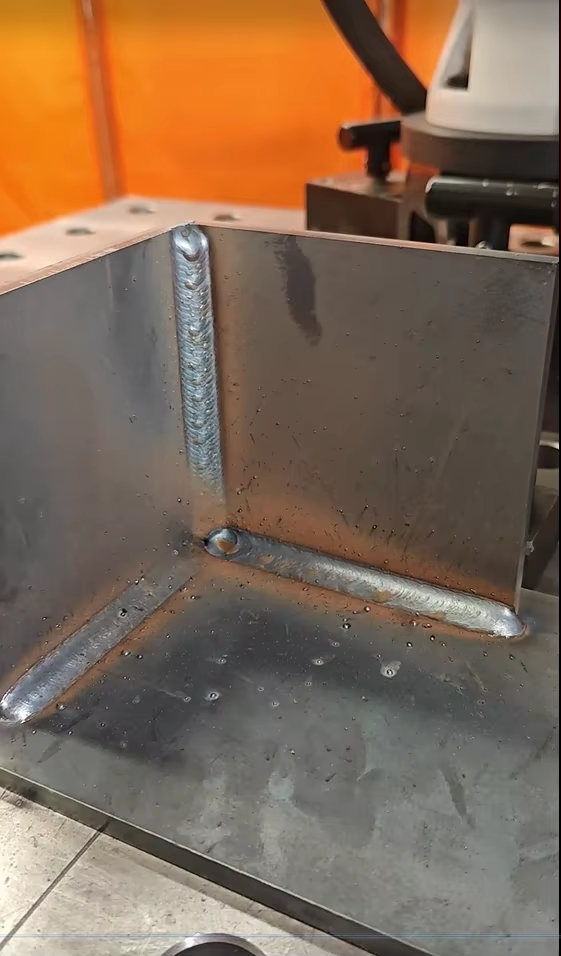
Technical Field Evaluation Report: 20kW 3D Structural Steel Processing Center with Integrated Automatic Unloading
1. Executive Summary
This report details the technical deployment and operational assessment of a 20kW 3D Structural Steel Processing Center within the infrastructure manufacturing sector in Pune, India. The evaluation focuses on the transition from conventional plasma/mechanical processing to high-power fiber laser technology for heavy-duty bridge engineering applications. The primary focus is on the synergy between 20kW photon density and the mechanical efficiency afforded by advanced 3D kinematics and automatic unloading systems.
2. Site Context: Bridge Engineering in the Pune Industrial Corridor
Pune has emerged as a critical hub for civil infrastructure fabrication, driven by major rail and road bridge projects spanning the Mula-Mutha rivers and various metro-rail expansions. These projects require structural components—primarily I-beams, H-beams, and C-channels—that meet stringent Bureau of Indian Standards (BIS) and Research Designs and Standards Organisation (RDSO) specifications.
Traditional fabrication methods involving manual layout, plasma cutting, and secondary drilling are no longer sufficient to meet the throughput demands or the tolerance requirements (often <0.5mm) for modern bridge spans. The deployment of the 20kW 3D processing center addresses these bottlenecks by consolidating multi-stage fabrication into a single automated workflow.
3. Technical Analysis of the 20kW Fiber Laser Source
The core of the system is the 20kW ytterbium fiber laser source. In the context of bridge engineering, where material thicknesses for gusset plates and web sections often exceed 20mm, the power density of a 20kW source provides distinct advantages:
- Reduced Heat-Affected Zone (HAZ): High-speed processing at 20kW minimizes the thermal input into the substrate. In bridge engineering, a minimized HAZ is critical to maintaining the metallurgical integrity of high-tensile steels (e.g., S355JO or E410), preventing brittleness in the structural joints.
- Kerf Geometry: The high power allows for the use of high-pressure nitrogen or oxygen-assist gases to achieve a near-parallel kerf. This eliminates the “taper” effect common in lower-wattage systems, ensuring that bolt holes are perfectly cylindrical throughout the depth of the flange.
- Piercing Efficiency: The 20kW source utilizes multi-stage frequency piercing, reducing the “blow-out” zone at the start of a cut. This is vital when processing thick-walled H-beams where precision starts are non-negotiable.
4. 3D Kinematics and Multi-Axis Structural Processing
Unlike flat-bed lasers, the 3D structural center utilizes a 5-axis or 6-axis head configuration coupled with a synchronized chuck system. This allows for:
4.1. Bevel Cutting for Weld Preparation
Bridge girders require complex bevels (V, X, or K-type) for full-penetration welding. The 3D head’s ability to tilt up to ±45 degrees while maintaining focal distance ensures that weld prep is completed during the primary cutting cycle. This removes the need for secondary grinding or edge-milling, which are labor-intensive and prone to human error.
4.2. Complex Geometry and Intersections
For trusses and space-frame bridges, the 20kW system manages complex “fish-mouth” cuts and oblique intersections on tubular and heavy-profile sections. The software compensation for beam deviation and profile eccentricity (common in hot-rolled steel) ensures that the fit-up on-site in Pune’s infrastructure projects is seamless, reducing the reliance on “force-fitting” during assembly.
5. The Role of Automatic Unloading in Heavy Steel Processing
The integration of an Automatic Unloading system is the primary solution to the “efficiency paradox” in heavy steel processing—where high-speed cutting is negated by slow, dangerous manual handling.
5.1. Precision Preservation
Heavy structural members, once cut, are susceptible to surface damage and deformation if handled via overhead cranes or manual forklifts. The automatic unloading system uses a synchronized hydraulic/pneumatic lifting and sorting mechanism. This ensures that the finished member is transferred to the collection bay without impact, preserving the precision-cut edges and the integrity of the 3D-processed holes.
5.2. Cycle Time Optimization
In Pune’s high-volume fabrication environments, downtime between profiles is a critical KPI. The automatic unloading system operates in parallel with the loading and cutting phases. As the 20kW head finishes the final cut on a 12-meter I-beam, the unloading conveyors extract the finished part while the chucks simultaneously reposition for the next raw stock. This “zero-gap” logic increases the effective beam-on time of the laser by approximately 35-40% compared to manual unloading systems.
5.3. Safety and Ergonomics
Handling 500kg to 2000kg structural members poses significant risk to personnel. Automation removes the human element from the “danger zone” of the machine’s movement envelope, aligning with modern ISO safety standards required by Tier-1 engineering firms in the Pune region.
6. Synergy: 20kW Power Meets Automated Logic
The synergy between the 20kW source and the automated structural center is realized through the CNC control system and nesting software.
- Dynamic Power Modulation: The system automatically adjusts the 20kW output based on the instantaneous velocity of the 3D head. During tight radius turns on a beam flange, the power is throttled to prevent over-burning, ensuring consistent edge quality.
- Real-time Sensing: Capactive height sensing and optical seam tracking work in tandem with the automatic unloading logic. If the system detects a potential collision during the unloading phase (due to a scrap piece not falling clear), the sensors halt operations, preventing damage to the expensive 20kW cutting head.
- Material Utilization: Advanced nesting for structural shapes (I, L, U profiles) reduces scrap. When combined with the high speed of the 20kW laser, the cost-per-cut is significantly lower than plasma, even when accounting for the higher capital expenditure.
7. Operational Impact on Bridge Fabrication Metrics
Field data from the Pune installation indicates the following performance improvements over traditional plasma cutting methods:
| Metric | Traditional Plasma | 20kW 3D Laser + Auto-Unload |
|---|---|---|
| Hole Tolerance | ±1.5mm (Requires Reaming) | ±0.2mm (Direct Fit) |
| Cutting Speed (25mm CS) | 0.8 m/min | 3.2 m/min |
| Secondary Processing | Grinding/Drilling Required | None (Weld-Ready) |
| Loading/Unloading Time | 25 mins (Manual) | 4 mins (Automated) |
8. Environmental and Maintenance Considerations in Pune
The Pune environment presents specific challenges, including high ambient temperatures during summer and particulate matter in industrial zones.
8.1. Chiller Performance
The 20kW source generates substantial heat. The integration of a dual-circuit, high-capacity industrial chiller with a precision of ±1°C is mandatory to prevent wavelength shifting or diode degradation. The chiller must be rated for 45°C+ ambient operation to ensure stability during the Pune summer months.
8.2. Dust Extraction
laser cutting of heavy structural steel produces significant volumes of fine ferrous oxide dust. A high-volume, pulse-jet filtration system is integrated into the 3D processing zone. This is critical not only for environmental compliance but also to protect the precision rack-and-pinion drives and the linear encoders that govern the system’s 3D accuracy.
9. Conclusion
The implementation of a 20kW 3D Structural Steel Processing Center with Automatic Unloading represents a paradigm shift for bridge engineering in Pune. By eliminating secondary processing, reducing HAZ-related risks, and automating the hazardous handling of heavy sections, the technology provides a robust solution for the increasing complexity of modern infrastructure. The technical synergy between high photon density and automated mechanical throughput ensures that fabrication shops can meet the dual demands of extreme precision and high-volume output.
10. Recommendations
To maximize the ROI of this system, it is recommended that Pune-based fabricators:
- Invest in specialized CAD/CAM training for 3D structural nesting to optimize the 20kW beam-on time.
- Implement a rigorous preventative maintenance schedule for the automatic unloading hydraulics to ensure long-term kinematic synchronization.
- Utilize high-purity assist gases to fully leverage the edge-quality capabilities of the 20kW source on critical structural joints.
Report Compiled By:
Senior Expert, Laser Systems & steel structures
Field Engineering Division













