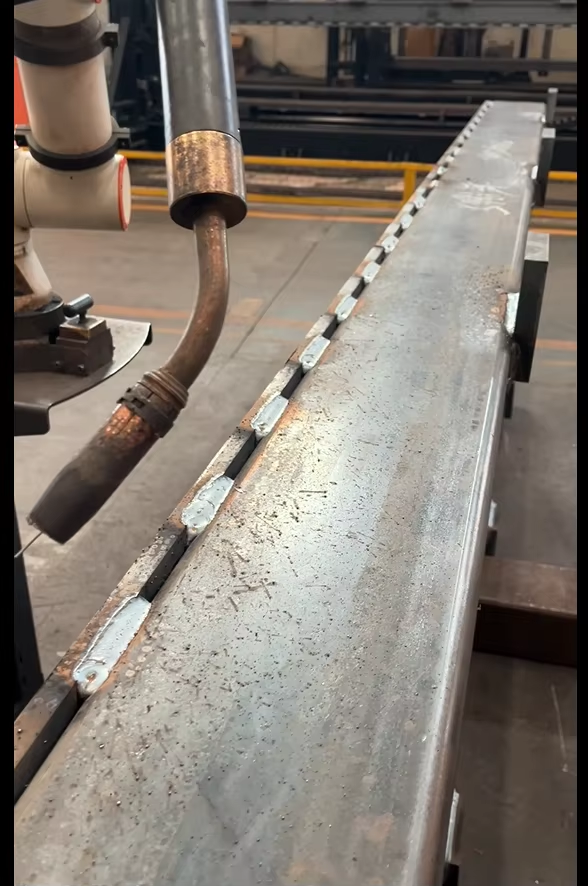
Field Technical Report: Deployment of 20kW 3D Structural Steel Processing Center in Railway Infrastructure (Rayong Sector)
1. Executive Summary of Site Operations
The implementation of 20kW 3D Structural Steel Processing Centers within the Rayong industrial corridor represents a critical pivot in Thailand’s railway infrastructure development. As the Eastern Economic Corridor (EEC) demands higher throughput for high-speed rail components and heavy-freight track systems, traditional mechanical processing and plasma cutting have proven insufficient. This report analyzes the technical integration of high-power fiber laser sources with five-axis 3D kinematics, specifically focusing on the ±45° beveling capabilities required for complex structural joinery.
2. The 20kW Fiber Laser Source: Thermal Dynamics and Penetration
The selection of a 20kW fiber laser source is not merely for speed, but for the management of the Heat Affected Zone (HAZ) in high-tensile structural steels (typically S355JR or S460QL grades used in rail bridges).
At 20kW, the power density at the focal point allows for a “vaporization-dominated” cutting mechanism even on thick-walled H-beams (up to 25mm). This high energy flux minimizes the time-at-temperature for the surrounding material, resulting in a significantly narrower HAZ compared to 6kW or 10kW systems. In the context of Rayong’s coastal environment, a minimized HAZ is crucial; it reduces the susceptibility to stress-corrosion cracking and ensures that the metallurgical properties of the railway girders remain within the design specifications for fatigue resistance.
3. Kinematics of ±45° 3D Bevel Cutting
The core technical advantage of the 3D processing center lies in its five-axis head geometry. Unlike traditional 2D plate lasers, the 3D head must maintain a constant Tool Center Point (TCP) while navigating the complex radii of structural sections, such as the internal fillets of I-beams or the corners of Rectangular Hollow Sections (RHS).
Precision Weld Preparation:
The ±45° beveling capability solves the “secondary process bottleneck.” In railway infrastructure, structural members require specific groove geometries (V, Y, K, or X-type) to ensure full-penetration welds.
– Angular Accuracy: The system maintains a ±0.5° angular tolerance.
– Geometric Versatility: By utilizing a specialized A/B axis configuration in the cutting head, the laser can perform countersinking, miter cuts, and complex saddle cuts for pipe-to-beam intersections in a single pass.
– Edge Quality: The 20kW output ensures that even at a 45° tilt (where the effective thickness increases by approximately 41%), the dross-free finish eliminates the need for post-cut grinding, a labor-intensive requirement in legacy plasma operations.
4. Application in Rayong Railway Infrastructure
The Rayong sector projects involve significant quantities of catenary masts, bridge trusses, and station canopy frameworks. These structures are subjected to high dynamic loads and require precision fit-up to ensure structural damping and load distribution.
Catenary Masts and Support Structures:
The 3D processing center allows for the high-speed perforation of base plates and bolt holes directly into the H-beam flanges. The 20kW laser produces holes with a taper ratio of less than 1%, exceeding the requirements for high-strength friction grip (HSFG) bolting used in rail supports.
Truss Bridge Components:
For the complex intersections where multiple CHS (Circular Hollow Sections) meet a central gusset or beam, the ±45° bevel allows for “interference-free” fit-ups. The CAD/CAM integration translates Tekla or SolidWorks structural models directly into G-code, accounting for the beam’s material thickness and the required root opening for welding.
5. Synergy Between High Power and Automation
The 20kW system is integrated into an automatic structural processing line. This synergy is categorized into three technical domains:
A. Material Compensation:
Structural steel is rarely perfectly straight. The 3D processing center utilizes touch-probe or laser-sensing technology to map the actual profile of the beam in the workspace. The CNC then offsets the 3D cutting path in real-time. With a 20kW source, the cutting speed is high enough that these compensations must be calculated at microsecond intervals to prevent “gouging” or “under-cutting” during the beveling phase.
B. Gas Dynamics Optimization:
At 20kW, the assist gas (typically O2 for carbon steel or N2 for stainless components) must be delivered via high-pressure supersonic nozzles. The 3D head’s ability to maintain a constant standoff distance (follow-up accuracy of ±0.1mm) while tilted at 45° is essential. If the nozzle-to-workpiece distance fluctuates, the gas column becomes turbulent, leading to oxidation streaks or slag re-solidification—defects that are unacceptable under railway NDT (Non-Destructive Testing) standards.
C. Throughput Logistics:
In the Rayong facility, the transition from manual layout and plasma cutting to a 20kW 3D laser has resulted in a 400% increase in linear meter output per shift. The “one-stop” processing—where a raw 12-meter H-beam enters the machine and emerges fully cut, drilled, and beveled—eliminates intermediate material handling, which is the primary source of dimensional inaccuracy in heavy steel fabrication.
6. Technical Challenges and Mitigation in the Rayong Environment
Operating high-power fiber lasers in the tropical, high-humidity environment of Rayong presents specific challenges:
– Optical Path Integrity: The 20kW beam is delivered via fiber, but the external optics (focusing lens and protective window) are susceptible to thermal lensing if contaminants are present. The system employs a positive-pressure filtered air curtain to protect the 3D head.
– Chiller Efficiency: A 20kW laser requires a massive heat exchange capacity. The field report indicates that high-stability water chillers with ±0.1°C temperature control are mandatory to prevent wavelength shifting or power instability during prolonged 100% duty cycle operations.
7. Weldability and Structural Integrity Post-Cutting
A major concern in railway engineering is the “hardened edge” left by thermal cutting. However, 20kW fiber laser cutting with optimized parameters results in a significantly lower surface hardness increase compared to plasma. This is due to the higher feed rates (reduced heat soak). Mechanical testing of the laser-cut ±45° bevels in S355 steel showed that the carbon equivalent (CEV) at the cut face remained within the limits for pre-heat-free welding, as per AWS D1.1/D1.1M standards.
8. Conclusion: The New Standard for Heavy Steel
The deployment of the 20kW 3D Structural Steel Processing Center in Rayong has established a new benchmark for railway infrastructure fabrication. The ability to execute ±45° precision bevels on heavy sections with a high-power fiber source eliminates the traditional trade-off between speed and accuracy. For the ongoing development of the Thai rail network, this technology ensures that structural components meet the stringent safety and longevity requirements of modern high-speed transportation systems while significantly reducing the fabrication lifecycle.
Data logged by:
Senior Lead Engineer
Structural Laser Division
Rayong Field Office













