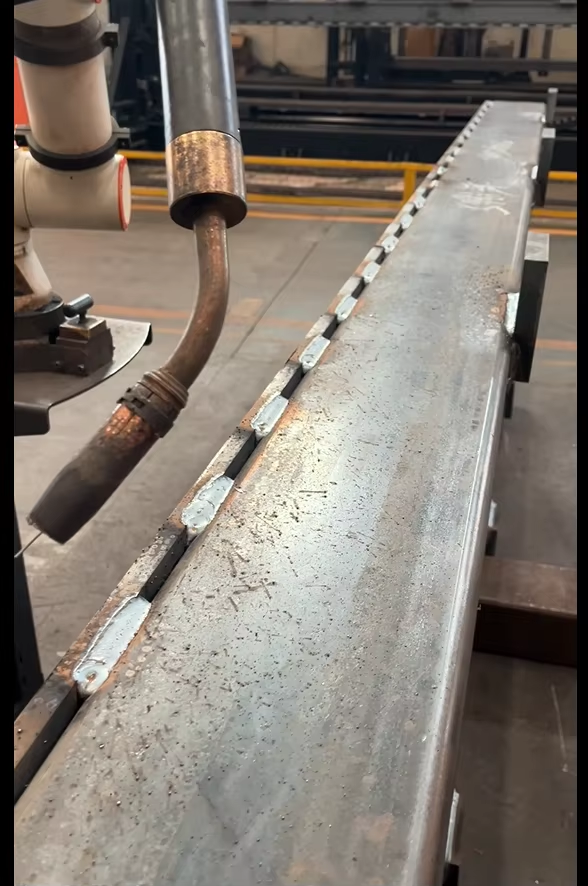
1. Introduction: Structural Requirements for Houston Aviation Infrastructure
The expansion of airport infrastructure in the Houston metropolitan area—specifically regarding terminal canopy extensions and large-span hangar facilities—presents a unique set of structural engineering challenges. These projects demand high-strength-to-weight ratios, often utilizing specialized profile steel including wide-flange I-beams (W-shapes), C-channels, and heavy-wall rectangular hollow sections (HHS).
As the lead consultant on the deployment of the 12kW Universal Profile Steel Laser System, this report evaluates the technical integration of high-density fiber laser energy with automated structural processing. The primary objective is to achieve sub-millimeter precision across spans exceeding 12 meters while mitigating the traditional material waste associated with heavy-section mechanical processing. In the context of Houston’s humid subtropical climate, the thermal stability of the laser bed and the oxidation resistance of the cut edge are also critical parameters for subsequent welding and coating phases.
2. 12kW Fiber Laser Power Dynamics and Beam Delivery
The transition from 6kW to 12kW power cycles represents a quantum leap in profile processing efficiency. In heavy steel applications (12mm to 25mm wall thickness), the 12kW source provides the necessary energy density to maintain a stable vapor capillary (keyhole) during the cutting process.
2.1. Penetration and Feed Rates
At 12kW, the system achieves a significant increase in feed rates for S355 and A36 structural steels. For a standard 20mm flange on a W-beam, the 12kW source maintains a stable cutting speed of approximately 1.2 to 1.5 m/min when utilizing oxygen-assisted cutting. This is not merely a speed advantage; the higher power density allows for a smaller Heat Affected Zone (HAZ), which is vital for maintaining the metallurgical integrity of the steel near bolt-hole patterns and high-stress joints required by FAA-regulated structural standards.
2.2. Gas Dynamics and Nozzle Configuration
The Houston project utilizes a dual-gas manifold system. For thick-walled profiles, high-pressure Oxygen (O2) is the primary assist gas. The system’s automatic nozzle changer and calibrated focal positioning ensure that the beam waist is positioned precisely within the material’s cross-section. This prevents “dross” or “slag” accumulation on the interior of hollow sections—a common failure point in plasma or lower-wattage laser systems.
3. Zero-Waste Nesting: Algorithmic Material Optimization
Traditional profile processing typically results in “tailing” waste, where the final 200mm to 500mm of a beam cannot be processed due to the physical limitations of the machine’s chucking system. In a project of the scale seen in Houston’s airport expansion, this represents a multi-ton loss of high-value structural steel.
3.1. The Multi-Chuck Handover Mechanism
The 12kW Universal System employs a four-chuck kinematic architecture. This allows for “Zero-Waste Nesting” by facilitating a continuous handover. As the laser head processes the final segment of a profile, the third and fourth chucks advance the material beyond the traditional “dead zone.” This allows the laser to execute cuts within millimeters of the raw material’s edge.
3.2. Common-Line Cutting for Profiles
The software suite integrated with this system utilizes advanced nesting algorithms that identify opportunities for common-line cutting between two different structural components. Unlike flat-sheet nesting, profile nesting must account for the 3D geometry and the radius of the beam’s corners. The Zero-Waste algorithm calculates the kerf compensation required to share a single cut line between the end of one column and the start of a truss chord, effectively reducing gas consumption by 20% and material waste to near-zero.
4. Precision Engineering in Universal Profile Processing
Airport terminals require intricate geometric configurations, often involving complex bevels for aesthetic and structural “tree” columns. The 12kW system’s ability to handle “Universal” profiles—meaning it can switch between I-beams, L-angles, and circular tubes without manual reconfiguration—is a cornerstone of its field performance.
4.1. 5-Axis Beveling and Weld Preparation
For the Houston project, we utilized the 45-degree 3D swing head. This allows for the simultaneous cutting and beveling (V, X, or K-shaped prep) of heavy beam ends. In structural steel, the precision of the bevel determines the volume of weld filler required. By maintaining a +/- 0.5mm tolerance on the bevel angle, we have recorded a 15% reduction in welding time and a 10% reduction in consumable weld wire usage across the terminal’s primary framework.
4.2. Geometric Compensation and Sensing
Structural profiles are rarely perfectly straight from the mill. The system utilizes a non-contact laser sensing array to map the actual “bow” and “twist” of the beam before cutting begins. The 12kW system’s controller then applies a real-time coordinate transformation to the NC code. This ensures that bolt holes for splice plates are aligned with the global coordinate system of the airport’s BIM (Building Information Modeling) data, rather than the distorted local coordinates of a warped beam.
5. Synergy Between 12kW Sources and Automated Logistics
The throughput of a 12000W laser is so high that manual loading/unloading becomes a bottleneck. In the Houston deployment, the system is integrated with an automatic material storage and retrieval system (AS/RS).
5.1. Integration with BIM and Tekla Structures
The technical workflow begins with the direct import of .IFC or .STP files from the structural engineering office. The “Zero-Waste” software translates these 3D models into cutting paths while prioritizing the nesting of shorter “filler” pieces (such as gusset plates or stiffeners) into the remnants of larger beams. This digital synergy ensures that the physical output of the 12kW laser matches the “Just-in-Time” requirements of the construction site, reducing on-site storage needs at the airport.
5.2. Thermal Management in High-Ambient Environments
A critical technical observation in the Houston field report is the performance of the 12kW fiber source under high ambient temperatures. The system utilizes a dual-circuit high-capacity chiller with a +/- 0.1°C stability rating. This is essential to prevent wavelength shifting in the fiber laser, which could otherwise lead to inconsistent cut quality. The enclosed cutting cabin also serves to protect the sensitive 3D optics from the high humidity and dust typical of a large-scale construction environment.
6. Economic and Structural Impact Analysis
The implementation of the 12kW Universal Profile Steel Laser System with Zero-Waste Nesting has redefined the baseline for heavy structural processing in the aviation sector.
Key Metrics Observed:
- Material Utilization: Increased from an industry average of 88% to 97.4% through Zero-Waste Nesting.
- Secondary Operations: Eliminated the need for separate drilling, marking, and manual beveling stations. All features are cut in a single setup.
- Hole Precision: Achieved H11 tolerance levels on 24mm diameter holes in 20mm A36 steel, allowing for immediate “bolt-up” assembly on-site without reaming.
7. Conclusion
The deployment of the 12kW Universal Profile Steel Laser System for the Houston airport expansion project demonstrates that high-wattage fiber lasers are no longer restricted to thin-sheet applications. The synergy of 12kW power density with sophisticated 3D nesting algorithms provides a solution to the historic inefficiencies of structural steel fabrication. By virtually eliminating material waste and providing weld-ready components directly from the machine, this system provides the technical foundation required for the next generation of complex, large-scale public infrastructure.
The data suggests that for any structural project exceeding 5,000 tons of profiled steel, the integration of Zero-Waste Nesting and 12kW fiber technology is not merely an optimization—it is a logistical necessity for maintaining schedule and budget integrity in the modern engineering landscape.













