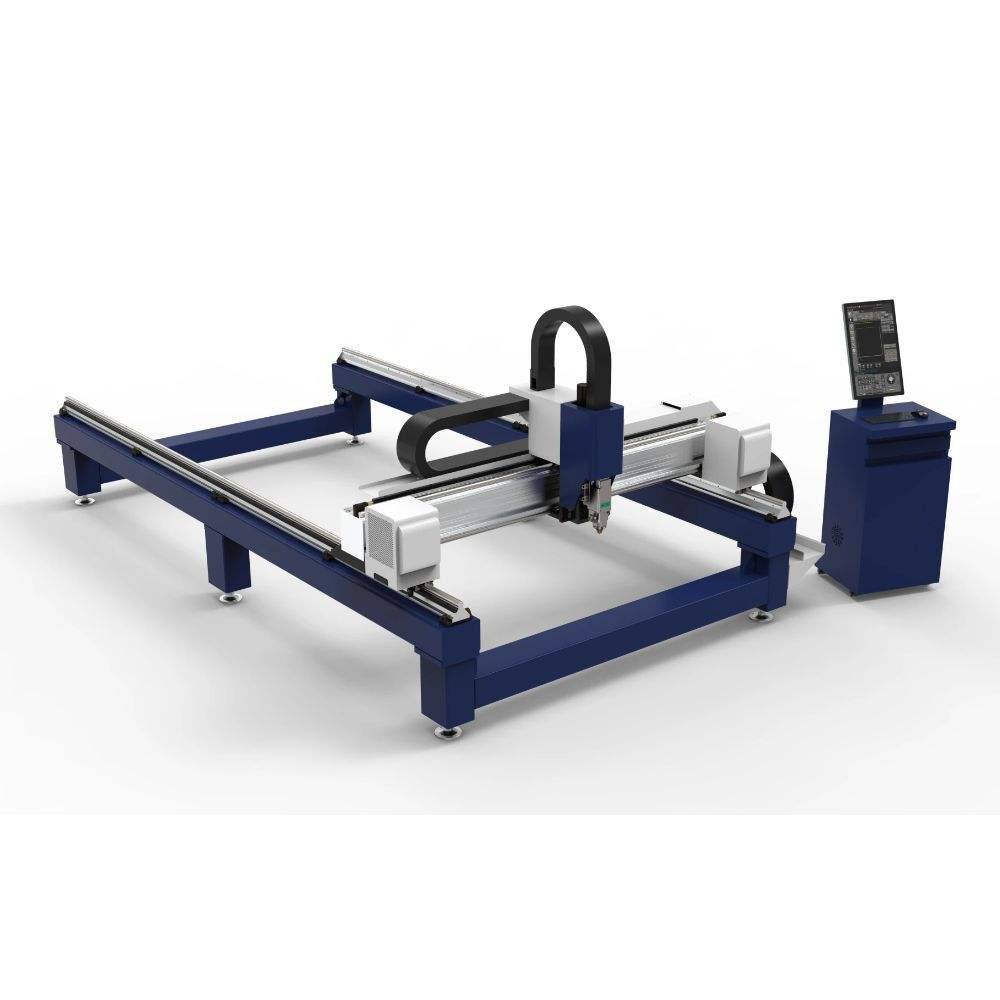
The Evolution of Structural Steel Fabrication in Hamburg
Hamburg has always been a city defined by its engineering prowess, from the historic Speicherstadt to the cutting-edge aviation labs of Finkenwerder. As the Hamburg Airport (Flughafen Hamburg) undergoes its next phase of modernization and terminal expansion, the demand for structural steel that meets both aesthetic and rigorous safety standards has never been higher. Traditional methods of processing large steel profiles—such as plasma cutting, sawing, and manual drilling—are increasingly viewed as bottlenecks in a project timeline that demands surgical precision and rapid deployment.
The introduction of the 12kW Universal Profile Steel Laser System represents the “Gold Standard” of this evolution. Unlike flatbed lasers designed for sheet metal, this system is a multi-axial powerhouse engineered to handle the massive structural members that form the skeleton of airport hangers, concourses, and baggage handling facilities. The shift to fiber laser technology at the 12kW level provides the necessary “punch” to penetrate thick-walled sections while maintaining a heat-affected zone (HAZ) so minimal that the structural properties of the specialized European steel grades remain uncompromised.
The Technical Superiority of the 12kW Fiber Laser Source
At the heart of this system lies a 12kW ytterbium-doped fiber laser. To an expert, the jump from 6kW or 8kW to 12kW isn’t just about cutting faster; it’s about the quality of the kerf and the ability to process “heavy” profiles with verticality and consistency. At 12kW, the energy density at the focal point is sufficient to maintain a stable melt pool even when traversing the varying thicknesses of a tapered I-beam or a heavy-walled rectangular hollow section (RHS).
In airport construction, where vibration resistance and fatigue life are critical, the clean cut of a 12kW laser is a game-changer. High-power fiber lasers produce a beam with a wavelength of approximately 1.07 microns, which is absorbed more efficiently by steel than the 10.6 microns of traditional CO2 lasers. This efficiency allows for high-speed “flying cuts” on profiles up to 20mm-30mm thick, depending on the alloy. For Hamburg’s engineers, this means that the massive trusses supporting terminal roofs can be fabricated with tolerances of +/- 0.1mm—a level of accuracy that makes on-site assembly as seamless as a Meccano set.
The Engineering Marvel: Infinite Rotation 3D Cutting Heads
While the 12kW source provides the raw power, the Infinite Rotation 3D Head provides the finesse. Conventional 3D laser heads are often limited by internal cabling, requiring a “rewind” motion after a certain degree of rotation (typically +/- 360 degrees). In the world of complex profile cutting, this rewind creates downtime and introduces potential start-stop defects in the cut.
The “Infinite Rotation” technology utilizes advanced slip-ring connectors or specialized fiber-optic conduits that allow the head to rotate indefinitely around the C-axis. This is coupled with a tilting A-axis (often up to +/- 45 or even 50 degrees). For an airport project, this capability is indispensable. Modern architectural designs for terminals often feature organic, non-linear geometries where columns meet beams at oblique angles.
With an infinite 3D head, the laser can perform complex bevel cuts for weld preparations—V, X, Y, and K-cuts—in a single continuous pass. Because the head never has to stop to “unwind,” the transition between the flange and the web of a beam is fluid. This ensures that the weld prep is perfectly uniform, which is vital for the automated welding robots often used in German workshops to ensure the structural safety of public transit hubs.
Strategic Application in Airport Infrastructure
Airport construction is uniquely demanding. The structures must support massive dead loads (roofing and glazing) and dynamic loads (wind shear and jet blast vibrations). The 12kW Universal Profile System is currently being utilized for several critical components in the Hamburg expansion:
1. **Long-Span Trusses:** The concourses require wide, column-free spaces. This is achieved through complex lattice girders. The laser system cuts the “fish-mouth” joints in circular hollow sections with such precision that they fit together with zero-gap tolerances, significantly reducing the amount of filler wire needed during welding.
2. **Facade Support Systems:** The glass curtains of modern terminals require thin yet incredibly strong steel profiles. The 12kW laser allows for the decorative perforation of these profiles without warping the material, combining structural function with architectural form.
3. **Baggage Handling Frameworks:** These systems involve miles of intricate steel channelling. The ability of the universal system to switch between C-channels, angles, and square tubes without extensive re-tooling allows the Hamburg project to stay ahead of schedule.
Integrating BIM and Digital Twins
One of the most significant advantages of deploying such a high-end system in a tech-forward city like Hamburg is its integration with Building Information Modeling (BIM). The 12kW laser system isn’t just a cutter; it’s a digital fabrication node.
The structural engineers at the airport design the steelwork in software like Tekla or Revit. These 3D models are exported directly to the laser’s CAD/CAM interface. The software automatically calculates the nesting on the 12-meter-long raw profiles and programs the 3D head’s path. This “digital-to-steel” workflow eliminates human error in measurement and marking. In fact, the laser can also be used to etch part numbers, weld symbols, and alignment marks directly onto the steel, facilitating rapid assembly on the construction site near the tarmac.
Efficiency, Sustainability, and the Hamburg Climate Plan
Hamburg has set ambitious goals for carbon neutrality. In the construction sector, this means reducing waste and energy consumption. Fiber lasers are inherently more efficient than older technologies, boasting a wall-plug efficiency of about 35-40%, compared to the 10% of CO2 lasers.
Furthermore, the precision of the 12kW 3D system drastically reduces material waste. Because the nesting is optimized by AI algorithms, “off-cuts” are minimized. Additionally, because the laser produces a finished edge that requires no grinding or secondary deburring, there is a significant reduction in the consumption of abrasives and the energy required for manual labor. The lack of heavy chemicals or cutting fluids in the laser process also makes it a “greener” choice for the sensitive environmental zones surrounding the airport and the nearby Alster basin.
The Expert Verdict: A New Standard for Infrastructure
From a fiber laser expert’s perspective, the deployment of a 12kW Universal Profile Steel Laser System with Infinite Rotation in Hamburg is not merely an incremental upgrade—it is a strategic asset. The sheer power of 12kW handles the heavy lifting of structural engineering, while the infinite 3D kinematics solve the geometric puzzles posed by modern architecture.
For the Hamburg Airport construction, this translates to faster build times, lower costs per ton of fabricated steel, and an unprecedented level of structural safety. As we look toward the future of civil engineering, the “Hamburg Model”—utilizing high-power fiber lasers for large-scale infrastructure—will likely become the blueprint for airport and stadium projects globally. The synergy of power, precision, and digital integration ensures that the steel skeletons of our transport hubs are as advanced as the aircraft that fly from them.