The Dawn of High-Power Fiber Lasers in Saudi Infrastructure
The Eastern Province of Saudi Arabia, with Dammam at its heart, is currently witnessing an unprecedented surge in infrastructure development. As a cornerstone of Saudi Vision 2030, the expansion of aviation hubs demands not just volume, but surgical precision in structural steel fabrication. The introduction of the 12kW Universal Profile Steel Laser System represents a shift from conventional plasma or mechanical cutting to high-density photonics.
As a fiber laser expert, I have observed that the 12kW threshold is the “sweet spot” for structural engineering. It offers the perfect balance between photon density and thermal management. At 12kW, the laser can effortlessly penetrate thick-walled structural steel (up to 40mm-50mm depending on the grade) with a heat-affected zone (HAZ) that is significantly smaller than that of oxygen-fuel or plasma cutting. This is critical for airport construction, where the integrity of every weld-prep and bolt-hole determines the seismic and wind-load resilience of the terminal buildings.
Technical Architecture of the 12kW Fiber Engine
The heart of this system is the 12kW ytterbium-doped fiber laser source. Unlike CO2 lasers of the past, the 1.06-micron wavelength of the fiber laser is absorbed more efficiently by steel, leading to faster processing speeds. At 12kW, the energy density at the focal point is sufficient to vaporize steel almost instantaneously.
For Dammam’s airport projects, this means that the “piercing time”—the time it takes to create the initial hole in a beam or plate—is reduced to milliseconds. When you are processing thousands of structural profiles for a hangar or a terminal roof, those saved seconds accumulate into hundreds of hours over the project’s lifecycle. Furthermore, the 12kW source provides a “high-speed stable cutting” range that ensures the edge quality is smooth enough to require zero post-processing. In the rigorous world of aviation construction, where every component must meet ISO standards, the “cut-and-weld” readiness of this system is an invaluable asset.
The “Universal Profile” Capability: Beyond Flat Sheets
What distinguishes a “Universal Profile” system from a standard laser cutter is its ability to handle three-dimensional geometries. Airport architecture is rarely composed of flat plates; it is a complex web of I-beams, H-beams, C-channels, and hollow structural sections (HSS).
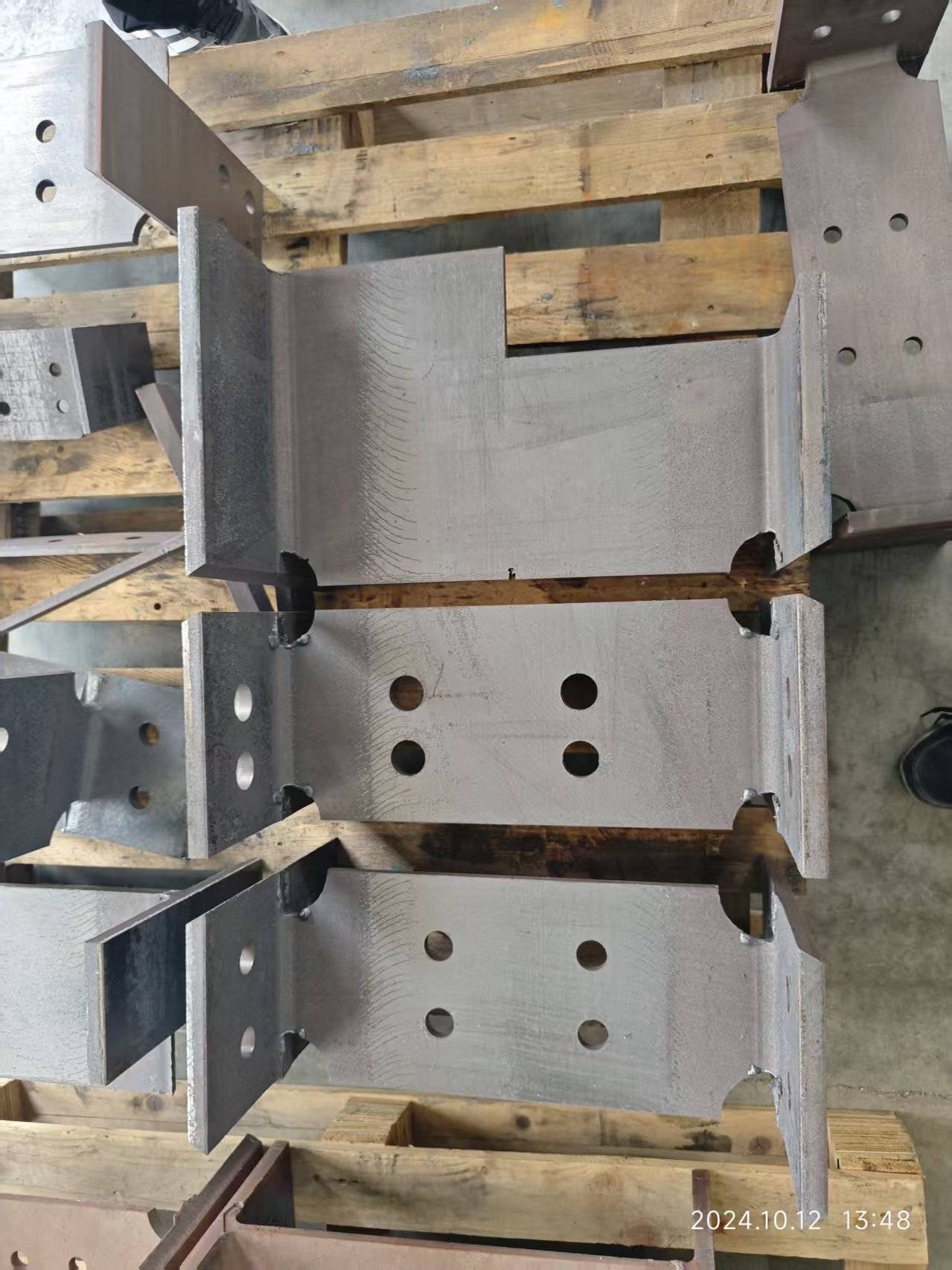
The universal system utilizes a multi-axis head—often a 3D or 5-axis configuration—combined with a sophisticated chuck and rotary system. This allows the laser to move around the profile, cutting complex notches, bird-mouth joints, and bolt holes on all sides of a beam in a single setup. For the Dammam airport project, this capability allows for the creation of intricate “geodesic” structures and curved canopy supports that would be nearly impossible to fabricate accurately using manual methods. The software integration allows architects to send CAD files directly to the machine, ensuring that the physical output is a 1:1 replica of the digital twin.
Revolutionizing Throughput with Automatic Unloading
In any high-output fabrication environment, the machine is only as fast as its slowest manual process. Historically, the “bottleneck” has always been the removal of heavy, cut steel profiles from the work zone. A 12kW laser cuts so fast that a manual unloading team cannot keep up, leading to machine idle time.
The Automatic Unloading system integrated into the Dammam installations solves this by using heavy-duty conveyor systems and hydraulic lifters or robotic arms. Once a profile—such as a 12-meter I-beam—is finished, the system automatically detects the completion, activates the unloading grippers, and moves the finished part to a staging area while simultaneously loading the next raw profile. This creates a “lights-out” manufacturing capability. For a massive project like an airport terminal, where deadlines are non-negotiable, the ability to run the 12kW laser 24/7 with minimal human intervention is the difference between being ahead of schedule and facing liquidated damages.
Precision Engineering for Airport Safety Standards
Airport construction is governed by some of the world’s strictest safety protocols. The structural steel must withstand not only the weight of the building but also the vibrations of aircraft, high wind loads, and thermal expansion.
The 12kW Universal Laser provides a level of precision (within ±0.1mm) that manual fabrication cannot match. Bolt holes are perfectly circular and perpendicular, ensuring that load distribution across the structure is exactly as the engineers calculated. In Dammam’s harsh climate, where temperatures can fluctuate wildly, the precision of the fit-up is even more vital. Properly cut joints reduce the stress on welds, leading to a more durable structure. Furthermore, the laser’s ability to etch part numbers and assembly instructions directly onto the steel profiles during the cutting process streamlines the on-site assembly at the airport, reducing the risk of human error during the “Meccano-style” buildup of the terminal.
Adapting to the Dammam Environment: Cooling and Filtration
Operating a 12kW laser in Dammam presents unique environmental challenges. The Eastern Province is known for high ambient temperatures and saline, humid air, both of which are enemies of high-precision electronics and optics.
The 12kW systems deployed here are equipped with industrial-grade, dual-circuit chillers that maintain the laser source and the cutting head at a constant temperature, regardless of the heat outside. Moreover, the “Universal” systems feature pressurized optical paths and advanced dust extraction. Since airport construction generates significant volumes of particulate matter, the high-capacity filtration systems ensure that the laser’s internal components remain pristine. As an expert, I emphasize that the longevity of a laser in the Saudi climate depends entirely on these environmental protection systems, which have been specifically ruggedized for the Dammam industrial landscape.
Economic Impact and the Saudi Vision 2030
The deployment of this technology in Dammam is more than a technical upgrade; it is an economic catalyst. By localized the fabrication of complex structural steel, Saudi Arabia reduces its reliance on imported pre-fabricated components. This builds local technical expertise and creates high-value jobs for Saudi engineers and technicians.
The efficiency of the 12kW laser significantly lowers the “cost per part.” While the initial investment in a 12kW universal system with automatic unloading is substantial, the ROI (Return on Investment) is realized through the sheer volume of the airport project. The reduction in labor costs, the elimination of scrap through intelligent nesting software, and the speed of delivery make it the most cost-effective solution for large-scale infrastructure. It aligns perfectly with the Vision 2030 goal of industrial diversification and the transformation of the Kingdom into a global logistics hub.
Conclusion: The Future of Middle Eastern Fabrication
The 12kW Universal Profile Steel Laser System with Automatic Unloading is setting a new benchmark for construction in the Middle East. As Dammam continues to expand its gateway to the world, the precision, speed, and automation of fiber laser technology provide the backbone for this growth.
From the perspective of a fiber laser expert, we are seeing a move away from “brute force” construction toward “intelligent fabrication.” This system does not just cut steel; it processes data into physical form with incredible efficiency. For the engineers and contractors working on Dammam’s airport expansion, this machine is not just a tool—it is a competitive advantage that ensures the structures of tomorrow are built with the highest standards of safety, beauty, and speed. The skyline of Dammam is being reshaped, one laser-cut beam at a time.