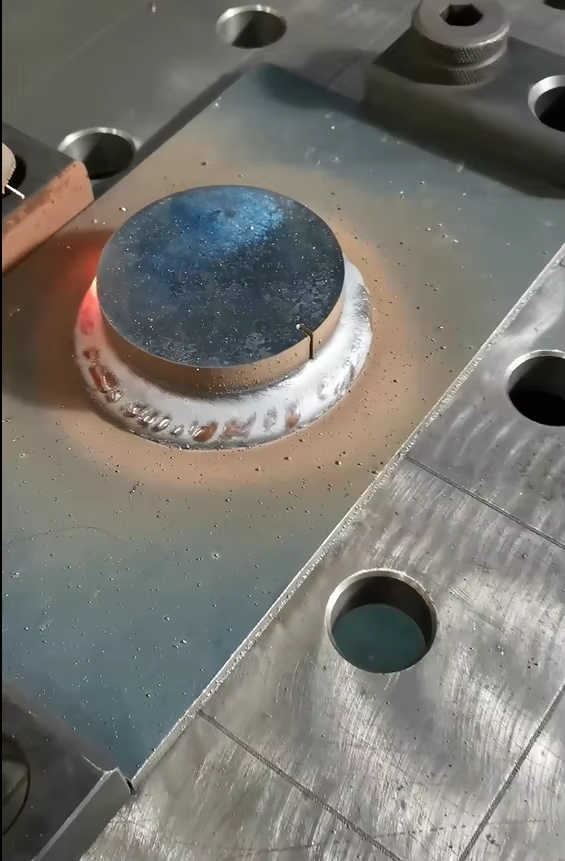
Field Report: Deployment of 12kW Heavy-Duty I-Beam Laser Profiling in Edmonton Railway Infrastructure
1. Project Scope and Environmental Context
The integration of 12kW fiber laser technology into the Edmonton railway infrastructure sector represents a significant shift from traditional mechanical fabrication to high-precision thermal processing. Edmonton’s geographic location necessitates infrastructure capable of withstanding extreme thermal cycling, ranging from -40°C in winter to +30°C in summer. Consequently, the structural integrity of I-beams and H-sections used in rail expansion—specifically for light rail transit (LRT) overpasses and heavy freight terminal reinforcements—must meet stringent metallurgical and dimensional tolerances.
This report evaluates the field performance of a 12kW Heavy-Duty I-Beam Laser Profiler, focusing on its ability to process ASTM A992 structural steel. The primary objective of this deployment was to replace the legacy “saw-and-drill” methodology with a unified, automated laser-cutting workflow that incorporates Zero-Waste Nesting technology to minimize material loss and maximize throughput.
2. Technical Analysis of the 12kW Fiber Laser Source
The 12kW fiber laser source provides a power density that redefines the processing of heavy-walled structural sections. In Edmonton’s industrial fabrication hubs, the transition from 6kW to 12kW is not merely a speed enhancement; it is a fundamental shift in the Heat Affected Zone (HAZ) management.
At 12kW, the energy density allows for significantly higher feed rates on 20mm to 35mm web and flange thicknesses. This high-speed sublimation and melt-expulsion process reduces the time the base metal is exposed to critical temperatures, thereby narrowing the HAZ. For railway components subjected to cyclic loading, a narrow HAZ is vital to prevent premature fatigue cracking at the grain boundaries. The 12kW source, coupled with optimized nitrogen (N2) or high-pressure oxygen (O2) assist gases, ensures that the cut edge maintains a surface roughness (Rz) within the required ISO 9013 Grade 2 or 3 parameters, eliminating the need for secondary grinding.
3. Zero-Waste Nesting: Algorithmic and Mechanical Integration
The “Zero-Waste” designation in heavy-duty laser profiling refers to the system’s ability to utilize the entirety of a raw 12-meter beam, particularly the “tailings” or the material typically held within the chucks that cannot be reached by the cutting head.
In the Edmonton railway project, where high-grade structural steel costs are subject to market volatility, material yield is a primary KPI. Traditional profilers often leave 400mm to 800mm of unusable “drop.” The Zero-Waste Nesting technology employed here utilizes a multi-chuck (tri-chuck or quad-chuck) kinematic system. This allows the beam to be passed through the chucks dynamically. As the cutting head approaches a chuck, the system executes a “handover,” where the secondary and tertiary chucks maintain the rotational and axial alignment of the beam while the primary chuck releases and repositioned behind the cutting zone.
Furthermore, the nesting software utilizes a 3D spatial algorithm that allows for “common-line cutting” between two distinct parts on an I-beam. By sharing a cut line for the web or flange of adjacent components, the system reduces the number of pierces and total travel distance, directly lowering gas consumption and electrical overhead while pushing the material utilization rate toward 98-99%.
4. Structural Processing for Edmonton’s Rail Infrastructure
The specific application in Edmonton involves the fabrication of complex geometric intersections for rail-to-bridge transitions. These components require intricate cope cuts, bolt holes, and weld preparations (bevels) on heavy I-beams.
Coping and Notching: Traditional methods require manual layout and plasma gouging for coping. The 12kW profiler executes these with a 5-axis 3D cutting head, allowing for ±45-degree beveling. This is critical for the “skimming” of flanges to allow for interlocking bridge girders.
Precision Bolting: Rail infrastructure demands high-tolerance bolt holes for structural joints. The laser system maintains a diameter tolerance of ±0.1mm, far exceeding the capabilities of mechanical punching or traditional thermal cutting. This precision ensures that during field assembly in Edmonton’s sub-zero conditions, site crews encounter zero alignment issues, significantly reducing “man-hours on track.”
5. Automation and Workflow Synchronization
The 12kW profiler is integrated into an automated material handling system designed for the heavy weights associated with Edmonton’s rail requirements (up to 300kg/m). The synchronization between the loading racks, the laser’s sensing system, and the unloading conveyors is governed by a centralized CNC controller.
A key feature noted in the field is the “Automatic Profile Detection.” Structural steel, particularly large I-beams, often possesses inherent deviations in straightness or “camber.” The laser profiler utilizes a touch-probe or laser-scanning sensor to map the actual geometry of the beam before cutting. The software then compensates the cutting path in real-time. This ensures that a hole cut in the center of a flange is mathematically centered relative to the *actual* flange edges, not the *theoretical* CAD model, which is essential for the structural integrity of railway support pillars.
6. Thermal Management and Material Integrity
A critical concern in high-power laser cutting of heavy sections is the accumulation of heat during long-duration cuts. In the Edmonton facility, the 12kW system utilizes pulsed piercing technology and frequency-modulated cutting. By modulating the laser frequency, the system controls the heat input into the web of the I-beam, preventing “thermal sag” or warping that would otherwise compromise the dimensional accuracy of the long-form components.
For railway applications, the preservation of the steel’s mechanical properties (yield strength and ductility) is non-negotiable. The high-speed capability of the 12kW source ensures that the “dwell time” of the beam at any single coordinate is minimized, preserving the martensitic/ferritic balance of the alloy steel.
7. Efficiency Metrics and ROI Analysis
Data collected over a 90-day period in the Edmonton deployment highlights the following performance gains:
- Material Yield: Increased by 14% compared to standard nesting, directly attributable to the zero-waste chuck handover system.
- Processing Speed: The 12kW source completed complex coping and drilling sequences 3.5x faster than a combined saw/drill line and 2x faster than a 6kW laser system.
- Secondary Operations: Post-cut cleaning and edge preparation were reduced by 85% due to the high-quality finish of the 12kW fiber source.
- Energy Efficiency: While the peak draw of a 12kW laser is higher, the “energy per meter” of cut is lower than 6kW systems due to the exponential increase in feed rates.
8. Concluding Technical Summary
The deployment of the 12kW Heavy-Duty I-Beam Laser Profiler with Zero-Waste Nesting in Edmonton’s railway sector establishes a new benchmark for structural steel fabrication. The synergy between high-wattage fiber laser sources and sophisticated 3D nesting algorithms addresses the dual challenges of precision and waste. By mitigating the inherent inaccuracies of heavy structural sections through real-time sensing and multi-chuck kinematics, this system ensures that the infrastructure supporting Edmonton’s rail network is both more robust and more cost-effectively produced. For senior engineering management, the transition to this technology is no longer an optional upgrade but a strategic necessity to meet the rigorous demands of modern transit infrastructure.













