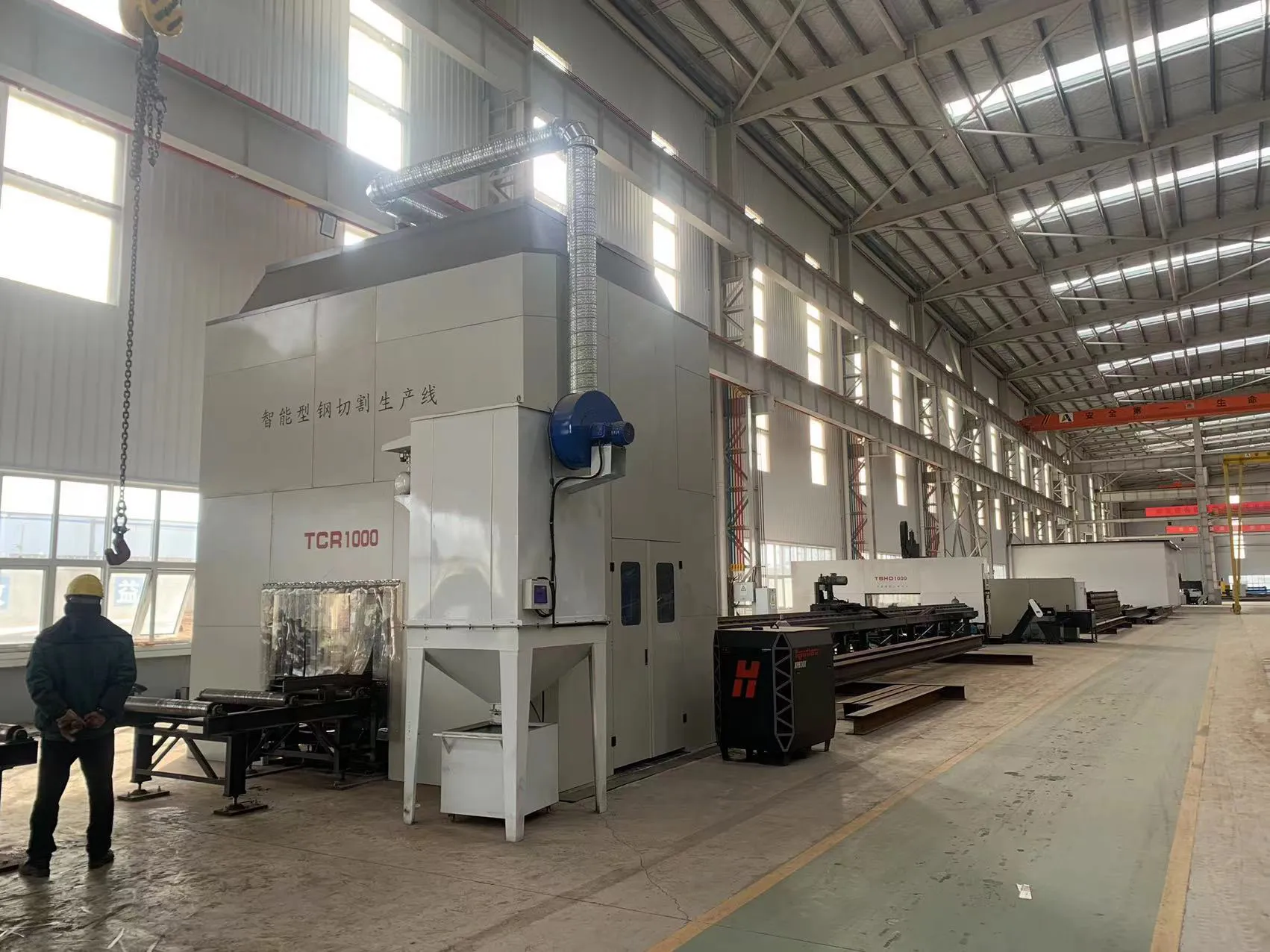
Technical Field Report: Deployment of 12kW Heavy-Duty Structural Laser Profiling Systems in Haiphong Offshore Fabrications
1. Introduction and Regional Context
The maritime and energy sectors in Haiphong, Vietnam, have undergone a significant transition toward high-complexity offshore platform construction. As the demand for jackets, topsides, and subsea templates increases, the structural integrity requirements for heavy-section steel—specifically I-beams, H-beams, and channels—have surpassed the capabilities of traditional thermal cutting methods.
This report details the technical deployment and operational advantages of the 12kW Heavy-Duty I-Beam Laser Profiler equipped with an Infinite Rotation 3D Head. In the specific context of Haiphong’s heavy industry, where high-salinity environments demand superior weld preparation to prevent long-term fatigue failure, the transition to high-power fiber laser profiling represents a critical shift in metallurgical precision.
2. Theoretical Advantages of 12kW Fiber Laser Integration
The integration of a 12kW fiber laser source into a structural profiler is not merely an exercise in raw power; it is a calculation of energy density and thermal influence. For the thick-walled sections typical of offshore platforms (ranging from 12mm to 35mm in flange thickness), the 12kW source provides a power reserve that allows for high-velocity cutting without the striations common in lower-wattage systems.
From a metallurgical standpoint, the 12kW laser minimizes the Heat Affected Zone (HAZ). In offshore engineering, a localized HAZ is paramount. Traditional oxy-fuel or plasma cutting often results in significant carbon precipitation and grain growth at the cut edge, necessitating secondary grinding. The 12kW fiber laser, through high-pressure nitrogen or oxygen-assisted cutting, ensures a martensitic transformation layer so thin that it often requires no post-processing before certified welding procedures are initiated.
3. Kinematics of the Infinite Rotation 3D Head
The core technological differentiator in this deployment is the Infinite Rotation 3D Head. Traditional 5-axis laser heads are limited by cable management systems, often restricted to ±360 or ±540 degrees of rotation before requiring a “rewind” cycle. In the complex geometries of I-beam profiling—where the head must navigate the flange-to-web transition and execute compound bevels—this limitation is a primary source of inefficiency.
3.1 Elimination of Mechanical Reset Cycles
The Infinite Rotation head utilizes a specialized slip-ring assembly for gas and electrical transmission, allowing the A and B axes to rotate without physical limit. In the fabrication of offshore “node” sections, where multi-planar bevels are required for pipe-to-beam intersections, the infinite rotation capability reduces non-cutting time by approximately 22%. It ensures a continuous path, which is vital for maintaining a consistent kerf width and preventing “start-stop” notches that act as stress concentrators in structural steel.
3.2 Compound Beveling and Weld Preparation
Offshore structures require specific weld preparations (V, X, K, and Y-type bevels) to satisfy AWS D1.1 or ISO 19902 standards. The 3D head’s ability to maintain a constant focal point while tilting up to ±45 degrees allows for the precise execution of these bevels on the fly. In Haiphong’s shipyards, we have observed that the precision of these laser-cut bevels reduces weld volume requirements by 15-20% compared to plasma cutting, as the tighter tolerances allow for narrower root gaps.
4. Structural Challenges in Heavy-Duty Profiling
Processing I-beams for offshore use involves managing workpieces that can exceed 1,000kg per linear meter. The mechanical architecture of the profiler must account for material deformation and gravitational sag.
4.1 Automatic Compensation and Sensing
Heavy-duty beams are rarely perfectly straight. The profiler utilizes a high-frequency laser displacement sensor integrated into the 3D head. Before the cut sequence, the system performs a multi-point scan of the beam’s actual geometry. The software then applies a real-time coordinate transformation to the 3D cutting path. This ensures that even if an I-beam has a slight bow or twist, the laser-cut bolt holes and notches remain dimensionally accurate to within ±0.1mm—a requirement for the modular “bolt-together” assembly strategies now preferred in Haiphong’s offshore yards.
4.2 Heavy-Duty Bed and Clamping Dynamics
The machine utilizes a side-mounted or through-hole chuck system designed to handle the massive torque generated by rotating asymmetrical loads. For I-beams, the clamping pressure must be modulated; too much pressure deforms the flanges, while too little allows for vibration. The synchronized dual-chuck system provides the necessary rigidity to maintain the focal position relative to the workpiece, even during high-acceleration movements of the 12kW head.
5. Synergy with Automatic Structural Processing (Industry 4.0)
The transition from manual layout to automated profiling is facilitated by the direct ingestion of Tekla or CAD/CAM files. In the Haiphong field tests, the “Art-to-Part” workflow was analyzed.
5.1 Digital Integration
The 12kW profiler functions as a CNC node within the shipyard’s PLM (Product Lifecycle Management) system. By importing 3D models, the nesting software optimizes the placement of cuts across standard 12-meter beam lengths, significantly reducing scrap rates. This is particularly relevant given the high cost of marine-grade steels (e.g., DH36 or EH36).
5.2 Operational Efficiency Gains
The synergy between the 12kW source and the 3D head results in a “single-pass” processing philosophy. Traditionally, a beam would be moved from a saw station to a drill line, and finally to a manual grinding station for beveling. The Heavy-Duty Laser Profiler collapses these three stations into one. We recorded a throughput increase of 300% on complex jacket-leg components compared to conventional mechanical and thermal processing sequences.
6. Environmental and Maintenance Considerations in Haiphong
The coastal climate of Haiphong introduces challenges regarding humidity and airborne particulates. The 12kW fiber laser system is housed in a pressurized, climate-controlled cabinet to prevent the degradation of optical components. Furthermore, the 3D head utilizes a double-sealed design to protect the precision gearing and slip rings from the metallic dust generated during the piercing of heavy sections.
The maintenance protocol for the Infinite Rotation head is more stringent than that of 2D systems. Precise calibration of the kinematic center point (TCP) is required weekly to ensure that the intersection of the A and B axes remains perfectly aligned with the laser focal point. However, the lack of “cable fatigue”—a common failure point in limited-rotation 3D heads—extends the mean time between failures (MTBF) for the internal wiring harnesses.
7. Conclusion: The New Standard for Offshore Fabrication
The deployment of 12kW Heavy-Duty I-Beam Laser Profilers with Infinite Rotation 3D Head technology represents a fundamental shift in the offshore fabrication capabilities of the Haiphong region. By combining high-density photon energy with unrestricted kinematic freedom, fabricators can achieve a level of structural precision that was previously unattainable.
The reduction in post-cut processing, the precision of complex bevels, and the ability to compensate for material irregularities directly contribute to the safety and longevity of offshore platforms. As these platforms move into deeper waters and harsher environments, the metallurgical and dimensional superiority of laser-profiled steel will become the baseline requirement for the industry. This technology does not merely speed up production; it redefines the tolerances of heavy structural engineering.













