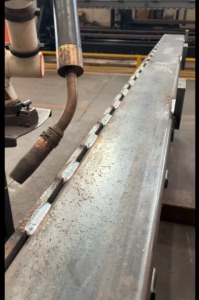
The Dawn of High-Power Fiber Lasers in Jakarta’s Structural Sector
Jakarta is a city characterized by its vertical ambition and its role as the gateway to Indonesia’s massive infrastructure projects, including the “IKN” (New Capital City) initiatives. For decades, the structural steel industry relied on plasma cutting or manual oxygen-fuel torches to profile I-beams. While functional, these methods introduced significant thermal distortion, wide kerf widths, and the requirement for intensive post-processing.
The introduction of the 12kW fiber laser has fundamentally altered the ROI (Return on Investment) for local fabricators. A 12kW power source offers the “sweet spot” for structural steel; it provides enough energy density to vaporize thick-walled steel instantly, resulting in a narrow Heat-Affected Zone (HAZ). In the humid, high-demand environment of Jakarta, where production uptime is critical, the fiber laser’s solid-state design ensures minimal maintenance compared to older CO2 variants, allowing for 24/7 operation in the city’s industrial corridors like Cikarang and Tangerang.
Infinite Rotation 3D Head: Redefining Geometric Freedom
The defining feature of this heavy-duty profiler is the Infinite Rotation 3D Head. Traditional 3D laser heads are often limited by “cable wind-up,” meaning the head must periodically “unwind” after a certain number of rotations, which breaks the cutting path and increases cycle time.
The Infinite Rotation system utilizes advanced slip-ring technology and high-torque servo motors to allow the cutting torch to rotate indefinitely. For a modular construction project, this is revolutionary. It allows the laser to perform:
- Complex Beveling: Creating V, Y, K, and X-shaped bevels in a single pass for weld preparation.
- Countersinking: Precision-cutting bolt holes that are ready for immediate assembly.
- Notching and Bird-Mouth Cuts: Essential for the interlocking joints found in modular frames.
This 360-degree agility means that the I-beam does not need to be flipped or repositioned as frequently, maintaining the mechanical reference point and ensuring that the top flange, bottom flange, and web are all perfectly synchronized in their geometry.
Driving Efficiency in Modular Construction
Modular construction relies on the “Lego” principle—components are manufactured in a controlled factory environment and assembled on-site. In the context of Jakarta’s congested urban center, reducing on-site work is a logistical necessity.
The 12kW I-Beam Profiler supports this by integrating directly with BIM (Building Information Modeling) software. Structural engineers can export TEKLA or AutoCAD files directly to the laser’s nesting software. The machine then executes the cuts with a precision of ±0.05mm. When these beams arrive at a construction site in Jakarta, they fit together perfectly. There is no “forcing” beams into place with cranes or performing emergency on-site welding modifications. This precision accelerates the assembly of modular units by up to 40%, drastically reducing the time spent blocking Jakarta’s busy streets for construction logistics.
The Technical Advantage of 12kW Power for Structural Steel
Why 12kW? In the world of fiber lasers, power equals speed and thickness capability. For heavy-duty I-beams, which often feature web thicknesses exceeding 20mm, a lower-power laser would struggle to maintain a clean cut, often leaving “dross” (hardened slag) on the underside.
A 12kW source produces a high-energy plasma at the cutting point that ejects molten material with incredible force. This results in a “mirror-like” finish on the cut edge. For Jakarta-based manufacturers, this means the beam can move straight from the laser bed to the paint shop or the galvanizing tank. By skipping the grinding and cleaning phase, a factory can double its throughput without increasing its footprint. Furthermore, the 12kW power allows for “High-Speed Air Cutting” on thinner sections, utilizing compressed air instead of expensive oxygen or nitrogen, significantly lowering the cost per meter of the cut.
Heavy-Duty Engineering for Indonesian Industrial Conditions
The “Heavy-Duty” moniker of this profiler refers to its physical construction. Processing I-beams that can weigh several tons requires a machine bed designed with extreme rigidity. The machines deployed in Jakarta’s industrial zones feature a reinforced hollow-welded bed that has been stress-relieved through high-temperature tempering.
This prevents the frame from warping over time, even under the constant vibration of heavy loading and unloading. The pneumatic chuck system is another critical component; it must automatically center and clamp beams of varying sizes—from small C-channels to massive 1000mm H-beams. In the tropical climate of Jakarta, these machines are often equipped with industrial-grade chillers and dust extraction systems to handle the ambient heat and the fine particulate matter generated during the vaporizing process, ensuring the longevity of the sensitive fiber optics.
Environmental and Economic Impact in the Local Market
Sustainability is becoming a key metric for Indonesian construction firms. The 12kW I-Beam Laser Profiler is significantly more energy-efficient than plasma systems or older laser technologies. Because the fiber laser has a wall-plug efficiency of about 30-40%, it consumes far less electricity—a vital consideration given the industrial power tariffs in West Java.
Moreover, the precision of laser cutting significantly reduces material waste. Advanced nesting algorithms can fit more parts into a single length of steel, minimizing the “drop” or scrap. In a city like Jakarta, where the cost of raw materials can fluctuate due to import duties and global shipping, saving even 5% of material across a large-scale modular project can result in millions of dollars in savings.
Conclusion: The Future of Jakarta’s Skyline
The integration of 12kW Heavy-Duty I-Beam Laser Profilers with Infinite Rotation 3D Heads marks the end of the “approximate” era of Indonesian steel fabrication. As Jakarta continues to densify and the push for modular, prefabricated housing and office space grows, the demand for high-tolerance structural components will only increase.
For the local fabricator, investing in this technology is not just about staying competitive; it is about enabling a new type of architecture. With the ability to cut complex geometries in heavy steel as easily as a plotter draws on paper, architects and engineers are no longer limited by the constraints of traditional tools. The future of Jakarta is being cut with light, and that light is a 12,000-watt beam of pure precision, rotating infinitely to build the foundations of a modern Indonesia.