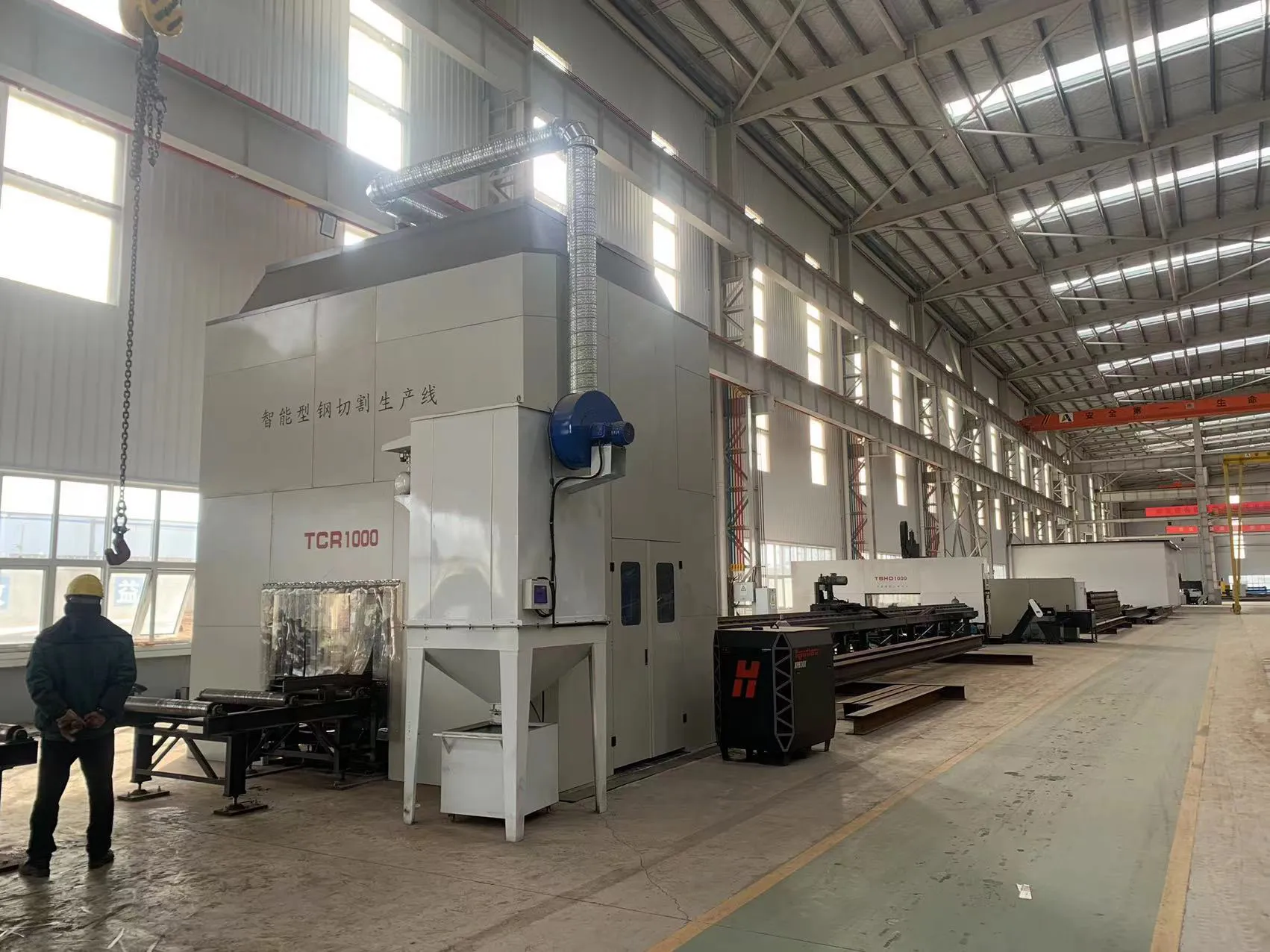
Field Engineering Report: Integration of 12kW Fiber Laser Profiling in Heavy-Duty Structural Racking (Rayong Sector)
1. Project Scope and Environmental Context
This report details the technical deployment and operational analysis of a 12000W (12kW) Heavy-Duty I-Beam Laser Profiler equipped with an integrated Automatic Unloading System. The installation site is located in Rayong, Thailand, within a high-output manufacturing facility specializing in industrial storage racking systems for the Eastern Economic Corridor’s (EEC) logistics hubs.
The primary objective was to replace legacy plasma cutting and mechanical drilling arrays with a singular, high-density energy source capable of processing S235 and S355 grade carbon steel I-beams and H-beams. The specific requirements of the storage racking sector—namely dimensional repeatability for bolt-hole patterns and high-speed profiling of structural members—demanded a shift toward high-kilowatt fiber laser technology.
2. 12kW Fiber Laser Source: Thermal Dynamics and Penetration
The heart of the profiler is a 12kW ytterbium fiber laser source. In the context of heavy-duty I-beams (typically ranging from 150mm to 600mm in depth), the 12kW threshold is critical for maintaining “dross-free” cutting speeds on flange thicknesses exceeding 15mm.
2.1. Power Density and Kerf Characteristics:
At 12kW, the power density allows for high-speed sublimation and melt-expulsion. Unlike lower-wattage systems (4kW–6kW) which struggle with the transition between the web and the thicker flange of an I-beam, the 12kW source maintains a stable keyhole. This stability reduces the Heat Affected Zone (HAZ), which is vital for maintaining the metallurgical integrity of the load-bearing beams used in high-bay racking.
2.2. Assist Gas Dynamics:
During the Rayong commissioning, Oxygen (O2) was utilized for thicknesses above 12mm to leverage the exothermic reaction, while high-pressure Nitrogen (N2) was calibrated for thinner web sections to ensure an oxide-free finish. The 12kW overhead provides enough pressure headroom to increase feed rates by 40% compared to 8kW benchmarks.
3. Kinematics of 3D Structural Profiling
Processing I-beams for storage racking is not a linear operation. It involves complex 3D geometries, including “bird-mouth” joints, cope cuts, and high-precision bolt holes for seismic-rated uprights.
3.1. Multi-Axis Head Articulation:
The profiler utilizes a 5-axis or 6-axis robotic head configuration (depending on the specific B/C-axis rotation requirements). This allows the 12kW beam to remain perpendicular to the material surface even when transitioning across the radius of the I-beam’s inner flange.
3.2. Compensation for Structural Irregularities:
Structural steel, particularly hot-rolled I-beams common in Thai markets, often exhibits “camber” or “sweep.” The system’s capacitive sensing and mechanical touch-probing routines recalibrate the cutting path in real-time. This ensures that the bolt-hole patterns—essential for the modular assembly of racking—are aligned within a ±0.1mm tolerance across a 12-meter span.
4. Automatic Unloading: Solving the Heavy-Duty Throughput Bottleneck
The most significant advancement in this 12kW installation is the transition from manual or overhead-crane-assisted unloading to a fully automated synchronous system.
4.1. The “Heavy-Duty” Challenge:
An I-beam of 12 meters can weigh upwards of 800kg to 1.5 tons. Manual handling introduces significant downtime (cycle-time inflation) and poses extreme safety risks. Furthermore, improper handling of hot, freshly cut profiles can lead to structural bowing.
4.2. Mechanism of the Automatic Unloading System:
The unloading module employs a series of heavy-duty hydraulic lifters and lateral transfer chains. As the laser completes the final cut on a profile, the unloading grippers—synchronized with the machine’s CNC—support the finished part from beneath.
* **Support Logic:** The system uses “Follower Supports” that prevent the beam from sagging during the cutting process, which is a common cause of kerf deviation in heavy-duty profiling.
* **Lateral Sorting:** Once the cut is finalized, the beam is mechanically shifted to a secondary conveyor. This allows the primary laser bed to immediately accept the next raw member, effectively achieving a “zero-gap” production cycle.
4.3. Precision Preservation:**
By automating the unloading, we eliminate “collision-induced” deformation. In storage racking, even a 2mm deviation in a 10-meter upright can lead to catastrophic failure under vertical load. The automatic system ensures the beam is placed on the cooling racks in a perfectly neutral stress state.
5. Application Specifics: Storage Racking in Rayong
Rayong’s industrial environment serves the automotive and petrochemical sectors, where “Double Deep” and “Drive-In” racking systems are standard. These systems require extreme precision in the interlocking joints.
5.1. High-Density Racking Requirements:**
The 12kW profiler enables the fabrication of “Heavy Duty Pallet Racking” where the beam-to-column connection relies on precisely tapered slots. Traditional punching methods cause local work-hardening and micro-fractures; the fiber laser’s rapid thermal cycle avoids this, ensuring that the racking can withstand the dynamic loads of forklift operations and seismic shifts.
5.2. Throughput Metrics:**
In the Rayong facility, the implementation of the 12kW profiler with automatic unloading resulted in:
* **300% Increase in Throughput:** Compared to the previous band-saw and radial-drill workflow.
* **Labor Reduction:** From a 4-man handling crew to a single CNC operator and a logistics handler.
* **Material Utilization:** Advanced nesting software, optimized for I-beams, reduced scrap rates by 12% by allowing “common-line” cutting on the web-end profiles.
6. Thermal Management and Environmental Factors
Rayong is characterized by high humidity and ambient temperatures exceeding 35°C. For a 12kW fiber laser, thermal management is paramount.
6.1. Dual-Circuit Chiller Integration:**
The system utilizes a high-capacity chiller to maintain the laser source at a constant 22°C (±0.5°C) and the cutting head at 28°C to prevent condensation. In the heavy-duty sector, the duty cycle is often 100%; therefore, the chiller’s ability to dissipate the heat generated by 12kW of continuous output is the primary factor in system longevity.
6.2. Dust and Fume Extraction:**
Processing heavy I-beams generates significant particulate matter, especially when cutting through thick flanges. A high-volume, zoned dust extraction system was integrated, pulling air directly from the cutting zone beneath the beam. This maintains the integrity of the linear guides and the rack-and-pinion drive system.
7. Maintenance and Operational Stability
To sustain 24/7 operations in the Rayong racking sector, the following maintenance protocols were established:
* **Protective Window Monitoring:** At 12kW, even a minor contaminant on the protective window can lead to catastrophic lens failure due to thermal absorption. The system includes an internal pressure sensor to detect “back-reflection” and “thermal bloom.”
* **Nozzle Calibration:** Automatic nozzle changing and cleaning cycles are triggered every 10 piercings to ensure the gas jet remains laminar, preventing “striations” on the I-beam’s vertical surface.
8. Conclusion
The deployment of the 12kW Heavy-Duty I-Beam Laser Profiler in Rayong represents a paradigm shift for the structural steel and storage racking industry. The synergy between the 12kW high-wattage source and the Automatic Unloading technology solves the dual challenges of heavy material handling and high-precision structural requirements.
For the storage racking sector, where safety margins and assembly speeds are non-negotiable, the ability to profile complex I-beams with sub-millimeter accuracy at industrial speeds is an essential competitive advantage. This installation confirms that the integration of automated material handling is no longer an “option” but a technical requirement for high-kilowatt structural processing.
Report End.
Senior Engineer: [Structural Steel & Laser Systems Division]
Location: Rayong, Thailand













