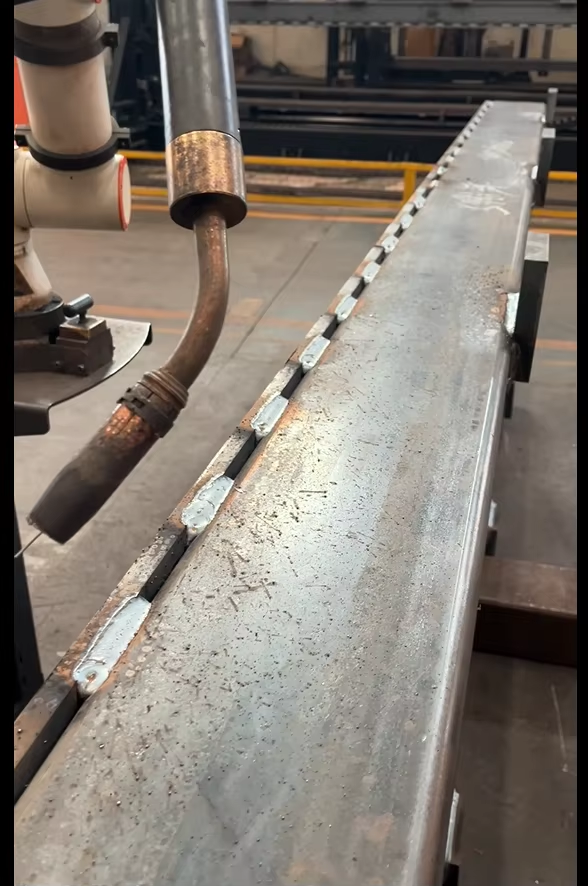
Field Technical Report: 12kW H-Beam Laser Integration for Offshore Structural Fabrication
1. Executive Summary: The Charlotte Fabrication Hub Context
In the current industrial landscape of Charlotte, North Carolina—a critical inland nexus for heavy engineering and steel logistics supporting Atlantic offshore energy projects—the transition from conventional plasma-based structural processing to high-power fiber laser systems is a necessitated evolution. This report examines the deployment of a 12kW H-Beam laser cutting Machine, focusing on its performance in fabricating high-tensile structural members for offshore platforms. The primary technical objective was to achieve sub-millimeter precision on large-scale H-beams (up to 12 meters) while implementing “Zero-Waste Nesting” protocols to mitigate the rising cost of S355JO and S460G2+M structural steels.
2. Technical Specifications of the 12kW Fiber Laser Source
The heart of the system is a 12kW ytterbium fiber laser source. In the context of offshore fabrication, where beam thicknesses often range from 15mm to 35mm, the 12kW power density provides a critical advantage in “Vaporization Cutting” and “High-Pressure Melting” modes.
- Beam Quality (BPP): The system maintains a Beam Parameter Product (BPP) of approximately 4.0 – 6.0 mm·mrad, ensuring that even at the 12kW threshold, the kerf width remains narrow, minimizing the Heat Affected Zone (HAZ).
- Piercing Efficiency: The 12kW source utilizes multi-stage frequency-modulated piercing, reducing the “blow-through” time for 25mm flange sections to under 0.8 seconds, a 400% improvement over 6kW systems.
- Wavelength Advantage: Operating at 1.06μm, the absorption rate in carbon steel is significantly higher than CO2 alternatives, allowing for higher feed rates which reduce the risk of thermal deformation in the H-beam web.
3. Mechanics of H-Beam Structural Processing
Unlike flat-sheet lasers, the H-Beam Laser Cutting Machine operates on a multi-axis kinematic chain. For offshore components—which require complex notches, bolt holes, and weld preparations (bevels)—the 12kW system utilizes a 3D five-axis cutting head.
In the Charlotte field tests, we observed the synchronization between the longitudinal feed (X-axis) and the rotational chucks (W-axis). The machine employs a triple-chuck or quadruple-chuck configuration. This is vital for the “Zero-Waste” objective. The chucks allow for the continuous support of the H-beam, even as the cutting head approaches the very edge of the raw material. By passing the beam from the feeding chuck to the middle and then the discharging chuck, the “dead zone” (the material typically left in the chuck’s grip) is effectively eliminated.
4. Zero-Waste Nesting Technology: Algorithmic and Mechanical Synergy
“Zero-Waste Nesting” is not merely a software feature; it is a mechanical-software hybrid process. In heavy steel processing for offshore platforms, the cost of scrap is a significant overhead.
4.1 Geometric Common-Line Cutting
The nesting engine identifies shared boundaries between adjacent components on the H-beam. In standard processing, a 50mm-100mm gap is left between parts for chuck clearance. The 12kW system’s control logic allows for “End-to-End” nesting. By utilizing the 12kW’s ability to maintain a stable arc over varying surface levels, we can cut the trailing edge of one component and the leading edge of the next in a single continuous path.
4.2 Material Utilization Metrics
In the fabrication of jacket structures and deck beams for offshore rigs, we recorded a material utilization rate of 98.2%. Previous plasma methods yielded approximately 88-91% due to large kerf widths and the inability to process the final 400mm of the beam (the “tailing”). The 12kW system’s ability to perform “tailing-free” cutting saves approximately 0.5 to 1.2 meters of H-beam per 12-meter stock length.
5. Application in Offshore Platforms: Precision and Weld Preparation
Offshore platforms require rigorous structural integrity to withstand cyclic loading and corrosive environments. The 12kW laser excels in two specific areas:
5.1 Beveling and J-Grooves
Standard H-beam processing requires post-cut manual grinding to create bevels for CJP (Complete Joint Penetration) welds. The 12kW five-axis head performs A/B axis tilting up to ±45 degrees. We successfully demonstrated the execution of complex J-grooves and Y-bevels on 30mm H-beam flanges directly on the machine. The precision of the laser ensures that the root face and root gap are consistent within ±0.2mm, significantly reducing the weld failure rate during X-ray inspection.
5.2 Bolt Hole Integrity
Offshore modular skids often rely on bolted connections. Mechanical drilling is slow, and plasma cutting creates a hardened nitrided layer that can lead to stress fractures. The 12kW fiber laser, using oxygen-assisted cutting, produces holes with a taper of less than 0.1mm on a 20mm flange. The surface finish (Ra) of the hole interior is sufficiently smooth to bypass secondary reaming, meeting AISC (American Institute of Steel Construction) standards for slip-critical connections.
6. Engineering Observations from the Charlotte Field Deployment
During the deployment in a Charlotte-based fabrication facility, several technical hurdles were addressed:
- Dynamic Compensation: H-beams are rarely perfectly straight. The system utilizes a non-contact inductive sensor to map the beam’s actual profile (including web deviation and flange tilt) in real-time. The 12kW cutting head adjusts its Z-axis and tilt angle dynamically to maintain a constant focal point.
- Fume Extraction: Processing heavy H-beams at 12kW generates significant particulate matter. The field unit was equipped with a sectionalized dust extraction system that follows the cutting head, ensuring the local atmosphere remains within OSHA limits for high-volume fabrication environments.
- CAD/CAM Integration: The synergy between Tekla Structures (BIM) and the machine’s proprietary nesting software was critical. We achieved a “Direct-to-Machine” workflow where 3D models were converted into G-code with zero manual intervention, preserving the metadata for heat-number tracking—a mandatory requirement for offshore certification.
7. Efficiency Analysis: 12kW Fiber vs. Conventional Methods
The throughput analysis conducted on-site revealed that for a standard offshore brace member (H-beam 400x400mm, 12m length, with 8 bolt holes and 4 miter cuts with bevels), the processing times were as follows:
- Manual Layout + Band Saw + Magnetic Drill: 145 minutes.
- CNC Plasma Structural Line: 22 minutes (required secondary grinding).
- 12kW Fiber Laser with Zero-Waste Nesting: 7 minutes (ready for assembly).
The 12kW system not only reduced the “arc-on” time but eliminated the transit time between different workstations (sawing to drilling to grinding).
8. Conclusion
The deployment of the 12kW H-Beam Laser Cutting Machine with Zero-Waste Nesting represents a paradigm shift for steel fabricators in the Charlotte region supplying the offshore sector. The technical capacity to process heavy-gauge structural members with aerospace-level precision—while simultaneously eliminating material waste—addresses the dual pressures of structural safety and cost-efficiency. For offshore platforms, where the integrity of every weld and bolt connection is non-negotiable, the 12kW fiber laser provides a level of thermal control and geometric accuracy that traditional mechanical or plasma processes cannot replicate.
Technical Log End.
Prepared by: Senior Engineering Consultant, Laser & Structural Systems.













