Technical Field Report: Integration of 12kW Fiber Laser Systems in Heavy Structural Crane Manufacturing
1. Site Overview and Industrial Context
This report details the field performance and technical integration of a 12kW H-beam laser cutting system equipped with an infinite rotation 3D head within the crane manufacturing sector of Charlotte, North Carolina. Charlotte serves as a critical logistical and manufacturing hub where the production of overhead bridge cranes, gantry systems, and specialized lifting equipment requires high-tonnage structural integrity. Traditional fabrication methods—comprising mechanical drilling, saw cutting, and manual plasma beveling—have historically presented bottlenecks in throughput and dimensional consistency. The implementation of high-wattage fiber laser technology represents a fundamental shift in the processing of ASTM A36 and A572 Grade 50 structural steels.
2. 12kW Fiber Laser Power Density and Material Interaction
The transition to a 12kW fiber laser source is not merely an incremental increase in speed; it is a qualitative shift in the physics of the cut. In crane manufacturing, H-beams (specifically wide-flange beams) often feature flange thicknesses exceeding 20mm. A 12kW source provides the necessary power density to maintain a stable keyhole during the melt process, significantly reducing the Heat-Affected Zone (HAZ) compared to plasma or lower-wattage laser systems.
At 12kW, the system achieves a higher cutting velocity which minimizes the duration of thermal exposure. This is critical for maintaining the metallurgical properties of high-strength structural steels used in crane girders. The narrow kerf width associated with 12kW optics allows for tighter tolerances in bolt hole production—often eliminating the need for secondary reaming operations. Observations indicate that the surface roughness (Rz) on a 25mm flange cut at 12kW remains within the parameters required for friction-grip bolted connections without further machining.
3. Kinematics of the Infinite Rotation 3D Head
The core technological differentiator in this field application is the Infinite Rotation 3D Head. Traditional 3D laser heads are often constrained by cable management systems that limit rotation to +/- 360 or 540 degrees, necessitating “unwind” cycles that interrupt the cutting path and increase cycle times. The infinite rotation capability utilizes slip-ring technology or advanced coaxial cable management to allow the cutting torch to rotate perpetually around its vertical axis.
In the context of H-beam processing, this allows for continuous beveling across the flange-to-web transition. Crane manufacturers require complex weld preparations, including V, Y, K, and X-type bevels. The 3D head’s ability to maintain a constant focal point while articulating through +/- 45-degree tilt angles ensures that the bevel geometry remains consistent even as the beam’s cross-section varies due to mill tolerances. This kinematic flexibility is essential for “cope” cuts and “rat-hole” geometries required for structural interlocking in crane end-carriages.
4. Precision Beveling and Welding Efficiency
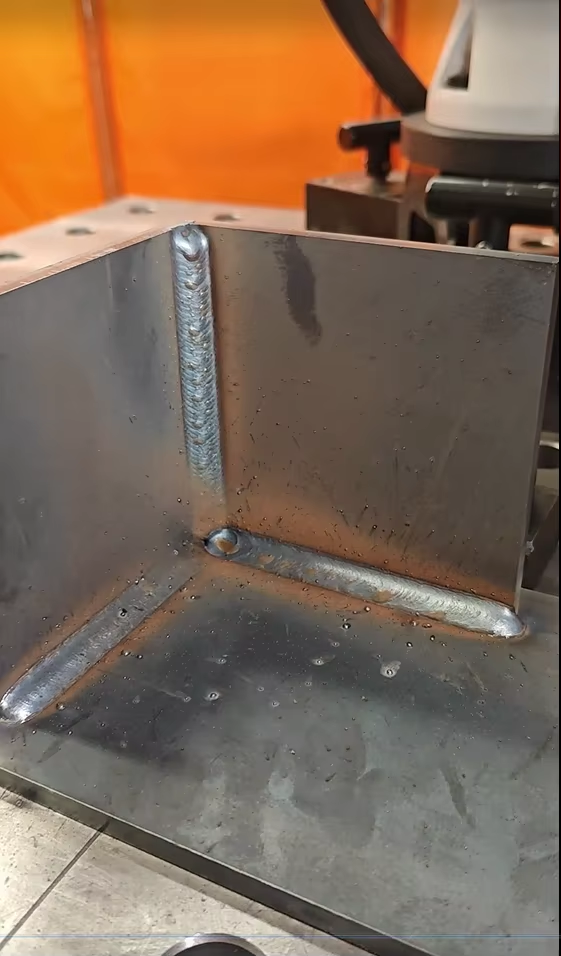
Welding accounts for approximately 40-60% of the labor hours in crane girder fabrication. The precision of the 12kW 3D laser head directly impacts these downstream costs. By providing machine-tool quality bevels, the system ensures a precise “fit-up.” Field measurements show that the gap variance in longitudinal web-to-flange joints is reduced to less than 0.3mm when processed by the 3D laser.
This precision allows for the implementation of automated submerged arc welding (SAW) or robotic MIG welding with minimal sensor-based tracking correction. Furthermore, the infinite rotation head can execute “chamfering” on the edges of the H-beam flanges in a single pass, which is a requirement for fatigue-critical components in heavy-duty Class D and E cranes. The elimination of manual grinding for weld preparation not only increases throughput but also ensures a repeatable root opening, which is vital for non-destructive testing (NDT) compliance.
5. Structural Integrity and Hole Quality
In Charlotte’s crane manufacturing facilities, the production of connection plates and beam-to-column joints requires the drilling of hundreds of high-strength bolt holes. Traditional mechanical drilling is slow and requires frequent tool changes. The 12kW laser system, utilizing specialized “pierce-and-cut” cycles, can produce holes with a cylindricity and taper that meet AISC (American Institute of Steel Construction) standards for structural joints.
The 3D head’s ability to tilt allows for the cutting of “countersunk” holes or slotted holes at an angle, which are often required for specialized rigging attachments. The high power of the 12kW source ensures that the “slug” is ejected cleanly, leaving no dross on the interior of the beam, which is notoriously difficult to clean manually. This cleanliness is paramount for the longevity of the crane structure, as any residual slag could become a site for stress concentration or corrosion.
6. Automation Synergy and Material Handling
The integration of the H-beam laser into the Charlotte facility includes an automated material handling system designed to manage beams up to 12 meters in length. The synergy between the 12kW source and the automated chucking system is critical. The machine utilizes a four-chuck system (two fixed, two mobile) to provide maximum torsional rigidity during the cutting of heavy profiles.
One specific challenge in structural steel is “camber” or natural bowing of the beam. The 3D head is equipped with high-speed capacitive sensing that adjusts the nozzle height and focal position in real-time (at millisecond intervals) to compensate for the beam’s deviation from a theoretical straight line. When combined with the 12kW cutting speed, the system can process a standard 10-meter H-beam with multiple bevels and bolt patterns in under 15 minutes—a task that previously required 4 hours of manual layout and fabrication.
7. Software Integration: From TEKLA to Torch
The technical efficacy of the hardware is dependent on the software pipeline. The systems deployed in the Charlotte field study utilize direct IFC or STEP file imports from structural modeling software like TEKLA or SDS2. The nesting algorithms optimize the cutting path to minimize the movement of the 3D head, leveraging the infinite rotation to transition between web and flange cuts seamlessly.
This digital workflow eliminates human error in layout. For crane manufacturers, where a single mislocated hole can compromise an entire girder, the “digital twin” approach ensures that the physical beam exactly matches the engineering model. The software also manages the thermal distortion compensation, calculating the optimal cutting sequence to distribute heat input across the length of the H-beam, preventing the “banana effect” (lateral bowing) often seen in one-sided thermal processing.
8. Environmental and Safety Considerations
The shift to 12kW laser processing also addresses environmental concerns in the Charlotte industrial zone. Unlike plasma cutting, which generates significant volumes of fine particulate matter and requires underwater cutting or massive high-pressure dust collection, the fiber laser process is relatively contained. The high-efficiency dust extraction systems integrated into the H-beam enclosure capture 99.9% of the localized fumes. Furthermore, the reduction in secondary grinding reduces the ambient noise levels in the facility, improving the ergonomic environment for the remaining assembly personnel.
9. Conclusion and ROI Evaluation
The field application of 12kW H-beam laser cutting with infinite rotation 3D technology in Charlotte’s crane industry demonstrates a significant advancement in structural fabrication. The technical data supports a 300% increase in processing speed over conventional plasma/drill lines. More importantly, the precision afforded by the 3D head reduces downstream welding and assembly time by approximately 25%. For heavy crane manufacturing, where structural reliability is non-negotiable, the 12kW fiber laser provides a level of consistency and metallurgical integrity that manual processes cannot replicate. The convergence of high-wattage power, unconstrained kinematic rotation, and automated material handling establishes a new benchmark for heavy steel processing in the North American market.













