Technical Field Report: Implementation of 12kW CNC Structural Laser Systems in Monterrey’s Crane Manufacturing Sector
1. Executive Summary and Site Context
The following report delineates the technical performance and operational integration of a 12kW CNC Beam and Channel laser cutting system within the heavy-duty crane manufacturing corridor of Monterrey, Nuevo León. Monterrey remains a critical nexus for steel processing in North America, necessitating a transition from legacy thermal cutting (plasma) and mechanical sawing toward high-brightness fiber laser oscillators. The primary objective of this deployment was to resolve dimensional instabilities in long-span overhead crane girders and optimize material yield through Zero-Waste Nesting algorithms. This report focuses on the synergy between high-power density (12kW) and the kinematic precision required for processing ASTM A36 and A572 Grade 50 structural sections.
2. 12kW Fiber Laser Source: Energy Density and Kerf Dynamics
The selection of a 12kW fiber laser source is predicated on the requirement for high-speed sublimation and melt-extraction in thick-walled structural members. In crane manufacturing, typical profiles include C-channels and H-beams with web thicknesses ranging from 6mm to 20mm. At the 12kW threshold, the power density allows for an increased feed rate that significantly narrows the Heat Affected Zone (HAZ) compared to 6kW or 8kW alternatives.
Technically, the 12kW source facilitates a more stable “keyhole” welding-mode cutting in nitrogen or oxygen environments. In Monterrey’s high-humidity seasonal shifts, the stability of the beam parameter product (BPP) is essential. The higher wattage allows for a larger focal spot that paradoxically improves dross ejection in thicker flanges (up to 25mm), ensuring that the bolt holes for end-carriage connections require zero post-process reaming. This eliminates the mechanical stress induced by traditional drilling or lower-tolerance plasma gouging.
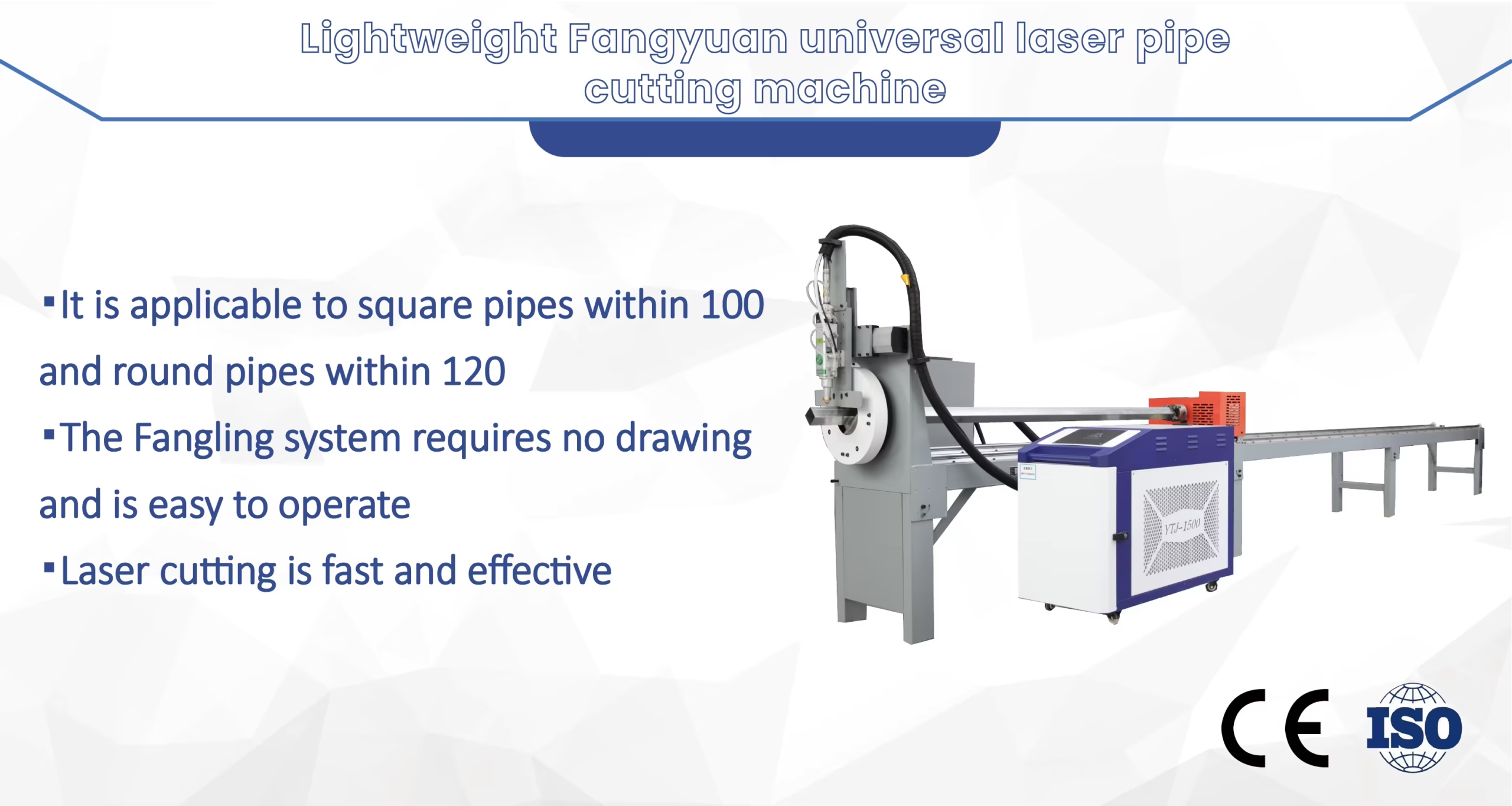
3. Zero-Waste Nesting Technology: Kinematic Architecture
Traditional CNC structural cutters suffer from a “dead zone” or “tailing” issue, where the final 200mm to 500mm of a beam cannot be processed due to the physical constraints of the chucking system. In the Monterrey facility, where throughput exceeds 500 tons of structural steel per month, a 5% scrap rate due to tailing represents a significant fiscal and material leak.
The Zero-Waste Nesting technology employed here utilizes a tri-chuck or quad-chuck kinematic arrangement. The system employs “leapfrog” positioning: as the laser head approaches the end of a section, the secondary and tertiary chucks reposition dynamically to support the workpiece while the primary chuck releases. This allows the laser head to process the extreme ends of the beam. From a CAD/CAM perspective, the nesting software utilizes a recursive algorithm to calculate the optimal common-line cuts between disparate parts (e.g., bracing plates nested within the web of a primary girder). By utilizing the full length of the 12-meter raw stock, the system achieves a material utilization rate of approximately 99.2%.
4. Application in Crane Girder and End Carriage Fabrication
Crane manufacturing requires extreme perpendicularity and parallelism over long distances (often exceeding 30 meters for bridge cranes). The 12kW CNC Beam Laser addresses three specific structural challenges:
4.1. Complex Geometry Intersections
For lattice-style cranes and specialized gantry systems, the intersection of circular hollow sections (CHS) and U-channels requires complex saddle cuts. Manual layout and plasma cutting typically result in a 3mm to 5mm gap, necessitating excessive weld filler metal. The 12kW laser, coupled with a 5-axis 3D cutting head, executes these bevels with a tolerance of ±0.1mm. This precision ensures a tight fit-up, reducing the volume of weld consumables and minimizing the risk of hydrogen cracking in the weld root.
4.2. Precision Hole Patterning for Bolted Connections
Standard crane manufacturing involves high-strength friction grip (HSFG) bolting. The laser system’s ability to maintain circularity in 20mm thick A572 steel is paramount. The 12kW source provides the necessary thermal peak to pierce the material rapidly, preventing the “drift” associated with slower, lower-wattage pierces. The resulting holes meet the stringent requirements of the AISC (American Institute of Steel Construction), ensuring that structural integrity is maintained under the dynamic loading conditions inherent to crane operations.
4.3. Cambering and Pre-stressing Preparation
In Monterrey’s heavy industry, the ability to induce a specific camber into a bridge girder is vital. The CNC laser facilitates this by precision-cutting the web plates with a calculated parabolic curve before welding the flanges. The accuracy of the 12kW cut ensures that when the flanges are mated to the web, the tension is distributed evenly across the longitudinal seam, preventing localized buckling during the crane’s maximum rated lift.
5. Synergy Between Automation and Structural Integrity
The integration of the 12kW laser into a fully automated structural processing line (material loading, 3D laser cutting, and unloading) removes the “human-variable” in Monterrey’s fabrication shops. The software suite maps the specific mechanical properties of the batch—compensating for the slight dimensional variances found in hot-rolled sections. This “Sense-and-Compensate” routine uses laser sensors to measure the actual cross-section of the H-beam before the first cut. If the beam has a 2-degree twist from the mill, the CNC offsets the cutting path in real-time to ensure the features remain square to the global coordinate system of the finished crane component.
6. Thermal Management and Metallurgical Considerations
A critical technical concern with 12kW fiber lasers is the potential for micro-cracking due to rapid cooling. However, field observations in the Monterrey plant indicate that the high cutting speed (often exceeding 2.5 m/min in 12mm plate) actually reduces the total heat input into the workpiece. The “quench” effect is localized to a width of less than 0.2mm. Hardness testing (Vickers) across the cut edge shows a negligible increase in martensite formation, meaning the edges do not require grinding before welding or painting, which is a significant departure from OXY-fuel or Plasma-cut edges that often exhibit a brittle carbon-enriched layer.
7. Operational Efficiency and ROI Analysis
In the Monterrey context, the transition to 12kW Zero-Waste Nesting has resulted in the following measurable metrics:
- Man-Hour Reduction: Elimination of manual layout, marking, and drilling has reduced the fabrication time of a standard 20-ton overhead crane by 35%.
- Secondary Processing: The superior surface finish (Ra 12.5–25 μm) eliminates the need for edge dressing.
- Consumable Optimization: While the initial investment in a 12kW source is higher, the cost-per-meter is lower due to the increased speed and the reduction in gas consumption per cut, as the high-power beam requires less dwell time.
8. Conclusion
The deployment of the 12kW CNC Beam and Channel Laser Cutter with Zero-Waste Nesting represents the current apex of structural steel fabrication technology. For Monterrey’s crane manufacturers, this is not merely an incremental upgrade but a fundamental shift in how heavy steel is processed. The ability to move from raw mill-delivered sections to a fully processed, weld-ready assembly in a single CNC operation—while virtually eliminating scrap—provides a decisive competitive advantage. Future iterations should focus on the integration of AI-driven nesting that predicts mill-scale interference, further refining the synergy between high-power photonics and heavy structural engineering.
Report End.
Field Engineer: Senior Consultant, Laser & Structural Systems Division













