The Dawn of High-Power Structural Laser Processing
For decades, the fabrication of structural steel for offshore platforms relied on a fragmented workflow: mechanical sawing for length, followed by manual drilling, and culminating in labor-intensive oxy-fuel or plasma beveling for weld preparation. However, the emergence of the 12kW CNC fiber laser has fundamentally disrupted this sequence. As a fiber laser expert, I have witnessed the transition from 4kW systems—which struggled with the sheer thickness of offshore-grade steel—to the 12kW powerhouse that treats 20mm to 30mm steel sections with the same ease as thin sheet metal.
The 12kW fiber laser source provides a power density that allows for high-speed sublimation and melting, resulting in a minimal Heat-Affected Zone (HAZ). In the offshore industry, where fatigue resistance and structural integrity are paramount, maintaining the metallurgical properties of the base metal is critical. The high-intensity beam of a 12kW system ensures that the edges are clean, dross-free, and require zero post-processing before welding.
Infinite Rotation: The 3D Head Advantage
The true “secret sauce” of this machine lies in its 3D cutting head with infinite rotation capabilities. Traditional 5-axis heads are often limited by cable management systems, requiring “unwinding” after a certain degree of rotation. In a high-throughput environment like a Katowice fabrication shop, these seconds of downtime add up.
Infinite rotation allows the CNC head to orbit the beam or channel continuously. This is essential when cutting complex geometries such as “scalloped” cuts for pipe-to-beam intersections or intricate bolt-hole patterns on the flanges of H-beams. The 3D head can tilt up to ±45 degrees (or more in specialized configurations), enabling the creation of V-type, X-type, and K-type bevels. For offshore platforms, where deep-penetration welds are the standard for surviving the harsh conditions of the North Sea or the Baltic, these precision bevels are the difference between a joint that lasts 30 years and one that fails in five.
Mastering Beams and Channels: The Geometry Challenge
Cutting flat sheets is elementary; cutting structural sections like I-beams (IPE/HEA) and U-channels (UPN) is an exercise in complex spatial geometry. These profiles have varying thicknesses—the web is usually thinner than the flanges—and internal radii that can deflect a laser beam if not accounted for by the CNC controller.
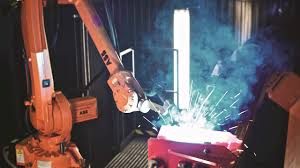
The 12kW system in Katowice utilizes advanced sensing technology. As the 3D head maneuvers around the beam, height sensors maintain a constant standoff distance even as the laser transitions from the flat web to the sloped internal surface of a channel flange. This synchronized movement of the 12kW laser and the 6-axis robotic gantry ensures that the focal point is always optimized, preventing “beam blow-out” and ensuring the kerf width remains consistent throughout the cut.
Offshore Platforms: Precision for Extreme Environments
Offshore platforms—whether for oil and gas or the burgeoning offshore wind sector—are among the most demanding structures on Earth. They must withstand galvanic corrosion, extreme wave loading, and sub-zero temperatures. Consequently, the tolerances for the structural members are incredibly tight.
A 12kW laser cutter provides a positional accuracy of ±0.05mm, a feat impossible with plasma or manual methods. When fabricating a “jacket”—the underwater lattice structure of a platform—the fit-up between the tubular legs and the bracing beams must be perfect. Gaps in fit-up lead to “weld pull” and internal stresses. By using the 12kW laser with a 3D head, fabricators in Katowice can produce “saddle cuts” and “fish-mouth cuts” on beams that slide into place with zero clearance, ensuring a superior weld root and overall structural longevity.
Why Katowice? The Industrial Nexus
Katowice and the wider Upper Silesian region have long been the industrial heart of Poland. Historically rooted in coal and steel, the region has undergone a massive technological pivot. Today, it serves as a primary hub for European heavy engineering.
The decision to house a 12kW infinite rotation laser in Katowice is strategic. The proximity to the Baltic shipyards (Gdańsk and Gdynia) allows for a seamless supply chain. Structural components can be precision-cut in the south of Poland and transported to the coast for final assembly. Furthermore, the local talent pool—engineers who understand both the physics of metallurgy and the complexities of 5-axis CNC programming—makes Katowice the ideal location for high-spec offshore fabrication.
The Economics of 12kW Laser Fabrication
From a CAPEX perspective, a 12kW CNC laser with a 3D head is a significant investment. However, the OPEX and ROI tell a different story. In a traditional shop, a single beam might spend 4 hours moving between a saw, a drill, and a manual grinding station. The 12kW laser performs all these tasks in under 15 minutes.
Moreover, the “Infinite Rotation” feature eliminates the need for manual flipping of the beam. The machine can process all four sides of a profile in a single setup. This reduction in material handling not only increases safety—a top priority in offshore engineering—but also eliminates the cumulative errors that occur when a heavy beam is re-clamped multiple times. For a large-scale offshore project involving thousands of tons of steel, the savings in man-hours and the reduction in scrap material (thanks to nesting software) can run into millions of Euros.
Integration with Industry 4.0
The 12kW laser cutters deployed in Katowice are not standalone tools; they are nodes in a digital ecosystem. These machines use sophisticated CAD/CAM software (such as Lantek or Tekla) that imports 3D models directly from the platform designers. The software automatically calculates the optimal cutting path for the infinite rotation head, accounting for the “unfolding” of the beam’s geometry.
Real-time monitoring of the 12kW laser source allows for predictive maintenance. If the protective window in the 3D head begins to show signs of contamination, or if the gas pressure (Oxygen or Nitrogen) fluctuates, the system alerts the operator before a part is ruined. In the context of offshore fabrication, where a single defective beam can delay a multi-million dollar “lift” at sea, this level of digital reliability is non-negotiable.
Conclusion: The Future of Offshore Engineering
The synergy between 12kW fiber laser power, infinite 3D rotation, and Katowice’s industrial expertise is setting a new global benchmark. We are moving away from an era of “approximate” structural engineering toward an era of “absolute” precision.
As we look toward the future—specifically the expansion of offshore wind farms in the Baltic—the demand for these high-spec machines will only grow. The 12kW laser does more than just cut steel; it provides the structural foundation for the energy transition. For the expert, the sight of a 12kW beam effortlessly carving a complex K-bevel into a heavy HEB-600 beam is a testament to how far we have come. In the hands of Katowice’s skilled fabricators, this technology is not just a tool—it is the engine of a new industrial revolution for the offshore world.