The Dawn of High-Power Fiber Lasers in Structural Fabrication
For decades, the structural steel industry relied on plasma cutting, oxy-fuel, or mechanical sawing for the preparation of large-scale components. While effective, these methods often lacked the precision required for complex assemblies and necessitated significant secondary finishing. The introduction of the 12kW fiber laser has fundamentally altered this landscape. At 12,000 watts, the laser’s power density allows it to vaporize thick-walled structural steel almost instantaneously, producing a heat-affected zone (HAZ) so narrow that the structural integrity of the base material remains uncompromised.
In a 3D processing environment, this power is not just about raw speed through flat plate; it is about the ability to maintain high feed rates while navigating the complex geometries of structural members. Whether it is a heavy I-beam for a railway bridge or a complex tubular truss for a station canopy, the 12kW source provides the “punch” necessary to maintain productivity across a wide range of material thicknesses, from 6mm gauge to 25mm+ structural sections.
3D Kinematics: Moving Beyond the Flatbed
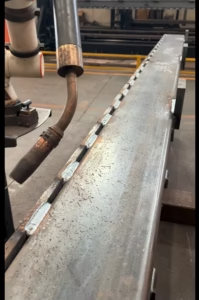
Traditional laser cutting is a 2D affair, limited to X and Y axes. However, railway infrastructure demands three-dimensional thinking. The Charlotte-based processing center utilizes a sophisticated 5-axis or 6-axis cutting head capable of tilting and rotating around the workpiece. This allows for high-precision beveling, which is essential for weld preparation.
In the railway sector, weld quality is non-negotiable. By performing the beveling—whether V, Y, X, or K-shaped—directly on the laser processing center, the facility eliminates the need for manual grinding or secondary CNC milling. The 3D head can cut complex bolt holes, service notches, and interlocking “tab-and-slot” geometries into beams and channels with a tolerance of +/- 0.1mm. This level of precision ensures that when components reach the construction site in the Charlotte rail corridor, they fit together perfectly, reducing field-welding time and structural errors.
Charlotte: A Strategic Nexus for Railway Infrastructure
Charlotte, North Carolina, has historically been a hub for transportation and logistics. With the presence of major rail lines like Norfolk Southern and CSX, as well as the expanding LYNX Blue Line and proposed regional rail expansions, the city is an ideal location for a high-tech structural steel processing center.
The proximity to major rail arteries means that raw material can be brought in via rail, processed using the 12kW laser, and shipped back out as finished structural kits with minimal drayage costs. The Charlotte facility is designed to support the “re-shoring” of infrastructure manufacturing, providing local contractors and government agencies with a domestic source for precision-cut steel that meets stringent “Buy America” requirements. This local capacity is vital for the rapid maintenance and expansion of bridge supports, catenary structures, and rolling stock components.
The Mechanics of Zero-Waste Nesting
One of the most significant costs in structural steel fabrication is material “drop” or scrap. Traditional nesting often leaves several feet of unused beam at the end of a production run. The Charlotte center employs “Zero-Waste Nesting” software, a sophisticated algorithmic approach to material optimization.
This software analyzes the entire production queue and intelligently nests parts across multiple stock lengths. It utilizes “common line cutting,” where a single laser pass creates the edge for two adjacent parts, effectively sharing the cut and eliminating the “skeleton” waste between them. Furthermore, the 3D processing software can perform “end-to-end” nesting, where the tail of one complex component is geometrically integrated into the head of the next.
For the high-volume requirements of railway infrastructure—such as thousands of identical sleeper plates or hundreds of unique bridge gussets—this technology can improve material utilization by up to 15-20%. In the context of expensive structural alloys, these savings represent millions of dollars over the lifecycle of a major infrastructure project.
Enhancing Railway Safety through Laser Precision
Railway components are subject to extreme cyclic loading and vibration. Any imperfection in a cut—such as a micro-crack from a dull saw or a jagged edge from a plasma torch—can become a stress riser, leading to fatigue failure over time.
The 12kW fiber laser produces a “glass-like” finish on the cut edge. The high-frequency modulation of the laser beam ensures that the kerf is consistent and free of dross. This is particularly critical for “dynamic” components of the rail system, such as switch gear and carriage frames. By providing a cleaner, more precise cut, the 12kW processing center in Charlotte directly contributes to the long-term safety and reduced maintenance requirements of the railway network.
The Digital Twin and Integrated Workflow
The 12kW 3D Structural Steel Processing Center does not operate in a vacuum. It is part of a fully digitized ecosystem. Before a single photon is fired, the entire cutting process is simulated via a “Digital Twin.” This allows engineers to verify that the 3D cutting head will not collide with the workpiece and that the nesting logic is optimized for the specific batch of steel.
For railway projects, which often use Building Information Modeling (BIM), the laser center can import 3D CAD files directly. This ensures that the physical component is an exact replica of the digital design. In Charlotte, this integrated workflow allows for “just-in-time” manufacturing. As a bridge replacement project progresses, the processing center can produce exactly what is needed for the next phase, reducing the need for on-site storage and the risk of component damage.
Environmental Impact and Sustainability
Beyond the “Zero-Waste” aspect of nesting, the 12kW fiber laser itself is an environmentally superior technology. Fiber lasers are significantly more energy-efficient than older CO2 lasers, converting a much higher percentage of electrical wall-plug power into usable light.
Furthermore, the precision of the laser reduces the need for secondary processes that consume energy and chemicals, such as pickling or heavy grinding. The reduction in scrap through advanced nesting means fewer tons of steel need to be melted and recycled, lowering the overall carbon footprint of the infrastructure project. In an era where “Green Procurement” is becoming a standard for government-funded railway projects, the Charlotte facility offers a clear competitive advantage.
Future-Proofing North American Transit
As the United States commits to modernizing its rail infrastructure—from high-speed passenger rail to high-capacity freight corridors—the demand for specialized structural steel will only increase. The 12kW 3D Processing Center in Charlotte represents the tip of the spear in this industrial evolution.
By leveraging the speed of fiber lasers, the precision of multi-axis robotics, and the efficiency of zero-waste software, the industry can finally move away from the slow, manual processes of the past. This facility is more than just a cutting shop; it is a center for engineering excellence that ensures the backbone of our transportation system—the steel under our tracks and over our rivers—is built to the highest possible standards of the 21st century.
Technical Specifications and Capability Summary
To summarize the capabilities of this Charlotte-based powerhouse:
– **Power Source:** 12kW Fiber Laser with adaptive beam shaping.
– **Capacity:** Processing of beams up to 1200mm in width and 15 meters in length.
– **Versatility:** Capable of handling H-beams, I-beams, C-channels, Angles, and RHS/CHS (Rectangular/Circular Hollow Sections).
– **Precision:** +/- 0.1mm positioning accuracy with full 3D beveling capability up to 45 degrees.
– **Software:** AI-driven Zero-Waste Nesting with real-time remnant tracking and BIM integration.
The 12kW 3D Structural Steel Processing Center is not merely an incremental improvement; it is a total reimagining of how we build. For the railway industry in Charlotte and across the Southeast, it provides a faster, cleaner, and more cost-effective path toward a connected future.