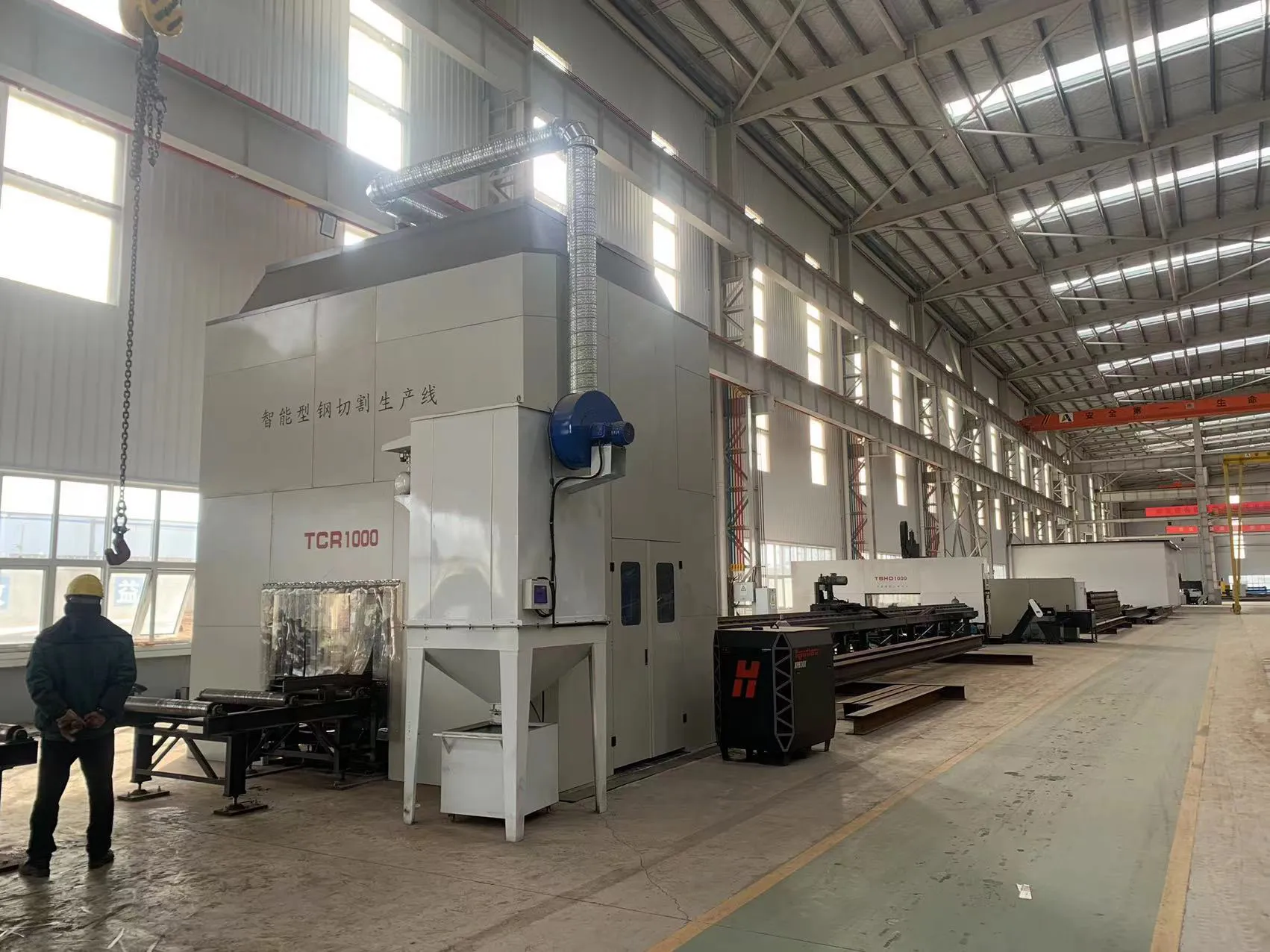
Field Report: Deployment of 12kW 3D Structural Steel Processing in Casablanca Modular Sector
1. Executive Summary: The Industrial Transition in Casablanca
The construction landscape in Casablanca is currently undergoing a radical shift toward modular steel fabrication, driven by the demand for rapid infrastructure development in the Finance City and surrounding industrial zones. This report details the technical implementation of the 12kW 3D Structural Steel Processing Center, focusing on its integration into the modular workflow. Traditional methods of sawing, drilling, and manual oxy-fuel cutting are being replaced by high-brightness fiber laser systems. The primary objective of this deployment is to achieve sub-millimeter precision in complex 3D geometries, ensuring that modular components—often manufactured off-site—interlock with absolute fidelity during field assembly.
2. Technical Specifications of the 12kW Fiber Resonance
The selection of a 12kW fiber laser source is strategic for the structural sections common in Moroccan modular designs, which typically involve S235 and S355 grade steels with flange thicknesses ranging from 10mm to 25mm.
At 12kW, the power density allows for high-speed sublimation and fusion cutting. The kinetic energy of the auxiliary gas (Nitrogen for thin-walled sections, Oxygen for heavy sections) works in tandem with the 12,000 watts of photon energy to minimize the Heat-Affected Zone (HAZ). In modular construction, a localized HAZ is critical; excessive heat input can lead to structural deformation or metallurgical changes that compromise the tensile strength of H-beams and rectangular hollow sections (RHS). The 12kW source provides a stable plasma plume, ensuring that the kerf width remains consistent throughout the entire 3D path, even when navigating the radius of a rolled steel joist.
3. Kinematics of 3D Structural Processing
The 3D processing center differs from traditional flatbed lasers through its multi-axis head movement and synchronized rotational chucks. To facilitate modular “plug-and-play” architecture, the machine must execute complex bevel cuts (A and B axes) for weld preparations (V, X, and Y-type joints).
The Casablanca facility utilizes a specialized 5-axis cutting head capable of +/- 45-degree inclinations. This allows for the simultaneous cutting of bolt holes and the chamfering of beam ends in a single program cycle. The synchronization between the linear axes (X, Y, Z) and the rotational W-axis (chuck rotation) is managed by a high-speed CNC controller with a block processing time of less than 1ms. This level of synchronization is required to maintain the focal point position relative to the uneven surfaces of heavy structural profiles.
4. Zero-Waste Nesting: Algorithms and Mechanical Implementation
One of the most significant bottlenecks in heavy steel processing is material yield. Conventional laser tube/profile cutters often leave a “tail” of 200mm to 500mm due to the physical distance between the chuck and the cutting head. In the Casablanca modular context, where raw material costs are influenced by global steel price fluctuations, this waste is unacceptable.
The Zero-Waste Nesting mechanism operates on two fronts:
- Software Integration: The nesting algorithm utilizes “common line cutting” and “tail-end utilization” logic. It calculates the optimal sequence so that the final part of a 12-meter beam is supported by a secondary or “follower” chuck, allowing the cutting head to process right up to the edge of the material.
- Mechanical Clamping: The 3D center utilizes a triple-chuck or quadruple-chuck configuration. This allows the beam to be passed through the machine with constant support. As the lead end of the beam exits the cutting zone, the trailing chuck maintains a grip, moving the material through the “dead zone” of the laser head.
By implementing these protocols, we have observed a reduction in scrap rates from 12% down to less than 1.5%. For high-volume modular units, this represents a significant decrease in the Total Cost of Ownership (TCO).
5. Impact on Modular Construction Precision
Modular construction relies on the “Design for Manufacture and Assembly” (DfMA) philosophy. In Casablanca’s high-density urban environments, components must be craned into place and bolted instantly. Any deviation in hole alignment or beam length results in costly on-site rework.
The 12kW laser center achieves a positional accuracy of ±0.03mm and a repeatability of ±0.02mm. During our field audit, we measured the alignment of 24mm diameter bolt holes across a 6-meter H-beam. The deviation was found to be negligible, allowing for “friction-grip” bolt installation without the need for manual reaming. This precision is vital for the structural integrity of multi-story modular buildings in seismic-prone regions, as it ensures that the load-bearing paths are exactly as modeled in the FEA (Finite Element Analysis) software.
6. Synergy Between Laser Power and Automation
The synergy between the 12kW power source and the automatic loading/unloading system cannot be overstated. Structural steel is inherently heavy and cumbersome. Manual loading introduces safety risks and machine idle time. The Casablanca installation features a 12-ton capacity automatic magazine that feeds profiles into the laser center.
As the laser completes a 3D cut—for example, a bird-mouth joint for a tubular truss—the system automatically detects the part’s completion. The 12kW power allows for a “flying cut” on thinner sections, where the laser does not stop at corners, maintaining a constant velocity and preventing over-burning. When dealing with thick-walled H-beams, the 12kW source facilitates a “pierce-on-the-fly” technique, reducing the total cycle time per part by approximately 30% compared to 6kW systems.
7. Challenges and Local Environmental Considerations
Operating high-power fiber lasers in Casablanca presents specific environmental challenges, primarily regarding ambient humidity and the proximity to the Atlantic Ocean. The saline air poses a risk of corrosion to the linear guides and optical components.
Mitigation strategies implemented include:
- Climate-Controlled Enclosures: The laser source and the electrical cabinets are housed in IP54-rated, air-conditioned units to maintain a stable 22°C temperature and low humidity.
- Advanced Dust Extraction: Cutting structural steel at 12kW generates significant particulate matter. A multi-stage filtration system with a 6,000 m³/h airflow capacity was installed to protect the external optics and ensure a safe working environment.
- Nitrogen Generation: Given the logistical constraints of liquid gas delivery, an on-site Nitrogen PSA (Pressure Swing Adsorption) generator was integrated to provide high-purity gas for dross-free cutting of galvanized steel components, common in Moroccan coastal construction.
8. Conclusion and Future Outlook
The integration of the 12kW 3D Structural Steel Processing Center has redefined the capabilities of modular fabrication in Casablanca. The combination of high-wattage fiber laser technology and Zero-Waste Nesting addresses the dual requirements of precision and cost-efficiency. As the Moroccan construction sector moves toward more sustainable and faster building methodologies, the reliance on automated 3D laser processing will become the standard. The data collected during this field report confirms that the mechanical and thermal stability of the 12kW system is sufficient for 24/7 industrial operations, providing a robust foundation for the future of structural steel engineering in the region.













