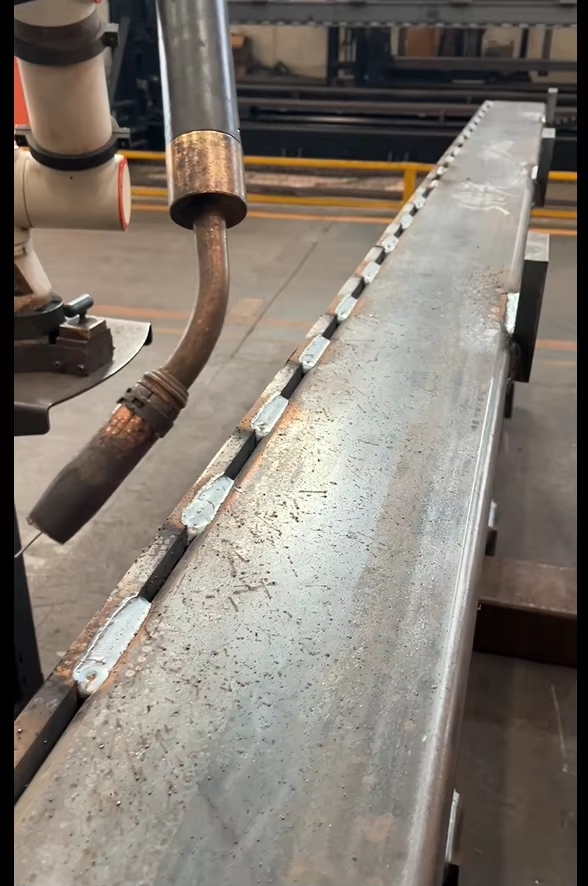
Technical Field Report: Implementation of 12kW 3D Structural Steel Processing in Edmonton’s Crane Manufacturing Sector
1.0 Introduction and Regional Context
This report evaluates the operational integration of a 12kW 3D Structural Steel Processing Center within the heavy industrial manufacturing landscape of Edmonton, Alberta. Given the region’s reliance on the oil and gas, mining, and heavy construction sectors, the demand for high-capacity overhead bridge cranes, gantry cranes, and jib cranes is significant. These structures require the processing of heavy-walled H-beams, I-beams, and C-channels, often utilizing high-tensile alloys such as ASTM A572 Grade 50.
Traditional fabrication methods—primarily manual layout, mechanical sawing, and plasma cutting—present limitations in terms of Heat-Affected Zone (HAZ) management and dimensional accuracy. The transition to a 12kW fiber laser source, coupled with 5-axis 3D kinematics and zero-waste nesting logic, represents a fundamental shift in structural steel throughput and geometric precision.
2.0 12kW Fiber Laser Source: Photonic Density and Material Interaction
The heart of the processing center is a 12kW solid-state fiber laser. In crane manufacturing, material thickness for end-trucks and bridge girder stiffeners often exceeds 20mm. At 12kW, the power density allows for high-speed fusion cutting with nitrogen or oxygen, depending on the required edge quality for subsequent welding.
The 12kW threshold is critical for achieving “one-pass” processing of heavy sections. Lower power sources (4kW–6kW) often struggle with the dross accumulation and slower feed rates on 25mm structural webs, leading to increased thermal deformation. The 12kW source provides the necessary photonic pressure to maintain a narrow kerf width, which is essential for the precision required in crane rail alignment and bolt-hole synchronization. Furthermore, the high brightness of the fiber source ensures that the beam quality (M²) remains stable even at the extended focal lengths required for 3D structural heads.
3.0 3D Kinematics and Multi-Axis Structural Processing
Unlike flat-bed laser systems, the 3D Structural Steel Processing Center utilizes a 6-axis robotic or gantry-based head capable of ±45-degree beveling. In crane fabrication, this is vital for weld preparation.
3.1 Beveling and Weld Preparation
Standard structural joints in crane girders require V, Y, or K-type bevels to ensure full penetration welds. The 3D head executes these bevels during the primary cutting phase, eliminating the need for secondary grinding or plasma gouging. This ensures that the bevel angle remains consistent across the entire length of a 12-meter H-beam, a feat nearly impossible with manual intervention.
3.2 Complex Geometry Execution
The system’s ability to process non-linear cutouts—such as lightening holes in bridge girders or complex notches for interlocking cross-members—is governed by the synchronization of the rotary chucks and the 3D cutting head. In Edmonton’s cold-weather applications, where brittle fracture is a concern, the smooth, laser-cut radius of a cutout significantly reduces stress concentration points compared to the jagged edges often produced by oxy-fuel or plasma.
4.0 Zero-Waste Nesting Technology: Algorithmic Efficiency
Material costs for heavy structural steel are a significant overhead in crane manufacturing. Traditional “tailings” (the unused portion of a beam held by the chuck) typically range from 300mm to 800mm. Zero-waste nesting technology utilizes a multi-chuck (triple or quadruple chuck) shifting system to minimize this remnant.
4.1 Multi-Chuck Synchronization
The zero-waste logic involves the mechanical hand-off of the workpiece between chucks during the cutting process. As the laser head approaches the final segment of the beam, the secondary and tertiary chucks reposition to provide support while allowing the head access to the absolute end of the material. This allows for “tail-less” cutting, where the final remnant is reduced to less than 50mm.
4.2 Common-Line Cutting on Profiles
The software architecture enables common-line cutting even on complex profiles like I-beams. By sharing a cut path between two parts, the system reduces the number of pierces and the total travel distance of the laser head. In a production run of 50 crane end-truck components, this nesting efficiency can result in a 12-15% reduction in raw material consumption.
5.0 Application in Crane Manufacturing: Precision and Alignment
The structural integrity of a crane depends on the perfect parallelism of its long-travel components. Any deviation in the bolt-hole patterns of the end-trucks relative to the bridge girder results in “crabbing,” which accelerates wheel wear and stresses the building’s runway beams.
5.1 Bolt-Hole Integrity
The 12kW laser maintains a diameter-to-thickness ratio that allows for the cutting of bolt holes with a tolerance of ±0.1mm. This precision allows for interference-fit bolts, which are common in high-capacity crane assemblies. The absence of the taper typically found in plasma-cut holes ensures that the load-bearing capacity of the bolted joint is maximized.
5.2 Torsional Rigidity and Fit-Up
By using the 3D laser to cut interlocking tabs and slots in the trolley frames, manufacturers can achieve “self-jigging” assemblies. This reduces the reliance on expensive assembly fixtures and ensures that the torsional rigidity of the crane component is established prior to the final welding phase.
6.0 Synergy Between Automation and 12kW Power
The efficiency of the 12kW source would be bottlenecked without integrated material handling. In the Edmonton facility, the processing center is coupled with an automatic loading system that utilizes hydraulic lifters and singulation conveyors to feed 12-meter sections into the machine.
6.1 Real-Time Sensing and Compensation
Structural steel is rarely perfectly straight. “Mill tolerance” often includes significant camber and sweep. The processing center employs laser displacement sensors to map the actual geometry of the beam in real-time. The 12kW cutting path is then dynamically adjusted to compensate for these deviations. This ensures that a cutout placed in the center of a web remains centered, regardless of the beam’s inherent twist.
6.2 Thermal Management
High-power laser cutting generates localized heat. However, the speed of the 12kW source—often exceeding 3 meters per minute on 10mm sections—minimizes the total heat input into the part. This low heat input is critical for crane components made from quenched and tempered steels, as it preserves the material’s mechanical properties and prevents the warping of long, slender members.
7.0 Quantitative Analysis of Throughput
A comparative analysis between traditional methods and the 12kW 3D system reveals the following:
- Layout and Marking: Reduced from 4 hours per girder to 0 minutes (integrated into the NC code).
- Cutting and Beveling: Reduced from 6 hours (manual plasma + grinding) to 45 minutes.
- Material Utilization: Increased from 82% to 96% through zero-waste nesting.
- Post-Processing: 90% reduction in secondary de-burring and edge preparation.
8.0 Conclusion
The implementation of a 12kW 3D Structural Steel Processing Center with zero-waste nesting represents the pinnacle of current fabrication technology for the crane manufacturing industry in Edmonton. The synergy between high-wattage fiber laser delivery and advanced 5-axis kinematics allows for a level of precision that meets the stringent safety and performance standards required for heavy-lift equipment. By minimizing material waste and eliminating secondary processing stages, manufacturers can achieve a significant reduction in lead times while simultaneously increasing the structural reliability of their products. This technology is not merely an incremental improvement but a necessary evolution for competing in the global heavy-industrial market.
End of Report
Author: Senior Engineering Consultant, Laser Systems & Structural Dynamics













