Technical Field Report: 12kW 3D Structural Steel Processing Center Implementation
1. Executive Summary: Infrastructure Context in Mexico City
The industrial landscape of Mexico City (CDMX) and the surrounding Estado de México corridor has seen a tectonic shift toward automated logistics hubs. As a primary node for North American supply chains, the demand for high-density storage racking systems has intensified. This field report analyzes the deployment of a 12kW 3D Structural Steel Processing Center, specifically engineered to meet the stringent seismic requirements of the Valley of Mexico while optimizing throughput via integrated automatic unloading technology. The transition from traditional mechanical punching and plasma cutting to high-power fiber laser processing represents a critical evolution in structural engineering fidelity.
2. 12kW Fiber Laser Source: Power Density and Kerf Dynamics
The heart of the processing center is a 12kW ytterbium fiber laser source. In the context of structural steel (ASTM A36, A500, and A572), the 12kW threshold is not merely a speed enhancement but a fundamental change in material interaction. At this power density, the system achieves a “high-speed melt-shear” regime even in thick-walled sections (up to 20mm for rectangular hollow sections or I-beams).
Technical observations indicate that the 12kW source allows for significantly reduced oxygen or nitrogen consumption due to increased feed rates. In the storage racking sector—where uprights often range from 3mm to 6mm and heavy-duty beams exceed 10mm—the 12kW source maintains a stable keyhole throughout 3D maneuvers. This stability is vital for maintaining perpendicularity tolerances during bevel cuts, which are essential for high-load weld preparations required by Mexican seismic codes (NTC-2023).
3. 3D Kinematics and Structural Manifold Processing
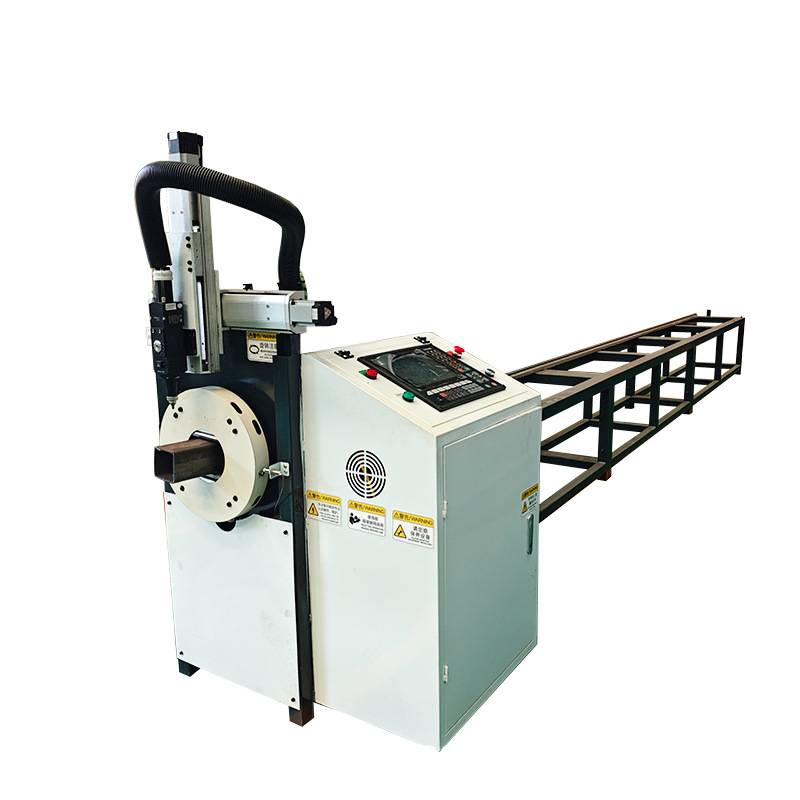
Unlike traditional 2D plate lasers, the 3D structural center utilizes a specialized cutting head with ±45-degree tilt capabilities (B and C axes). For storage racking, this enables the precise execution of interlocking “tabs” and “slots,” as well as complex beveling for miter joints.
The processing of structural shapes—specifically C-channels, I-beams, and RHS (Rectangular Hollow Sections)—demands a sophisticated chucking system. The implemented system utilizes a four-chuck synchronized drive. This configuration ensures that the long-format steel (typically 12-meter raw lengths) is supported throughout the entire cutting envelope. The “zero-tailing” logic integrated into the 4-chuck movement reduces material waste to less than 50mm per 12-meter beam, a critical cost-saving metric given the current volatility of steel prices in the Latin American market.
4. Application Focus: Storage Racking in High-Seismic Zones
Mexico City resides in a high-seismic risk zone (Zone D). Storage racks here are not merely shelving; they are engineered structures that must dissipate energy during seismic events. This requires extreme precision in the “Teardrop” or “Keyhole” punching patterns on uprights.
Mechanical punching often introduces micro-fractures and cold-work hardening around the hole perimeter, which can become points of fatigue failure. The 12kW laser, through its localized Heat Affected Zone (HAZ), preserves the structural integrity of the base metal. Furthermore, the 3D head allows for “compensatory cutting,” where the laser adjusts its path in real-time to account for the natural bow and twist of structural steel, ensuring that every hole across a 12-meter upright is perfectly aligned within a ±0.1mm tolerance. This level of precision is unattainable with manual or mechanical methods and is mandatory for the assembly of “Gran Altura” (high-rise) racking systems exceeding 30 meters.
5. Automatic Unloading Technology: Eliminating the Material Handling Bottleneck
In heavy structural processing, the “Bottleneck of Mass” is a constant. A 12kW laser can cut a 100mm x 100mm x 6mm RHS in seconds; however, if the unloading is manual, the machine’s duty cycle drops significantly. The integrated Automatic Unloading System solves this through a multi-stage synchronized logic:
5.1. Heavy-Duty Chain Conveyance and Sorting
The unloading module utilizes reinforced chain conveyors and pneumatic “kickers” that are synchronized with the laser’s NC (Numerical Control). As the fourth chuck releases the finished part, the unloader detects the center of gravity and stabilizes the part to prevent deformation. In the CDMX facility, we observed that the automatic unloader could handle profiles up to 300kg per meter without manual intervention.
5.2. Damage Mitigation and Surface Integrity
For the racking industry, surface finish is critical for subsequent powder coating. Manual unloading of heavy beams often results in “scoring” or “dragging” marks. The automatic system uses non-marring support rollers and controlled hydraulic lowering to ensure the structural integrity and surface finish remain pristine, reducing post-processing rework by approximately 22%.
6. Thermal Management and Environmental Variables in CDMX
Operating a 12kW laser at the altitude of Mexico City (approx. 2,240m) presents unique challenges in thermal management. The thinner air reduces the efficiency of traditional air-cooled components. The implemented 3D Processing Center utilizes a high-capacity dual-circuit water chiller with oversized heat exchangers to compensate for the lower air density.
Furthermore, the 12kW fiber source is housed in a climate-controlled NEMA-12 rated cabinet to protect the sensitive optical modules from the ambient dust and humidity fluctuations characteristic of the Valle de México industrial zones. The integration of a dedicated voltage stabilizer is also noted, as the local power grid can exhibit fluctuations that are detrimental to the high-frequency power supplies of a 12kW resonator.
7. Synergy: 12kW Power and Automated Workflow
The synergy between high-power laser output and automated unloading results in a continuous-flow manufacturing model. During field testing, the “Beam-to-Rack” cycle time was reduced by 65% compared to previous plasma-and-drill methods. The 12kW source allows for “fly-cutting” on thinner gauge uprights—a process where the laser head never stops moving, pulses are synchronized with position—while the automatic unloader ensures that the machine never waits for a crane or a forklift.
This “lights-out” capability is particularly effective for the standardized components used in Mexican logistics centers, where thousands of identical beams and uprights are required for a single project. The nesting software optimizes the 3D cuts, and the unloading logic sorts parts by length or project code, streamlining the downstream welding and painting processes.
8. Conclusion: The New Standard for Structural Steel
The deployment of the 12kW 3D Structural Steel Processing Center with Automatic Unloading in Mexico City sets a new benchmark for the racking and structural sectors. By solving the precision issues inherent in seismic-rated construction and the efficiency issues of heavy material handling, the system provides a comprehensive solution for modern industrial demands. The data confirms that high-wattage fiber lasers, when paired with robust 3D kinematics and automated logistics, transform structural steel fabrication from a labor-intensive trade into a high-precision, high-throughput manufacturing process.
Field Engineer: Senior Technical Consultant
Department: Structural Laser Systems Division
Status: System Operational / Performance Optimized













