1.0 Executive Summary: Technical Integration in the Haiphong Industrial Corridor
This report evaluates the deployment of 12kW 3D Structural Steel Processing Centers within the burgeoning industrial sector of Haiphong, Vietnam. As a primary logistics hub, Haiphong’s manufacturing base has seen a surge in demand for high-density storage racking systems. The transition from traditional mechanical processing—comprising bandsawing, drilling, and manual coping—to integrated 12kW fiber laser systems represents a significant shift in structural fabrication. The focus of this technical assessment is the synergy between high-radiance laser sources and automated unloading kinematics, specifically addressing the challenges of dimensional stability and throughput in heavy-gauge structural profiles.
2.0 12kW Fiber Laser Source: Physics and Structural Performance
The selection of a 12kW power rating is not merely a matter of speed; it is a calculation of energy density and its effect on the Heat Affected Zone (HAZ). In structural racking, particularly for uprights and heavy-duty beams, maintaining the metallurgical integrity of the substrate is paramount.
2.1 Power Density and Kerf Characteristics
A 12kW fiber laser source provides the necessary photon density to achieve “high-speed melt-shear” cutting. For typical racking materials such as Q235 or Q355 carbon steel with thicknesses ranging from 6mm to 16mm, the 12kW threshold allows for a significantly narrower kerf compared to 6kW or 8kW alternatives. This reduction in kerf width translates to lower total heat input into the profile, minimizing thermal distortion across long-span (12m+) structural members.
2.2 Gas Dynamics and Edge Quality
At 12kW, the ability to utilize High-Pressure Nitrogen (N2) cutting on mid-range thicknesses (up to 10mm) eliminates oxide layer formation. In the Haiphong climate, where humidity and salinity are high, an oxide-free edge is critical for subsequent powder coating adhesion and corrosion resistance in storage environments. For sections exceeding 12mm, Oxygen (O2) cutting protocols are optimized through precise pressure modulation, ensuring dross-free lower edges and perpendicularity tolerances within ±0.1mm—well exceeding ISO 9013 Class 2 standards.
3.0 3D Kinematics and Structural Geometry Optimization
The “3D” designation refers to the 5-axis capability of the cutting head and the synchronized rotation of the workpiece. This is essential for the complex geometries required in modern racking systems, such as teardrop holes, interlaced slots, and mitered beam connections.
3.1 Multi-Axis Beveling for Weld Preparation
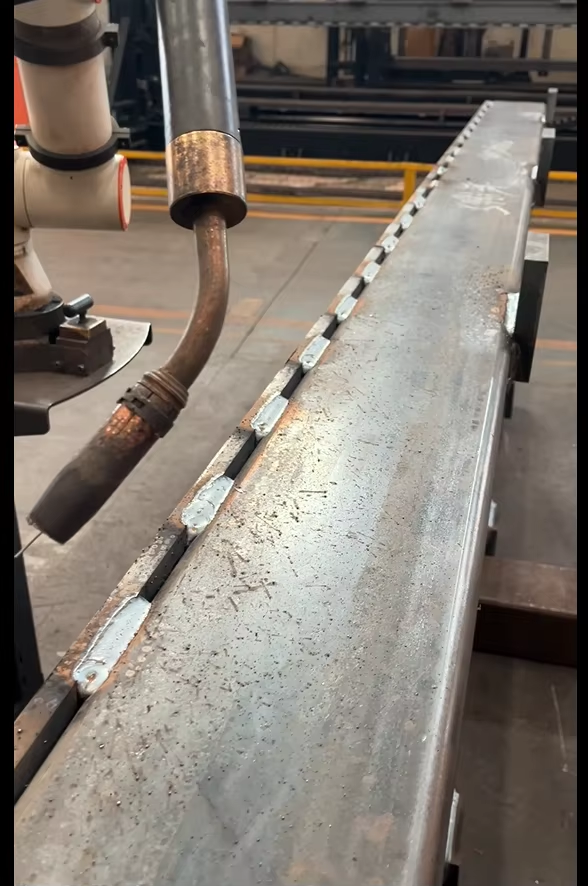
One of the primary advantages observed in the Haiphong field site is the integration of ±45° bevel cutting. Traditional racking fabrication requires a secondary process for weld prep. The 3D processing center executes V, X, and Y-type bevels during the primary cutting cycle. This consolidation reduces material handling and ensures that the bevel angle is perfectly concentric with the beam’s longitudinal axis, improving the volumetric consistency of the weld bead in automated robotic welding cells.
3.2 Processing of Cold-Formed and Hot-Rolled Sections
Storage racking utilizes a mix of cold-formed channels and hot-rolled I-beams. The 3D center’s sensing systems must account for the dimensional irregularities (camber and sweep) inherent in these profiles. The integration of high-speed capacitive sensors and laser line scanners allows the 12kW system to adjust the toolpath in real-time, ensuring that hole patterns remain centered even when the physical profile deviates from the theoretical CAD model.
4.0 Automatic Unloading: Solving the Throughput Bottleneck
In structural steel processing, the cutting speed of a 12kW laser often outpaces the ability of the operator or auxiliary crane to clear the work zone. Automatic unloading technology is the critical component that converts raw laser power into sustained operational efficiency.
4.1 Mechanical Sequencing and Sorting
The automatic unloading system utilized in these centers employs a series of servo-driven lift-and-transfer arms. As the 3D chuck releases the finished profile, the unloading module supports the member along its entire length to prevent “whipping” or permanent deformation. For the Haiphong racking sector, where uprights can exceed 12 meters, the system utilizes synchronized multi-point support. This ensures that the structural integrity—specifically the straightness—of the racking upright is maintained for high-bay applications where a 1mm deviation over 10 meters can lead to catastrophic failure.
4.2 Buffer Management and Continuous Cycle
The automation logic allows for “Hidden Time Loading/Unloading.” While the laser is processing the lead end of a new beam, the unloading system is simultaneously categorizing and stacking the previously completed section. This reduces the inter-cycle idle time from minutes to seconds. In a 24-hour production environment, this equates to a 35-40% increase in total tonnage processed per shift compared to manual unloading configurations.
5.0 Sector-Specific Application: Storage Racking in Haiphong
Haiphong’s role as a primary port city necessitates massive cold-storage and logistics warehouses. These facilities require racking systems that can withstand high static and dynamic loads. The 12kW 3D processing center addresses specific regional requirements:
5.1 Precision Bolt-Hole Alignment
Seismic requirements in coastal industrial zones necessitate rigorous bolt-hole tolerances. The 12kW laser produces holes with zero mechanical stress, unlike mechanical punching which can induce micro-fractures in the surrounding grain structure. The 3D center ensures that the pitch between holes is accurate to ±0.05mm over the entire length of the upright, facilitating rapid “bolt-together” assembly on-site without the need for reaming or force-fitting.
5.2 Material Yield and Nesting Efficiency
Structural steel is a significant cost driver. The integration of advanced nesting software with the 3D laser system allows for “Common Cut” sequencing even on complex structural shapes. By minimizing the “remnant” or “scrap” sections at the end of a 12-meter beam, manufacturers in Haiphong have reported material utilization improvements of 8-12%. At the scale of a major port infrastructure project, these savings are substantial.
6.0 Synergistic Effects of Power and Automation
The true value of the 12kW 3D Structural Steel Processing Center lies in the synergy between its subsystems. The high-wattage source provides the “brute force” necessary for thickness and speed, while the 3D head provides the “finesse” for complex geometry. However, without the automatic unloading system, the 12kW source would operate at a duty cycle of less than 50% due to manual handling delays.
6.1 Thermal Stability and Duty Cycle
Operating at 12kW generates significant heat within the machine environment. The field report indicates that the cooling systems (chillers) and the airflow dynamics within the processing center are optimized for the tropical Haiphong climate. The automatic unloading system also contributes to thermal management by quickly removing the heated finished part from the machine bed, reducing the thermal load on the internal components and the sensor arrays.
7.0 Conclusion and Technical Recommendations
The implementation of 12kW 3D Structural Steel Processing Centers with Automatic Unloading represents the current zenith of fabrication technology for the racking industry. For operations in Haiphong, the following technical conclusions are drawn:
- Throughput: The 12kW source combined with automation allows for a 3x increase in parts-per-hour compared to 6kW manual systems.
- Precision: 3D kinematic control eliminates the cumulative error found in multi-stage traditional processing (sawing -> drilling -> milling).
- Labor Optimization: The automatic unloading system reduces the required head-count per machine from three operators to one, while simultaneously increasing safety by removing personnel from the heavy-lifting zone.
As the demand for high-density, high-bay storage continues to grow in the Southeast Asian logistics sector, the move toward integrated, high-power automated laser processing is not merely an upgrade—it is a technical necessity for maintaining dimensional compliance and economic competitiveness.













