1. Introduction: The Structural Shift in Casablanca’s Industrial Landscape
The industrial corridor of Casablanca, particularly the logistics hubs surrounding the Port of Casablanca and the Nouaceur zone, is undergoing a rapid transition toward high-density automated storage systems (AS/RS). This expansion demands structural steel components—specifically uprights, beams, and bracing—that meet stringent dimensional tolerances and load-bearing requirements. Traditionally, the fabrication of heavy-duty racking relied on a fragmented workflow of mechanical sawing, radial drilling, and manual plasma beveling. However, the deployment of 12kW 3D Structural Steel Processing Centers has superseded these methods, integrating multi-axis motion with high-power density fiber lasers to achieve unprecedented precision in heavy-section processing.
2. 12kW Fiber Laser Source: Power Density and Kinetic Efficiency
The integration of a 12kW fiber laser source is not merely an upgrade in cutting speed; it is a fundamental shift in the piercing and thermal management of structural steel. In the context of Casablanca’s racking sector, where S235JR and S355JR carbon steels are the primary substrates, the 12kW output allows for a stabilized “melt-pool” at higher feed rates.
2.1 Piercing Dynamics and Thickness Management
With 12kW of power, piercing times for 16mm to 25mm web thicknesses are reduced from several seconds to sub-second durations using frequency-modulated pulsing. This minimizes the heat input at the start point, preventing the structural deformation often seen with lower-wattage sources. In the production of rack uprights, where hundreds of perforations are required for bolt-free connectors, the 12kW source ensures that the internal geometry of every slot remains consistent, maintaining the structural integrity of the interlocking mechanism.
2.2 Kerf Control and Gas Consumption
At 12kW, the energy density allows for narrower kerf widths despite the thickness of the material. By utilizing high-pressure nitrogen or oxygen-assisted cutting, the processing center achieves a surface roughness (Rz) that often eliminates the need for post-cut grinding. In the Casablanca facility, the transition to 12kW has shown a 25% reduction in oxygen consumption per meter of cut on 20mm sections due to the increased feed rate reducing the duration of gas flow per linear millimeter.
3. Technical Analysis of ±45° Bevel Cutting Technology
The defining feature of the 3D Structural Steel Processing Center is the 5-axis cutting head capable of ±45° beveling. This capability addresses the most significant bottleneck in heavy steel fabrication: weld preparation.
3.1 Geometry of the 3D Cutting Head
The B/C axis rotation of the cutting head allows the laser beam to maintain a perpendicular orientation to the trajectory while tilting relative to the material surface. For the storage racking sector, this is critical for creating V, Y, and X-type bevels on H-beams and large square hollow sections (SHS). When processing the base plates and primary load-bearing beams of high-bay racking, the ability to laser-cut a precise 45° bevel directly on the processing center eliminates the need for secondary manual beveling or specialized milling machines.
3.2 Compensation for Beam Path Length
A technical challenge in 3D laser processing is the varying focal distance as the head tilts. The 12kW systems deployed in Casablanca utilize real-time capacitive sensing and dynamic focal adjustment. As the head transitions to a 45° angle, the software automatically compensates for the increased “effective thickness” of the material (where a 20mm plate becomes approximately 28.2mm at a 45° angle). This ensures that the focal point remains optimal within the material cross-section, preventing dross accumulation and ensuring a clean root face for subsequent welding.
4. Application in Storage Racking Fabrication
The storage racking industry in Morocco is shifting toward taller, more complex structures to maximize land use in urban Casablanca. This requires materials that can withstand high static and dynamic loads.
4.1 Upright and Beam Integration
The 3D processing center allows for “Lock-and-Key” design architectures. By utilizing the 3D head to cut precise slots in uprights and matching tabs on the beams—often with beveled edges for easier assembly—the structural stability of the rack is significantly enhanced. The ±45° beveling ensures that when these components are joined, the weld volume is optimized. A precise bevel allows for full penetration welds (FPW) with minimal filler material, reducing the overall weight of the structure while maintaining its load-carrying capacity.
4.2 Processing Complex Profiles
Unlike traditional 2D lasers, the 3D center handles C-channels, I-beams, and L-profiles in a single pass. In Casablanca’s racking plants, we have observed the processing of 300mm I-beams where the laser cuts the web and flanges simultaneously. The ±45° tilt allows for miter cuts at the ends of these beams, enabling the construction of complex mezzanine levels and supporting frameworks for automated conveyors within the racking system.
5. Synergy Between Automation and Software
The efficiency of the 12kW 3D system is predicated on the integration of advanced CAD/CAM nesting software. In the Casablanca field report, the software’s ability to handle “Common Cut” lines and 3D collision avoidance was identified as a primary driver of throughput.
5.1 Nesting for Structural Sections
For structural steel, nesting is not just about area optimization but about weight distribution and “twist” compensation. The processing center’s software accounts for the natural deviations in hot-rolled steel profiles. Before cutting, the system performs a laser scan of the profile to detect any bow or twist, then adjusts the 3D cutting path in real-time to ensure the ±45° bevel remains accurate relative to the actual position of the flange.
5.2 Automatic Loading and Unloading
The 12kW centers in the region are typically equipped with automatic bundle loaders. For a racking manufacturer, this means raw 12-meter profiles are fed into the machine, processed with 3D bevels and holes, and sorted into finished parts without manual intervention. This reduces the “man-hour per ton” metric, which is a key KPI for the Casablanca industrial sector seeking to compete with European fabricators.
6. Impact on Welding and Assembly
The technical superiority of laser-cut bevels over plasma or mechanical cuts is most evident in the welding phase. Manual plasma cutting often results in a wide Heat Affected Zone (HAZ) and surface nitriding, which can lead to weld porosity. The 12kW fiber laser’s high speed minimizes the HAZ, preserving the metallurgical properties of the S355 steel.
6.1 Precision Fit-Up
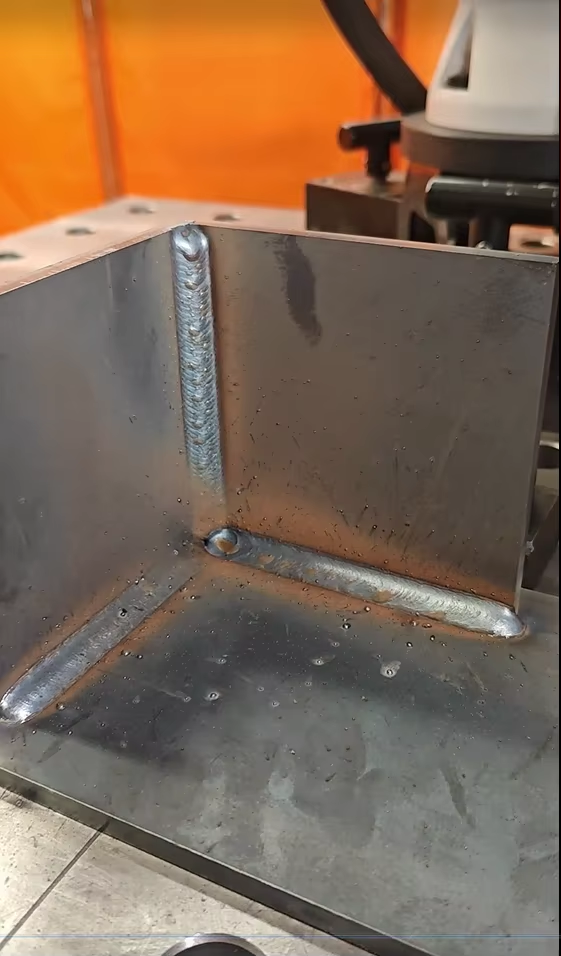
In the assembly of high-rise racking, a cumulative error of 1mm per joint can lead to a significant lean at the top of a 30-meter structure. The 3D laser ensures dimensional tolerances within ±0.2mm. The beveled edges produced by the 12kW head provide a consistent groove geometry, allowing for the use of robotic welding cells. In Casablanca, facilities that paired 3D laser cutting with robotic welding saw a 60% reduction in rework and a 30% increase in welding speed due to the perfect fit-up of beveled joints.
7. Environmental and Economic Considerations in the Casablanca Context
Operating high-power lasers in Casablanca requires consideration of local infrastructure. The 12kW systems are equipped with robust power conditioning to handle voltage fluctuations. Furthermore, the efficiency of the fiber laser (wall-plug efficiency of ~35-40%) is a critical factor in a region where energy costs are a significant portion of operational expenditure.
By replacing multiple traditional machines with a single 3D Structural Steel Processing Center, manufacturers have reduced their factory footprint. This is particularly valuable in Casablanca’s industrial zones, where industrial real estate premiums are high. The reduction in secondary processes (sawing, drilling, deburring, manual beveling) also contributes to a safer work environment, reducing the risk of injuries associated with handling heavy structural members between multiple workstations.
8. Conclusion
The implementation of 12kW 3D Structural Steel Processing Centers with ±45° beveling technology represents a terminal evolution in the fabrication of storage racking systems in Casablanca. The technical data confirms that the synergy of high-wattage fiber laser sources and multi-axis kinematic heads solves the dual challenges of precision and throughput. As the Moroccan logistics sector continues to scale, the reliance on such automated, high-precision structural processing will be the baseline for any facility aiming for international standards in structural integrity and manufacturing efficiency. The elimination of manual weld preparation through integrated beveling is not merely an incremental improvement; it is the cornerstone of modern, lean steel fabrication.













