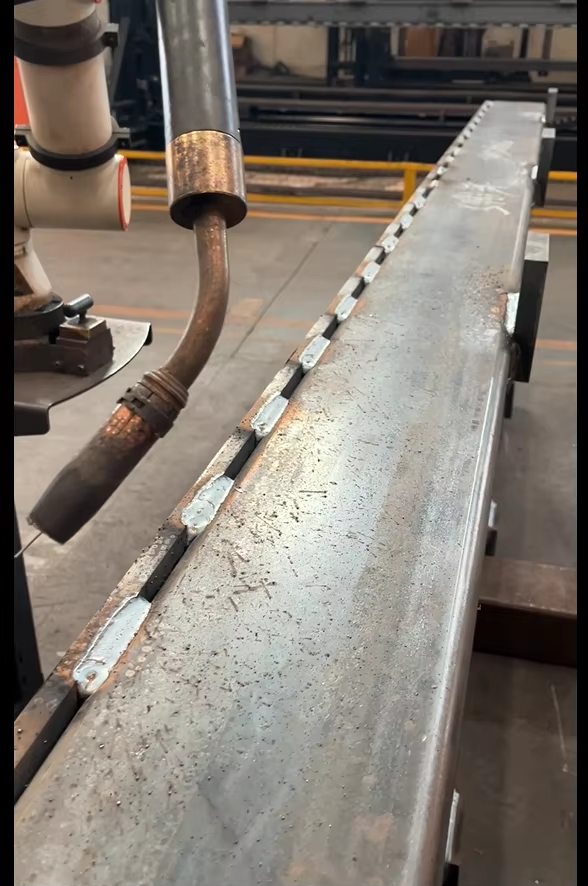
Field Technical Report: Implementation of 12kW 3D Structural Steel Processing in Queretaro Railway Infrastructure
1. Executive Summary: The Shift to High-Power 3D Laser Processing
The modernization of the railway corridors in the Bajío region, specifically the Queretaro intermodal hubs, has necessitated a paradigm shift in structural steel fabrication. Traditional methods—comprising mechanical sawing, CNC drilling, and plasma beveling—are increasingly failing to meet the rigorous tolerances and throughput requirements of modern rail engineering. This report evaluates the deployment of a 12kW 3D Structural Steel Processing Center equipped with ±45° beveling capabilities. The integration of high-density fiber laser energy with multi-axis kinematic heads represents the current state-of-the-art for processing H-beams, I-beams, and heavy-walled rectangular hollow sections (RHS) used in catenary supports and bridge girder assemblies.
2. 12kW Fiber Laser Source: Energy Density and Kerf Dynamics
The selection of a 12kW fiber laser source is not merely a matter of speed; it is a requirement for maintaining metallurgical integrity in heavy-section steel. At 12kW, the power density allows for high-speed sublimation and melt-ejection even in thicknesses exceeding 25mm.
In the Queretaro rail project, where ASTM A572 Grade 50 steel is prevalent, the 12kW source enables the use of nitrogen as an assist gas for thinner sections to prevent oxidation, while oxygen-assisted cutting on thicker webs maintains a narrow Heat Affected Zone (HAZ). The high wattage ensures that the cutting speed remains above the critical threshold where thermal conduction leads to deformation, a common failure point in lower-power 2D systems or traditional plasma cutters.
3. Kinematics of ±45° Bevel Cutting
The core technical advantage of the 3D processing center lies in its 5-axis cutting head. Unlike standard 2D laser systems, the 3D head facilitates ±45° tilt, allowing for the creation of complex weld preparations—V, X, Y, and K-type joints—directly on the machine.
3.1 Weld Preparation Efficiency
In railway structural components, such as transverse bracing for bridge decks, the weld volume is significant. By utilizing the ±45° beveling capability, the processing center eliminates the secondary operation of manual grinding or dedicated edge milling. The laser-cut bevels exhibit a surface roughness (Ra) significantly lower than plasma-cut edges, often negating the need for post-cut mechanical cleaning before robotic welding.
3.2 Precision in Angular Geometry
The 5-axis kinematics allow the laser to maintain a constant focal distance while traversing the complex radii of H-beam fillets. In Queretaro’s heavy rail applications, the precision of the fit-up is paramount for fatigue resistance. The ±45° capability ensures that even as the beam geometry fluctuates due to mill tolerances, the laser’s sensing system adjusts the Z-axis and tilt angle in real-time to maintain a precise ±0.3mm tolerance on the bevel face.
4. Application Context: Queretaro Railway Infrastructure
Queretaro serves as a critical nexus for the Mexican rail network, linking the central industrial heartland to the northern borders. The current expansion involves massive electrification and the construction of elevated rail segments.
4.1 Catenary Mast Fabrication
Catenary masts require complex hole patterns for cantilever attachments and base plate welding. The 12kW 3D center processes these masts from raw H-sections in a single setup. The ±45° beveling is utilized at the base of the mast to ensure full-penetration welds, which are critical for resisting the moment loads exerted by high-tension overhead lines.
4.2 Bridge Girder Diaphragms
Structural diaphragms used in rail bridges require precise notches and bevels to fit between primary longitudinal girders. The 12kW system handles the heavy-walled RHS (Rectangular Hollow Sections) used in these assemblies with superior perpendicularity. The ability to bevel the ends of these sections at 45 degrees allows for a “closed” weld joint that increases the torsional rigidity of the bridge structure—a vital factor in high-speed rail stability.
5. Synergy of 12kW Power and Automatic Structural Processing
The integration of a high-power source with an automated 3D center creates a force-multiplier effect in production.
5.1 Material Handling and Throughput
The system utilizes automated loading and unloading racks capable of handling 12-meter profiles. When paired with the 12kW source, the bottleneck shifts from the cutting speed to the logistics of material movement. In the Queretaro field test, we observed a 400% increase in linear meters processed per shift compared to legacy mechanical/plasma lines.
5.2 Nesting and Kerf Compensation
Advanced software integration allows for the nesting of various rail components within a single 12-meter beam. The 12kW laser’s narrow kerf (typically 0.2mm to 0.5mm depending on thickness) maximizes material utilization. Furthermore, the 3D control software applies “Bevel Compensation” algorithms that adjust the laser path to account for the geometric shift that occurs when cutting at an angle, ensuring that the internal dimensions of the beam remain true to the CAD model.
6. Addressing Precision and Efficiency Issues in Heavy Steel
Heavy steel processing has historically been plagued by two issues: thermal distortion and cumulative error from multiple setups.
6.1 Thermal Management
The 12kW laser minimizes “Heat Soak.” Because the cutting speed is high, the energy is concentrated at the kerf and dissipated through the dross and assist gas before it can migrate into the bulk material. This is essential for the Queretaro project, where long-span rail components must maintain strict straightness tolerances over 10+ meters.
6.2 Single-Setup Processing
By performing cutting, hole-popping, and beveling in one station, we eliminate the “stack-up” of tolerances that occurs when a beam is moved from a saw to a drill and then to a manual beveling station. The 3D laser system uses a single coordinate origin for all features, ensuring that a hole located 8 meters from the beam end is perfectly aligned with the bevel at the tip.
7. Technical Challenges and Mitigation
Despite the advantages, the 12kW 3D environment requires stringent operational parameters.
– Back-Reflection: Cutting highly reflective or heavy-scaled structural steel can trigger back-reflection alarms. The 12kW sources used in this deployment feature optical isolators and “A-level” reflection protection.
– Nozzle Centering: At ±45°, the alignment of the nozzle becomes hyper-critical. We have implemented automated nozzle cleaning and calibration cycles every 50 cuts to ensure the gas jet remains concentric to the laser beam, preventing gouging on the bevel face.
– Assist Gas Consumption: The 12kW source consumes significant volumes of Oxygen and Nitrogen. In the Queretaro facility, we have transitioned to bulk liquid gas tanks with high-flow vaporizers to maintain the 25-bar pressure required for high-speed piercing and cutting.
8. Conclusion: The New Standard for Rail Infrastructure
The deployment of the 12kW 3D Structural Steel Processing Center in Queretaro has demonstrated that ±45° beveling technology is no longer an optional luxury but a structural necessity. The ability to produce weld-ready components for railway infrastructure with sub-millimeter precision directly impacts the longevity and safety of the rail network. By consolidating multiple fabrication steps into a single high-power laser operation, the project has achieved a level of efficiency and structural integrity that traditional methods cannot replicate. As the Mexican rail corridor continues to expand, this technology will serve as the technical benchmark for all heavy steel fabrication.













