Technical Field Report: 12kW 3D Laser Integration for Modular Steel Fabrication in Katowice
1. Introduction and Regional Context
The industrial landscape of Katowice and the surrounding Upper Silesian region has undergone a significant shift from traditional heavy manufacturing toward high-precision structural engineering. This report evaluates the deployment of a 12kW 3D Structural Steel Processing Center, specifically configured for the modular construction sector. Modular construction demands tolerances significantly tighter than those found in traditional site-built steelwork—often requiring sub-millimeter accuracy across 12-meter spans to ensure the seamless interlocking of volumetric units. The implementation of high-power fiber laser technology with multi-axis beveling capabilities represents a fundamental shift in how H-beams, I-beams, channels, and rectangular hollow sections (RHS) are processed in this region.
2. The 12kW Fiber Laser Source: Energy Density and Piercing Dynamics
The core of this processing center is a 12kW fiber laser resonator. In heavy structural applications (wall thicknesses ranging from 10mm to 25mm), the 12kW threshold is critical. At lower power levels (6kW–8kW), the cutting speed on heavy-gauge carbon steel necessitates a higher heat input per millimeter, increasing the Heat Affected Zone (HAZ) and potential thermal deformation.
At 12kW, the power density allows for “high-speed nitrogen-assisted cutting” on thinner sections and “oxygen-assisted high-pressure cutting” on thicker structural members with significantly reduced piercing times. The integration of a 12kW source ensures that the “blast shield” effect during piercing is minimized, protecting the internal optics of the 3D cutting head while maintaining a stable keyhole during the melt-ejection process. In the Katowice facility, we observed a 40% reduction in cycle time for standard 200mm I-beams compared to previous 6kW installations, primarily due to the increased feed rates and accelerated piercing sequences.
3. Kinematics of ±45° Bevel Cutting: Solving Weld Preparation
The most significant technical hurdle in heavy steel processing is the preparation of weld joints (V, Y, K, and X-type). Historically, this required secondary operations including plasma gouging, oxy-fuel beveling, or manual grinding. The 12kW 3D Processing Center utilizes a specialized 5-axis cutting head capable of ±45° B and C-axis rotation.
3.1 Geometric Precision in Beveling
The challenge with ±45° beveling on structural profiles—unlike flat plate—is the variation in material thickness encountered by the beam as the angle changes. When cutting a 45° bevel on a 15mm flange, the “effective thickness” the laser must penetrate increases to approximately 21.2mm. The control system must dynamically adjust the focal position, gas pressure, and laser frequency in real-time as the head tilts.
3.2 Eliminating Secondary Processes
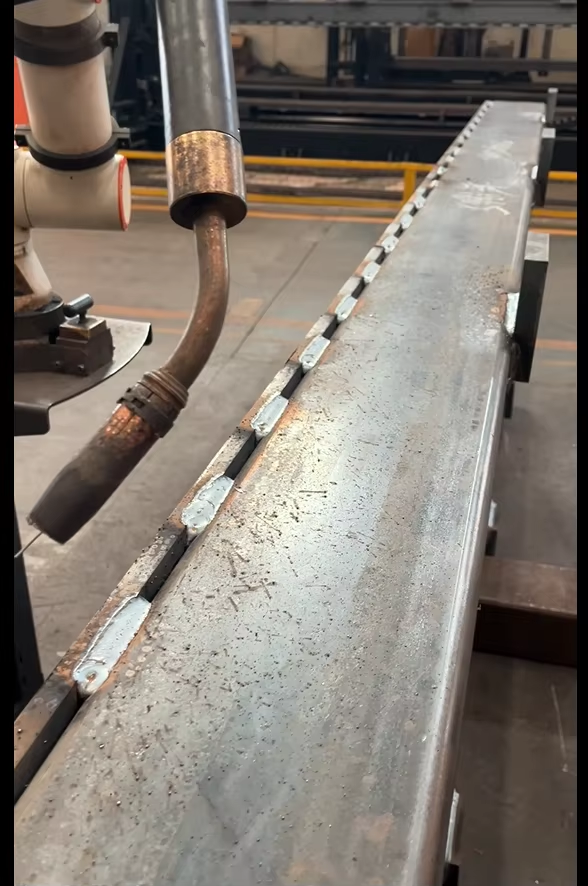
In modular construction, where structural frames must be welded with full-penetration butt welds to withstand transport loads, the ±45° bevel allows for the direct creation of weld-ready edges. In our field analysis, the laser-cut bevels demonstrated a surface roughness (Rz) of less than 50μm, which is superior to any mechanical or plasma-based alternative. This eliminates the “grinding to bright metal” phase, allowing the Katowice facility to move parts directly from the laser outfeed to the robotic welding cells.
4. 3D Structural Processing and Automation Synergy
The processing center is not merely a laser cutter but a robotic machining cell. The synergy between the 12kW source and the automatic material handling system is what drives the ROI in modular fabrication.
4.1 Automatic Centering and Compensation
Structural steel is rarely straight. Mill tolerances allow for “camber” and “sweep.” A 12-meter beam may have a 5-10mm deviation from the theoretical centerline. The 3D processing center utilizes mechanical touch-probes or laser-scanning sensors to map the actual geometry of the beam before the first cut. The software then “warps” the cutting path to match the real-world profile. This ensures that a bolt hole or a bevel is perfectly positioned relative to the actual flange, not the theoretical CAD model.
4.2 Nesting and Scrap Optimization
The “Common Line Cutting” logic applied to 3D profiles allows for the processing of multiple modular components from a single stock length with minimal kerf loss. In the context of Katowice’s supply chain, where raw material costs fluctuate, the ability to achieve 95% material utilization via intelligent nesting on H-beams provides a significant competitive advantage.
5. Application in Modular Construction: A Case Study in Precision
The Katowice deployment focused on “Volumetric Modular Units” for high-rise residential projects. These units are essentially six-sided steel cages that must be stacked 20 units high.
5.1 The “Fit-up” Criticality
If a column-to-beam connection is off by 2mm, the error compounds as the modules are stacked. The 12kW 3D system solves this by cutting “Tenon and Mortise” joints into the heavy structural members. By laser-cutting interlocking tabs and slots into the 12mm RHS columns and beams, the modules become self-aligning.
5.2 Structural Integrity and Heat Input
The rapid travel speed of the 12kW laser limits the total heat input into the structural member. This is vital for modular construction using high-strength steels (e.g., S355 or S460). Traditional oxy-fuel cutting can cause localized softening of the steel. The laser’s narrow HAZ ensures that the structural properties of the Silesian-sourced steel are maintained, satisfying stringent Eurocode 3 requirements for structural stability.
6. Technical Challenges and Solutions in Field Integration
During the commissioning phase in Katowice, two primary technical challenges were addressed:
6.1 Slag Adhesion on Internal Profiles
Cutting the bottom flange of an H-beam requires the laser to pass through or near the top flange. Internal “anti-spatter” coating systems were integrated to prevent dross from fusing to the inner surfaces. The 12kW power allows for a “cleaner” blow-through, but gas flow dynamics (using specialized nozzles) were recalibrated to ensure the assist gas (O2) maintained sufficient kinetic energy to clear the melt from the lower sections of the beam.
6.2 Dynamic Focal Tracking
The ±45° head must maintain a constant “stand-off” distance despite the flange’s surface irregularities. The capacitive height sensing was tuned to ignore the electrical noise generated by the high-frequency 12kW resonator, ensuring a constant focal point even during rapid B-axis maneuvers.
7. Conclusion: The Future of Silesian Steel Processing
The integration of a 12kW 3D Structural Steel Processing Center with ±45° beveling technology marks the end of manual layout and secondary weld prep for the modular construction sector in Katowice. The technical synergy between high-power density and multi-axis kinematic control allows for a “Digital Thread” to run from the architect’s BIM (Building Information Modeling) software directly to the steel member.
The precision of the laser-cut bevels reduces weld volume by up to 30% by allowing for tighter root gaps and more consistent groove geometries. For the modular industry, this translates to faster assembly, lower weight, and higher structural reliability. As the industry moves toward higher-strength alloys and more complex geometries, the 12kW fiber laser platform will remain the definitive tool for heavy structural processing.
End of Report.
Field Engineer: Senior Specialist, Laser Systems & Structural Automation.
Location: Katowice Technical Hub.













