Round Tube Laser Cutting: Intersections That Fit, Holes That Stay Round, and Pipe Sizes by Machine
By Jack Lee, Technical Manager, PCL Group · Updated 2026-10-29
Short answer
- On thick-wall tube a saddle cut square to the surface leaves a gap at the sides of the joint; set the contact line (outside, inside or mid-wall) or use a bevel head.
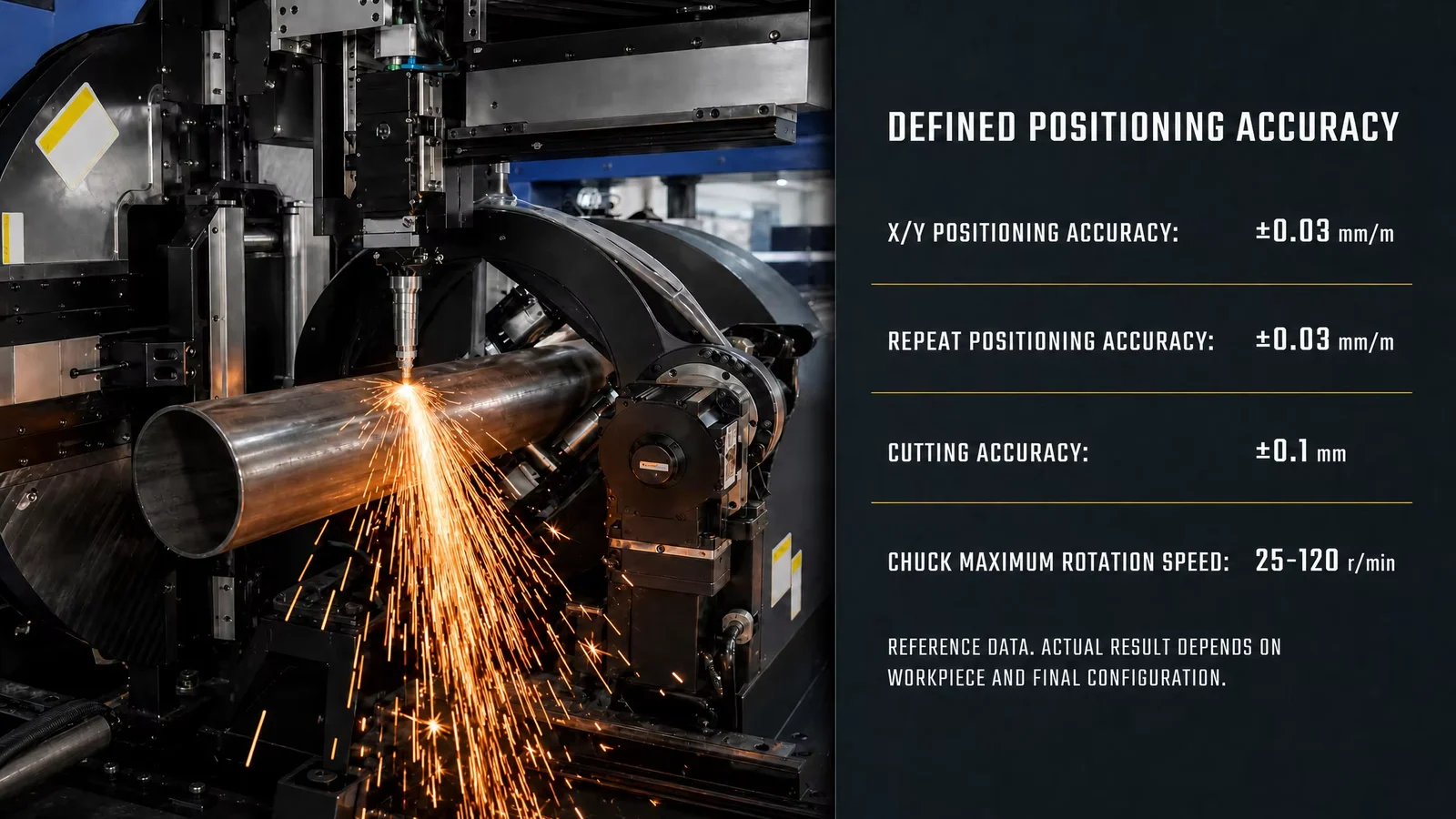
- Round tube is never perfectly round or straight: centre finding before cutting keeps holes on position.
- Small holes in thin tube can mark the opposite wall; lead-in placement, power at breakthrough and cut order reduce it.
- Pipe up to NPS 8 (219.1 mm) fits the LT240; NPS 10 to 14 needs the LT360; NPS 16 to 20 the LT520.
On this page
- What makes round tube different
- Problem 1: the intersection does not fit
- Problem 2: holes are off position or not round
- Problem 3: the weld seam is in the way
- Problem 4: marks on the opposite wall
- Problem 5: long tube whips or vibrates
- Problem 6: very small or very thin tube
- Pipe sizes, chuck fit and laser power
- Round tube joints a laser cuts
- Which machine for round tube
- Machines mentioned in this article
- FAQ
What makes round tube different
Round tube laser cutting looks simpler than square tube: no corners, no faces to reference. In practice it brings its own problems. The tube rotates continuously while the head follows the cut, so any ovality, bow or off-centre clamping shows up directly in hole position. Joints between two round tubes, the saddle or fish-mouth cuts that make up most round tube work, only fit if the wall thickness is handled correctly. This guide takes the problems one at a time, with the cause and the fix for each.
Problem 1: the intersection does not fit
What you see. A branch tube with a laser cut saddle sits tight at the crotch and the heel of the joint, but opens up at the two sides. The thicker the wall and the closer the branch is to the main tube diameter, the bigger the gap.
Why. A standard tube laser cuts square to the tube surface, so the inner and outer edges of the branch wall are cut at the same height. But the main tube is curved: at the sides of the joint its surface is higher under the inner edge of the branch than under the outer edge. The program has to fit the branch on its inner edge, or the inner edge would collide with the main tube. The outer edge then stands off by a step that depends only on the two diameters and the wall:
gap at the side = √(R² − (r − t)²) − √(R² − r²)
R = main tube outside radius, r = branch outside radius, t = branch wall
| Main × branch (Sch 40) | Branch wall, mm | Gap at the side, mm | What to do |
|---|---|---|---|
| 6″ × 3″, thin-wall 2 mm tube | 2.0 | 1.2 | Ignore; fillet weld fills it |
| 2″ × 1″ | 3.38 | 1.9 | Acceptable for fillet welds |
| 4″ × 2″ | 3.91 | 2.2 | Acceptable; check the weld procedure |
| 6″ × 4″ | 6.02 | 5.1 | Bevel head, or fit on mid-wall and grind |
| 8″ × 6″ | 7.11 | 7.7 | Bevel head or plasma bevel |
| 4″ × 4″ equal tee | 6.02 | 25.5 | Bevel cut essential |
Two rules of thumb fall out of the formula. As long as the branch is no more than about half the main tube diameter, the gap stays under the wall thickness. As the branch approaches the main tube size, the gap grows fast, and an equal tee cannot be fitted with a square cut at all.
Fix.
- Set the contact line in the software. Inner-edge contact gives a joint that seats without forcing; mid-wall contact halves the gap but leaves a little to grind at the sides.
- Use a bevel head on thick walls and near-equal diameters. The head tilts so the cut face follows the main tube around the joint and can add a weld preparation in the same pass. It is an option on the LT3 series.
- Model with the real wall. A 3D model with a nominal wall that differs from the tube in the rack gives the wrong fit.
For thick-wall pipe saddles with full weld bevels, plasma is often the better tool; see how to cut a pipe saddle.
Problem 2: holes are off position or not round
What you see. A row of holes drifts around the tube, or holes on one side are slightly oval.
Why. Tube standards allow ovality and straightness errors: EN 10219 and ASTM A500 for structural tube, EN 10305 for precision tube. If the control assumes a perfect circle centred in the chuck, every hole is placed on a surface that is not where the program thinks it is.
Fix.
- Run centre finding before cutting, so the control measures the real tube and shifts the program.
- Keep the tube supported close to the cut; long, thin tube sags between chucks.
- Recalibrate the centre of rotation after a crash or chuck service.
Problem 3: the weld seam is in the way
What you see. A hole or slot crosses the internal weld bead of welded tube and comes out ragged, or a tube that should slide inside another one jams on the seam.
Fix. Load every tube with the seam in the same position, tell the software which side it is on, and keep pierces and small holes off it. Where tubes telescope, specify seam-free or bead-removed tube.
Problem 4: marks on the opposite wall
What you see. On thin tube, the beam that breaks through the near wall leaves spots or a line on the inside of the far wall. On stainless and decorative tube that is a reject.
Fix.
- Start cuts on the scrap side so the breakthrough energy lands in material that falls out.
- Cut at the right speed for the wall; cutting too slowly with full power sends more energy across the tube.
- Cut holes before long contours that weaken the tube, and use micro-joints so slugs do not drop and spatter.
- Use nitrogen on stainless for a clean, oxide-free edge.
Problem 5: long tube whips or vibrates
What you see. On a 6 or 12 m bar of small-diameter tube, the free end swings as the chucks rotate fast, and holes near the far end lose accuracy.
Fix. Lower the rotation speed for long thin tube, use the follow-up supports between the chucks, and on long production runs consider a machine with a middle chuck, such as the three-chuck LT3, which supports the tube right next to the cut.
Problem 6: very small or very thin tube
Tube below about 20 mm diameter is at the bottom of the chuck range and needs care in clamping force, so it is not crushed. Walls under 1 mm cut fast but heat up; spread the cuts along the tube rather than cutting many holes close together in one place.
Pipe sizes, chuck fit and laser power
Common pipe sizes to ASME B36.10M with Schedule 40 and Schedule 80 walls, the smallest LT model that takes them and the laser power for a production cut on carbon steel. European EN 10255 and EN 10220 pipe uses the same outside diameters for most sizes.
| Pipe size | OD, mm | Smallest LT model | Sch 40 wall, mm | Laser power, Sch 40 | Sch 80 wall, mm | Laser power, Sch 80 |
|---|---|---|---|---|---|---|
| NPS 1/2 (DN 15) | 21.3 | LT240 | 2.77 | 1.5-2 kW | 3.73 | 3 kW |
| NPS 3/4 (DN 20) | 26.7 | LT240 | 2.87 | 1.5-2 kW | 3.91 | 3 kW |
| NPS 1 (DN 25) | 33.4 | LT240 | 3.38 | 3 kW | 4.55 | 3 kW |
| NPS 1-1/4 (DN 32) | 42.2 | LT240 | 3.56 | 3 kW | 4.85 | 3 kW |
| NPS 1-1/2 (DN 40) | 48.3 | LT240 | 3.68 | 3 kW | 5.08 | 3 kW |
| NPS 2 (DN 50) | 60.3 | LT240 | 3.91 | 3 kW | 5.54 | 3 kW |
| NPS 2-1/2 (DN 65) | 73.0 | LT240 | 5.16 | 3 kW | 7.01 | 6 kW |
| NPS 3 (DN 80) | 88.9 | LT240 | 5.49 | 3 kW | 7.62 | 6 kW |
| NPS 4 (DN 100) | 114.3 | LT240 | 6.02 | 6 kW | 8.56 | 6 kW |
| NPS 5 (DN 125) | 141.3 | LT240 | 6.55 | 6 kW | 9.53 | 6 kW |
| NPS 6 (DN 150) | 168.3 | LT240 | 7.11 | 6 kW | 10.97 | 12 kW |
| NPS 8 (DN 200) | 219.1 | LT240 | 8.18 | 6 kW | 12.7 | 12 kW |
| NPS 10 (DN 250) | 273.1 | LT360 | 9.27 | 6 kW | 15.09 | 12 kW |
| NPS 12 (DN 300) | 323.9 | LT360 | 10.31 | 12 kW | 17.48 | 12 kW |
| NPS 14 (DN 350) | 355.6 | LT360 | 11.13 | 12 kW | 19.05 | 12 kW |
| NPS 16 (DN 400) | 406.4 | LT520 | 12.7 | 12 kW | 21.44 | 12 kW |
| NPS 18 (DN 450) | 457.2 | LT520 | 14.27 | 12 kW | 23.83 | 12 kW |
| NPS 20 (DN 500) | 508.0 | LT520 | 15.09 | 12 kW | 26.19 | 12 kW |
Pipe above about 15 mm wall, or with full weld bevels, is usually cut faster and cheaper with plasma on a 5-axis tube plasma cutter.
Round tube joints a laser cuts
| Joint | Where it is used | Note |
|---|---|---|
| Saddle (fish-mouth) | Branch at 90° or any angle | Set the contact line for the wall |
| Offset saddle | Branch not on the centre line | Cut from the 3D model |
| Round tube to square tube | Frames mixing sections | Flat-face profile on the round tube end |
| Mitre | Bends from straight tube | Common-line cut between parts |
| Slot and tab | Self-locating frames | Clearance 0.1-0.2 mm |
| Hole for through-tube | Tube passing through tube | Hole contour wraps on the curved wall |
Which machine for round tube
For round tube up to Ø240 mm and walls up to about 6 mm, the LT240 tube laser with 1.5-6 kW covers most furniture, fitness, automotive and handrail work; round chucks are an option where round tube is almost all the work. Larger pipe goes on the LT360 and LT520. For high volumes of the same tube, the automatic loading tube laser keeps the laser cutting between bars, and for long, heavy or costly pipe with no tail waste, the LT3 three-chuck series. Programming of joints and nesting is covered in CNC tube cutting software.
Have a cutting job in mind? Send the section size, wall thickness and a drawing, and an engineer will tell you which method or machine fits.
Ask on WhatsAppMachines mentioned in this article
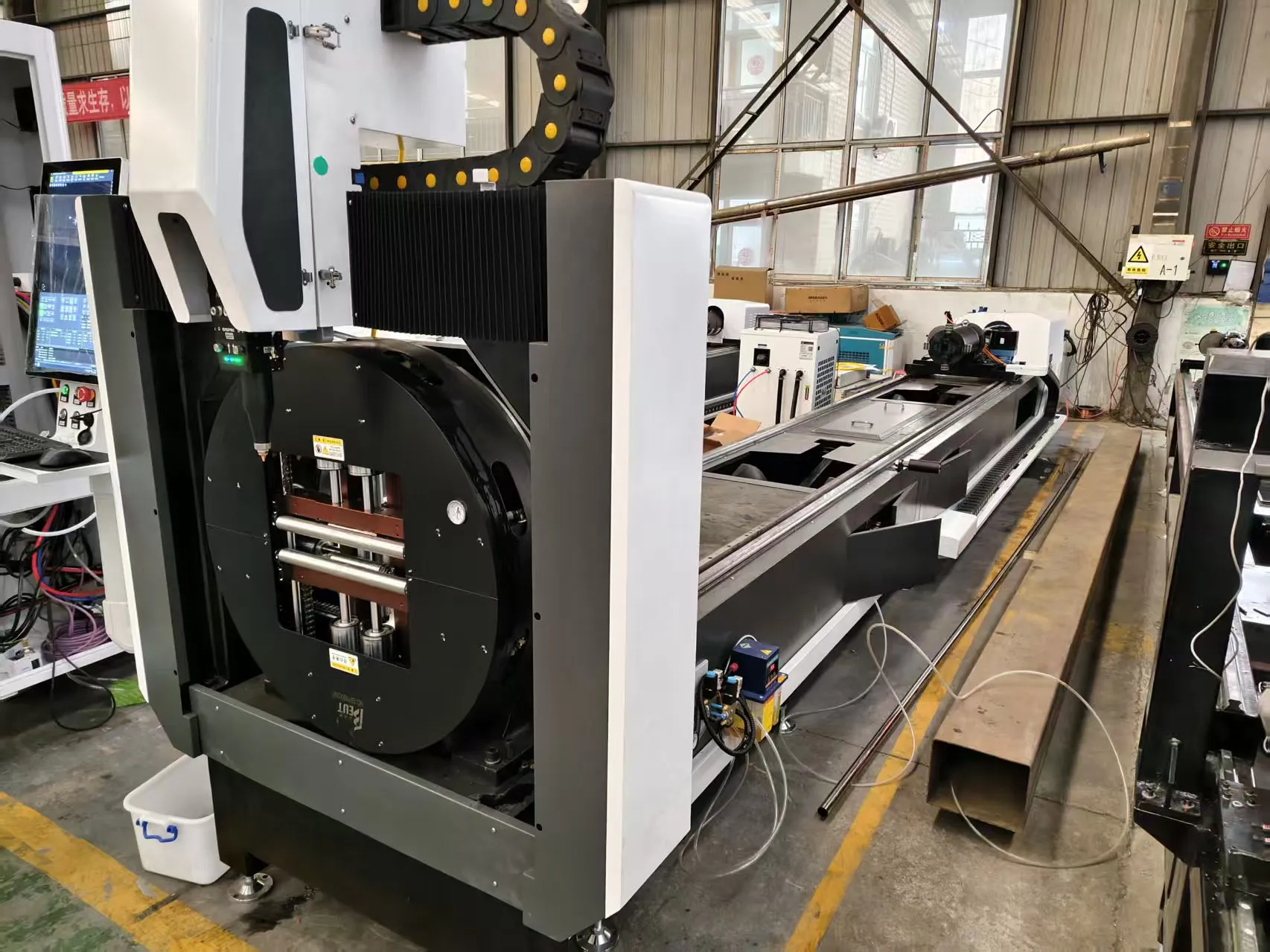
LT Series Tube Laser
Round tube Ø20-520 mm.
Compare all models →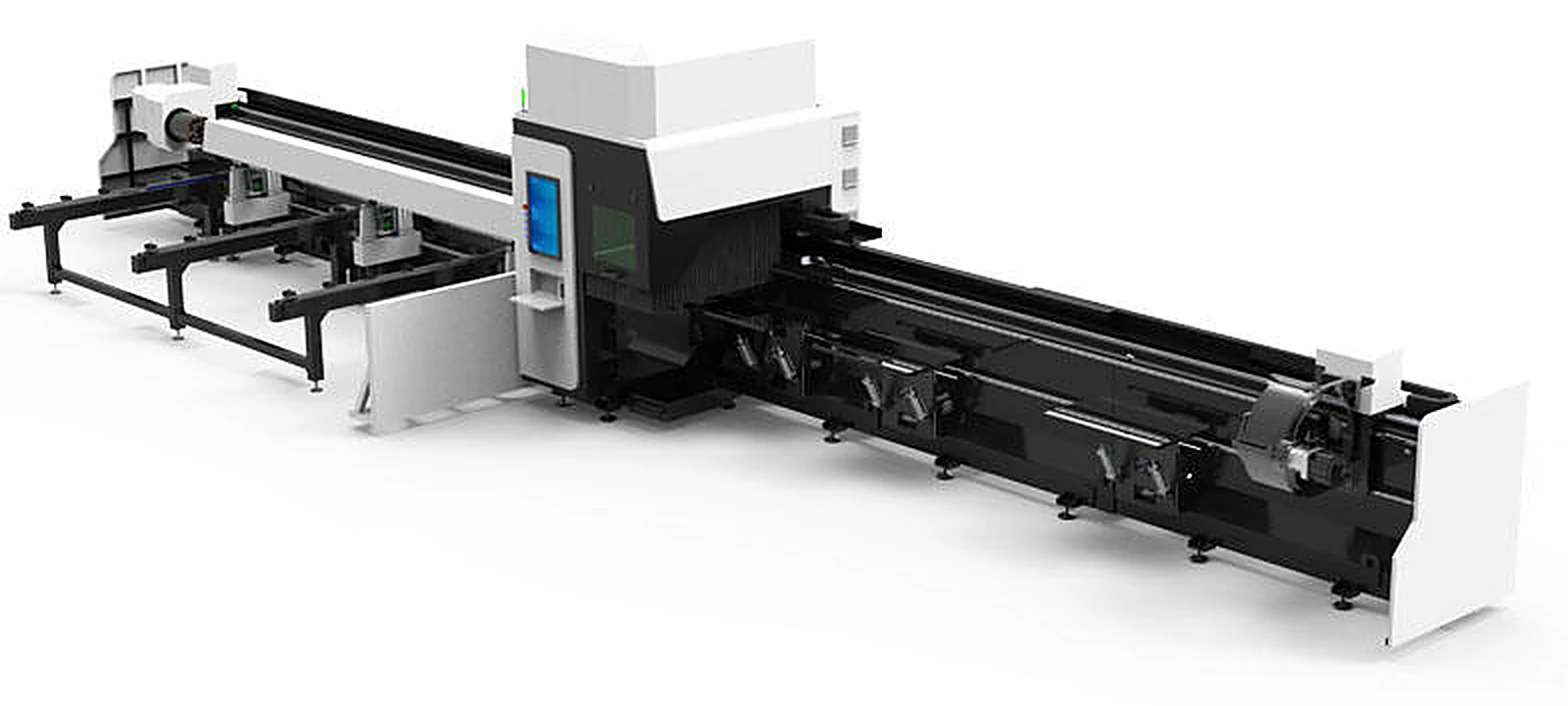
LT3 Three-Chuck Heavy Tube Laser
Zero tail, optional bevel head.
View machine →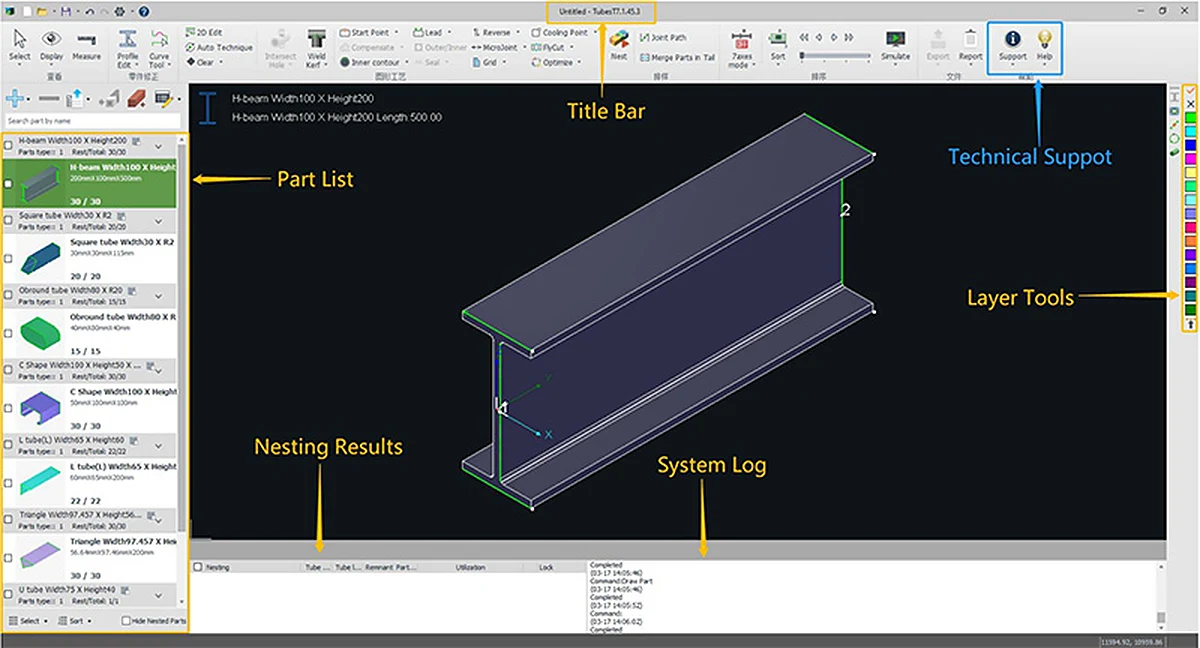
CNC Tube Cutting Software
Joints, nesting and CypTube settings.
View machine →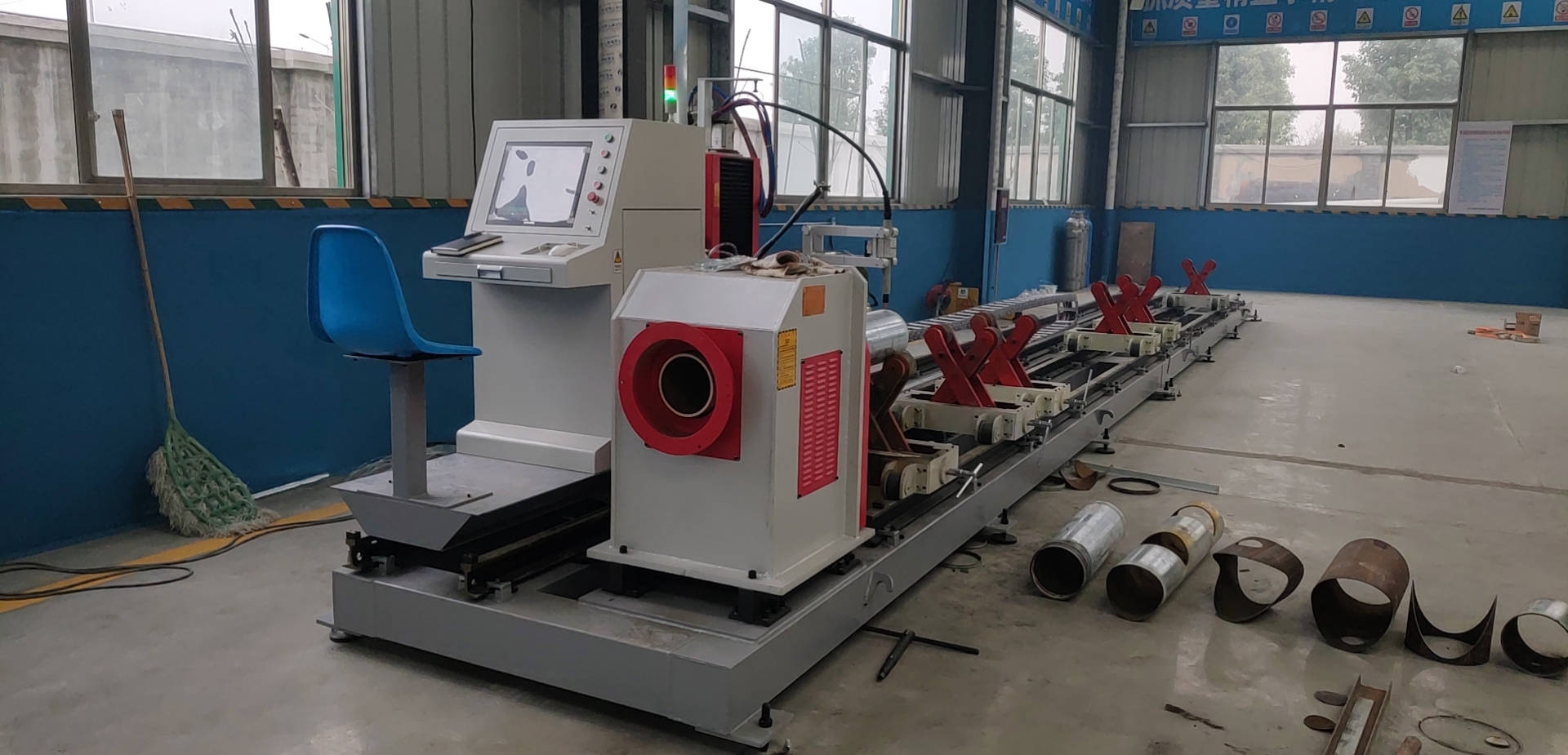
How to Cut a Pipe Saddle
Thick-wall saddles with plasma.
View machine →FAQ
Can a fiber laser cut round tube?
Yes. The chucks rotate the tube while the head follows the contour, cutting holes, slots, saddles and mitres in one clamping.
Why does my laser cut saddle joint have a gap?
On thick walls a cut square to the surface touches the main tube on the outside edge in some places and the inside edge in others. Set the contact line in the software or use a bevel head.
How big is the gap on a laser cut saddle?
At the side of the joint it is √(R² − (r − t)²) − √(R² − r²). For a 4 inch main with a 2 inch Sch 40 branch that is about 2.2 mm; for an equal tee it is too large to weld without a bevel cut.
What size pipe fits a 240 mm chuck?
Pipe up to 240 mm outside diameter, which includes NPS 8 (219.1 mm). NPS 10 and above needs a 360 or 520 mm chuck.
What laser power cuts 4 inch Schedule 40 pipe?
NPS 4 Schedule 40 has a 6.02 mm wall; a 3 kW laser cuts it, 6 kW gives more speed.
How do I stop marks on the inside of the tube?
Start cuts on the scrap side, cut at the right speed for the wall, use micro-joints so slugs do not drop, and use nitrogen on stainless.
What is the smallest tube a tube laser can cut?
About 20 mm diameter on the LT series; smaller tube needs special jaws and low clamping force.
Does tube ovality affect laser cutting?
Yes, within the tolerance of the tube standard. Centre finding before cutting corrects hole positions for the real tube.
Laser or plasma for pipe saddles?
Laser for thin and medium walls and accurate fit-up; plasma for thick-wall pipe with full weld bevels.
Round chucks or square chucks for round tube?
Square chucks clamp round tube well and also take square tube and open sections. Round chucks are an option when round tube is almost all the work.
Can it cut stainless steel round tube?
Yes, with nitrogen for a bright, oxide-free edge ready for welding.