Pipe Profile Cutting Machine: Types of Cuts, Bevels and Axes
A CNC pipe profile cutting machine (also called a pipe profiling machine, pipe profiling equipment, pipe profiler or pipe saddle cutting machine) shapes pipe ends and walls for welded joints: bevelled ends, mitres, branch holes, saddles and intersections, cut by plasma or oxy-fuel in one pass. This guide explains each cut, the geometry behind branch joints, weld bevel standards, how many axes you need and what decides the fit-up.
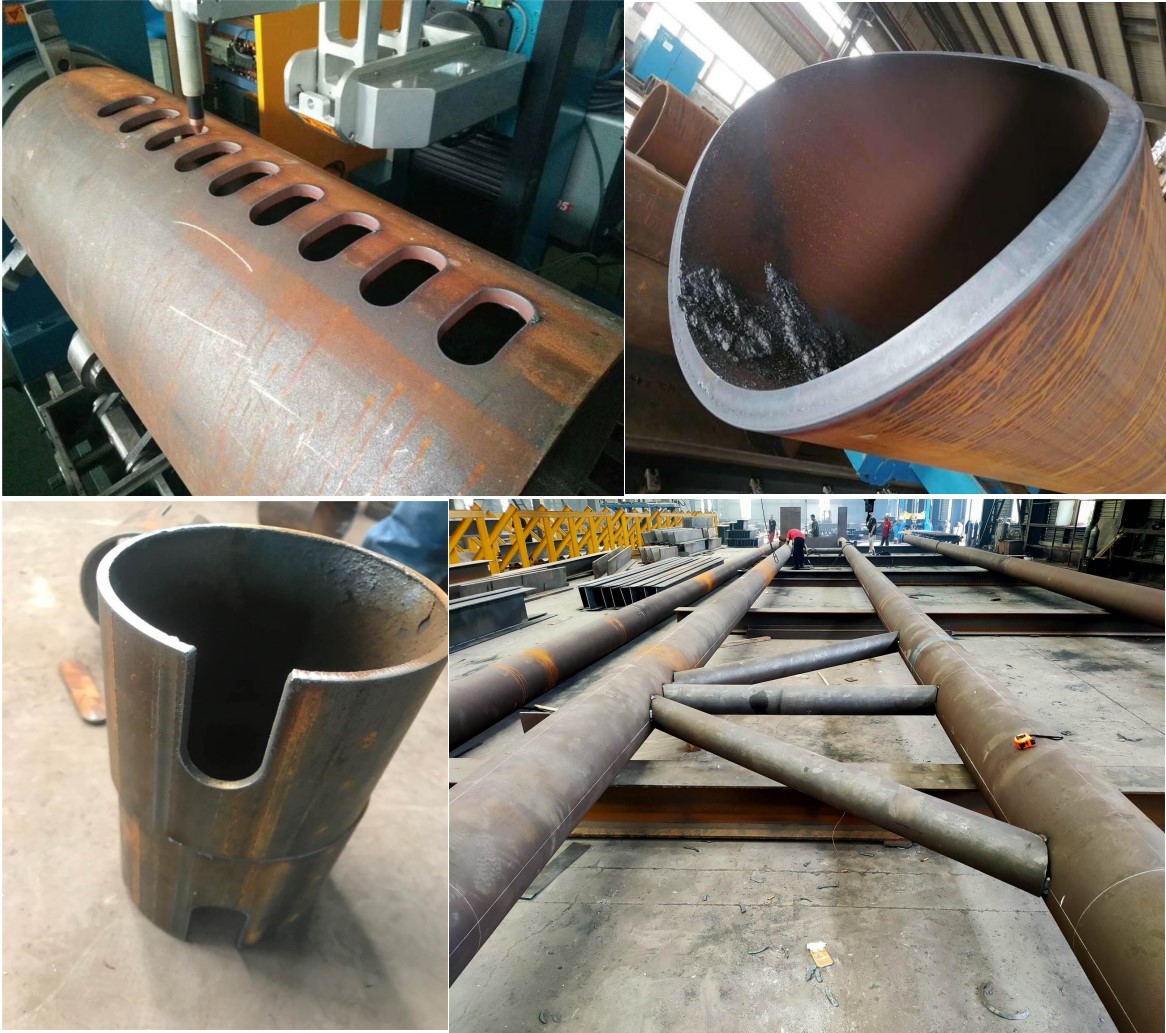
- Cut types
- 12
- Bevel
- cut with the profile
- Axes
- 3 / 5 / 6 / 8
- Processes
- Plasma, oxy-fuel, laser
- Input
- Pipe sizes or 3D model
What is pipe profile cutting?
Pipe profile cutting, also called pipe profiling or pipe and profile cutting, is cutting a pipe into the shape a welded joint needs. A straight cut only sets the length. A profile cut also shapes the end or the wall: a mitre for a change of direction, a hole in a header, a saddle on a branch so it sits tight on the main pipe, and the weld bevel along the edge.
In CNC pipe profiling the pipe turns in a chuck while a torch moves along it; a plasma pipe profiler uses a plasma torch, which covers most carbon steel pipe. The controller combines pipe rotation, torch travel and torch tilt so the torch follows a three-dimensional path calculated from the pipe sizes. The operator enters the diameters and angle, or loads a 3D model, and the machine cuts the joint ready for fit-up.
Pipe profile cutting vs plate profile cutting
“CNC profile cutting machine” means two different machines. In plate work, a CNC plasma profile cutting machine is a gantry that cuts flat parts from steel sheet and plate. In pipe work, a pipe profile cutting machine rotates the pipe and cuts saddles, holes and bevels around it. If you cut flat parts, see the gantry CNC plasma profile cutting machine for plate. If you cut pipe joints, the rest of this guide is for you.
Pipe cutting, beveling and profiling compared
| Machine | What it does | What it cannot do |
|---|---|---|
| Pipe saw or cutter | Cuts pipe to length, square end | Bevels, saddles, holes |
| Pipe beveling machine | Bevels straight pipe ends | Branch holes, saddles, bevels that change around a joint |
| 3-axis pipe profiler | Saddles, holes and mitres with a square edge | Weld bevels on profiles |
| 5-axis and up pipe profile cutting machine | Every profile in this guide, with the weld bevel in one pass | – |
12 types of pipe profile cuts
These are the cuts a CNC pipe profile cutting machine makes and where each one is used. Most real parts combine several: a header may have six branch holes and two bevelled ends, all cut in one set-up.
| Cut | What it is | Used for |
|---|---|---|
| Straight cut with bevel | Pipe cut to length with the weld bevel | Butt welds, pipe spools, pipeline |
| Miter cut | Angled end; two mitres make a change of direction | Segmented elbows, frames |
| Hole for branch | Opening in the main pipe where a branch is welded | Tees, headers, nozzles |
| Saddle cut | Branch end shaped to the curve of the main pipe | Tees, truss joints |
| Double saddle | Branch end that sits on two pipes at once | Truss nodes, manifolds |
| Saddle-miter | Saddle and miter combined in one end | Angled branches on bends |
| Lateral branch | Branch at an angle other than 90°, including size-on-size | Laterals, Y-pieces |
| Offset branch | Branch off the main pipe centreline | Tangential inlets, offset nozzles |
| Through holes | Holes through both walls, in line with each other | Pins, shafts, bracing |
| Slots | Slots in the wall, often for gusset plates | Plate-to-tube connections |
| Reinforcing pad | Saddle-shaped plate around a branch opening | Pressure piping, vessels |
| Custom openings | Windows and cut-outs of any shape | Access holes, vents, drains |
Saddle geometry: why size matters
For a branch at 90° on the centreline, the depth of the saddle (how far the sides of the branch end drop below the top) depends on the ratio of branch to main pipe diameter. Small branches are almost flat; size-on-size branches drop by half the main pipe diameter. Deep saddles are where hand marking goes wrong and where the bevel angle changes most.
| Main pipe OD (mm) | Branch OD (mm) | d/D | Saddle depth (outside) |
|---|---|---|---|
| 323.9 | 114.3 | 0.35 | 10.4 mm |
| 323.9 | 219.1 | 0.68 | 42.7 mm |
| 323.9 | 273.1 | 0.84 | 74.9 mm |
| 323.9 | 323.9 | 1.00 | 161.9 mm |
| 610 | 168.3 | 0.28 | 11.8 mm |
| 610 | 406.4 | 0.67 | 77.5 mm |
Calculated as R − √(R² − r²) on outside radii, branch at 90° with no offset. Angled and offset branches give asymmetric saddles, which the software calculates the same way.
Branch joints: why the bevel angle changes
At a branch joint the angle between the branch wall and the main pipe surface is different at every point around the joint: open at the sides, closed at the top and bottom of the main pipe. A fixed bevel would leave a groove that is too wide in some places and too tight in others. A machine with a tilting torch changes the bevel angle continuously as it cuts, so the weld groove stays even all the way round and the joint can be welded with full penetration.
| Joint | What gets cut |
|---|---|
| Set-on branch | Saddle on the branch end; hole in the main pipe about the size of the branch bore |
| Set-in branch | Hole in the main pipe sized to the branch outside diameter; branch end shaped to the main pipe inside surface |
| Lateral (angled) branch | Elongated hole and asymmetric saddle calculated for the branch angle |
| Offset branch | Saddle and hole calculated for a branch off the main pipe centreline |
Weld bevels for pipe
The weld bevel leaves room for the root pass and the filler passes. For butt welds, ASME B16.25 is the usual reference:
| Wall thickness | Bevel | Root face |
|---|---|---|
| Up to 22 mm | Single V, 37.5° ±2.5° | 1.6 ±0.8 mm |
| Over 22 mm | Compound: 37.5° to 19 mm depth, then 10° | 1.6 ±0.8 mm |
| Heavy wall, alternative | J-bevel, less weld metal | per procedure |
On branch joints the bevel is not a single number: it changes around the joint, as above. The welding procedure for the job sets the final preparation; the machine cuts what the procedure asks for.
How many axes do you need?
| Machine | What it can do | Typical parts |
|---|---|---|
| 3-axis | Profiles with a square edge: saddles, holes, mitres, no bevel | Light structures, frames |
| 5-axis | Profiles with the weld bevel, including changing bevels at branches | Pipe Ø40-600 mm, square tube, channel, angle |
| 6-axis large diameter | Profiles and bevels on heavy pipe | Pipe Ø600-2000 mm, up to 10 t |
| 8-axis | Pipe and H-beam profiles on one machine | Pipe up to Ø800 mm and beams up to 565 mm wide |
Plasma, oxy-fuel or laser?
| Process | Best for | Limits |
|---|---|---|
| Plasma | Carbon steel pipe up to about 50 mm wall; fast cutting and beveling | Slight edge angle on thick walls |
| Oxy-fuel | Very thick carbon steel walls, typically 6-200 mm; often fitted to plasma machines as a second torch system | Slow; carbon and low-alloy steel only |
| Fiber laser | Thin-wall tube, stainless steel, fine detail | Higher machine cost; thick walls are slow or not possible |
What decides the fit-up in CNC pipe profiling
The program is exact; the pipe is not. These are the factors that decide whether a profiled joint closes without grinding:
- Ovality: an out-of-round pipe moves the cut surface away from the calculated path. Larger machines measure the pipe and correct the path.
- Straightness: a bent pipe wobbles as it turns. Support rollers and shorter overhangs reduce the effect.
- Real wall thickness: rolled pipe varies from the nominal wall. For set-in branches and bevels with a root face, enter the measured value.
- Torch height: automatic height control keeps the arc length constant over uneven surfaces, which keeps the kerf and bevel consistent.
- Kerf compensation: the cut is as wide as the arc. The software offsets the path by half the kerf so the part, not the scrap, is to size.
- Lead-ins and pierce points: on thick walls, start the cut in the scrap side so the pierce mark does not land on the joint.
Common problems and fixes
| Problem | Likely cause | Fix |
|---|---|---|
| Gap at the sides of a saddle | Main pipe diameter entered wrong, or pipe oval | Measure the real OD; use path correction |
| Weld groove uneven around a branch | Fixed bevel instead of a variable bevel | Cut on a 5-axis or higher machine |
| Bevel angle off on thick wall | Plasma edge angle not compensated | Adjust the bevel offset in the cutting table |
| Dross on the underside | Speed or current wrong for the wall | Use the cutting chart for the thickness |
| Burned corners on square tube | Full speed through the corner | Corner slow-down and height lock |
| Hole in the wrong place | Pipe datum or seam position not set | Set the zero position before cutting |
What the software needs
- Main pipe: outside diameter and wall thickness.
- Branch pipe: outside diameter and wall thickness.
- Geometry: branch angle, offset from the centreline and position along the pipe.
- Weld preparation: bevel angle and root face from the welding procedure.
- Or a 3D model: complex parts and trusses can be programmed from the model instead of parameters.
Where pipe profiling is used
| Industry | Typical profiled parts |
|---|---|
| Steel structures | Tube trusses, space frames, node joints, columns |
| Process piping | Headers, tees, laterals, bevelled spools |
| Offshore and jackets | Brace ends, chord openings, node connections |
| Pressure vessels | Nozzle openings, reinforcing pads |
| Shipbuilding | Pipe spools, structural tubes |
| Machinery and cranes | Booms and frames from tube, channel and angle |
Have a joint that is hard to cut?
Send the main and branch pipe sizes or a drawing. We cut a sample on our machine in Jinan and send you the video.
How to choose a pipe profile cutting machine
- Largest and smallest pipe: sets the chuck, the bed and the model.
- Wall thickness and material: decides plasma, oxy-fuel or laser.
- Joint types: if you need bevels on saddles or branch holes, choose 5 axes or more.
- Other sections: square tube, channel or H-beam on the same machine changes the model.
- Pipe length and weight: decides bed length, supports and loading.
- Test cut: send a drawing and have a sample cut on your own pipe before you buy.
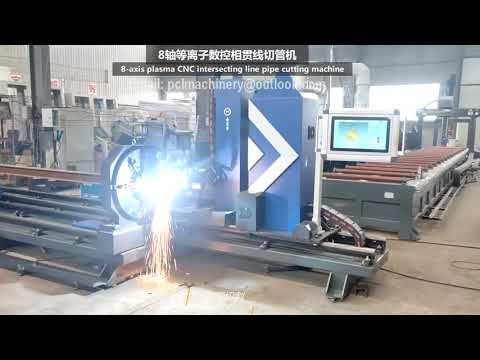
Pipe profile cutting machines
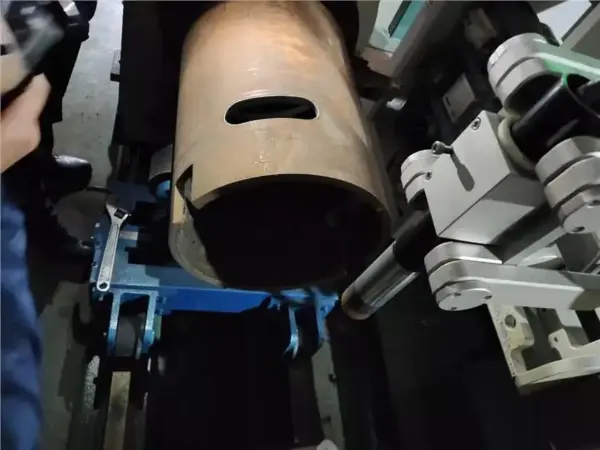
CNC Pipe Cutting and Beveling Machine
All pipe profiling and beveling models compared.
Compare all models →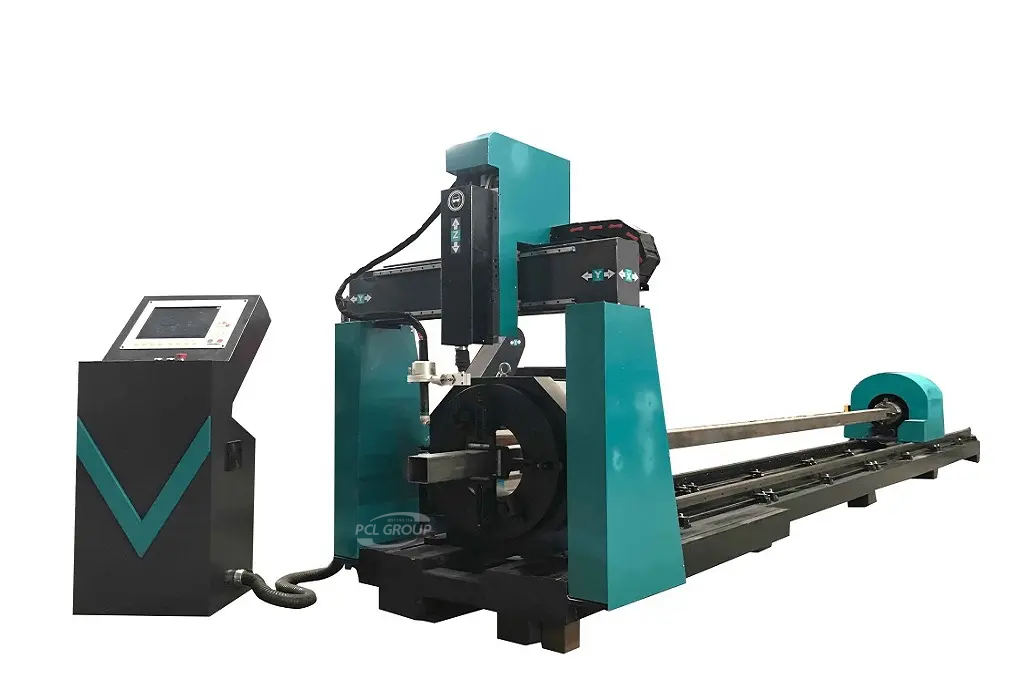
5-Axis CNC Tube Plasma Cutting Machine
Pipe Ø40-600 mm, tube, channel and angle.
View machine →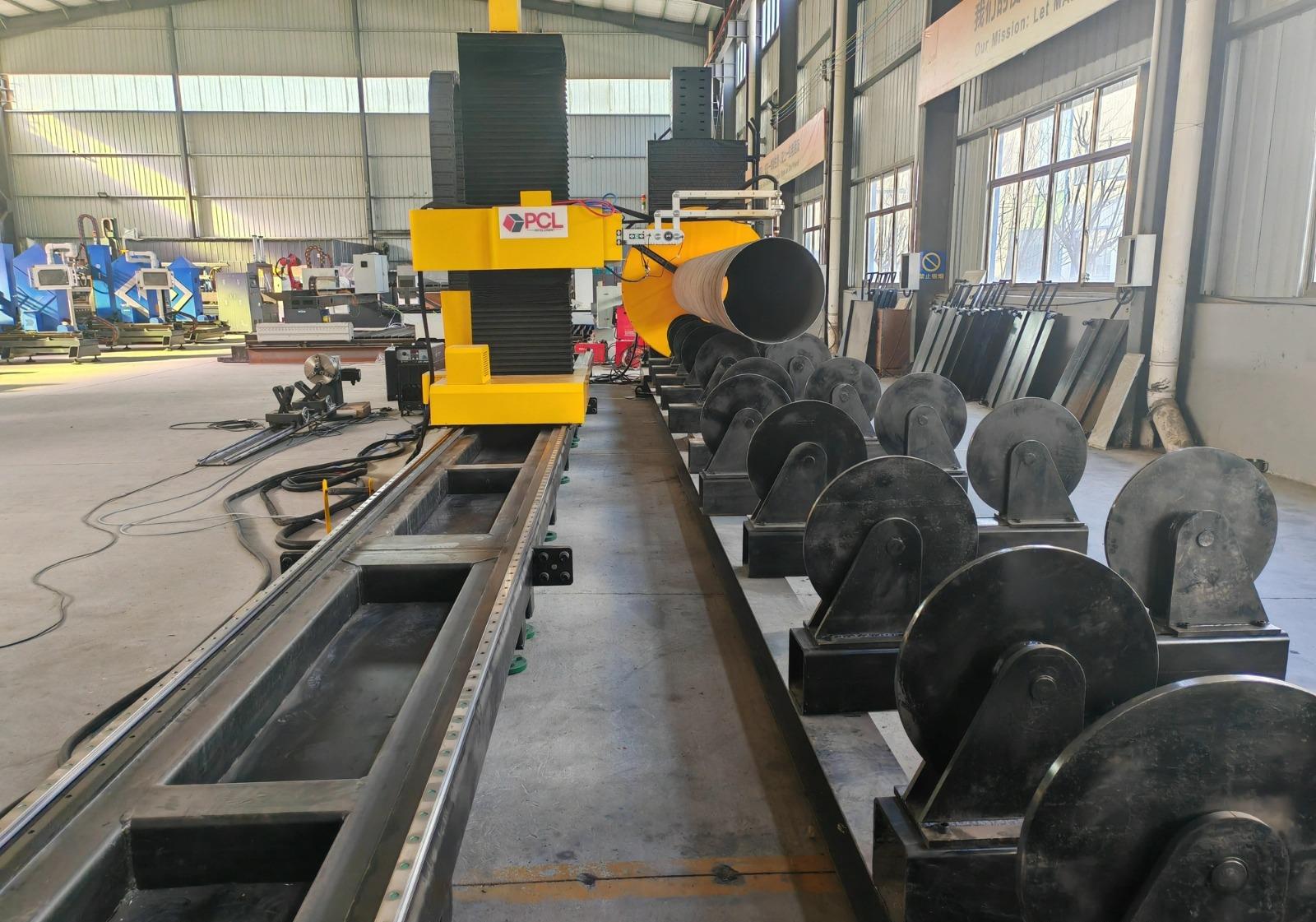
Large Diameter Pipe Cutting Machine
Pipe Ø600-2000 mm, up to 10 t.
View machine →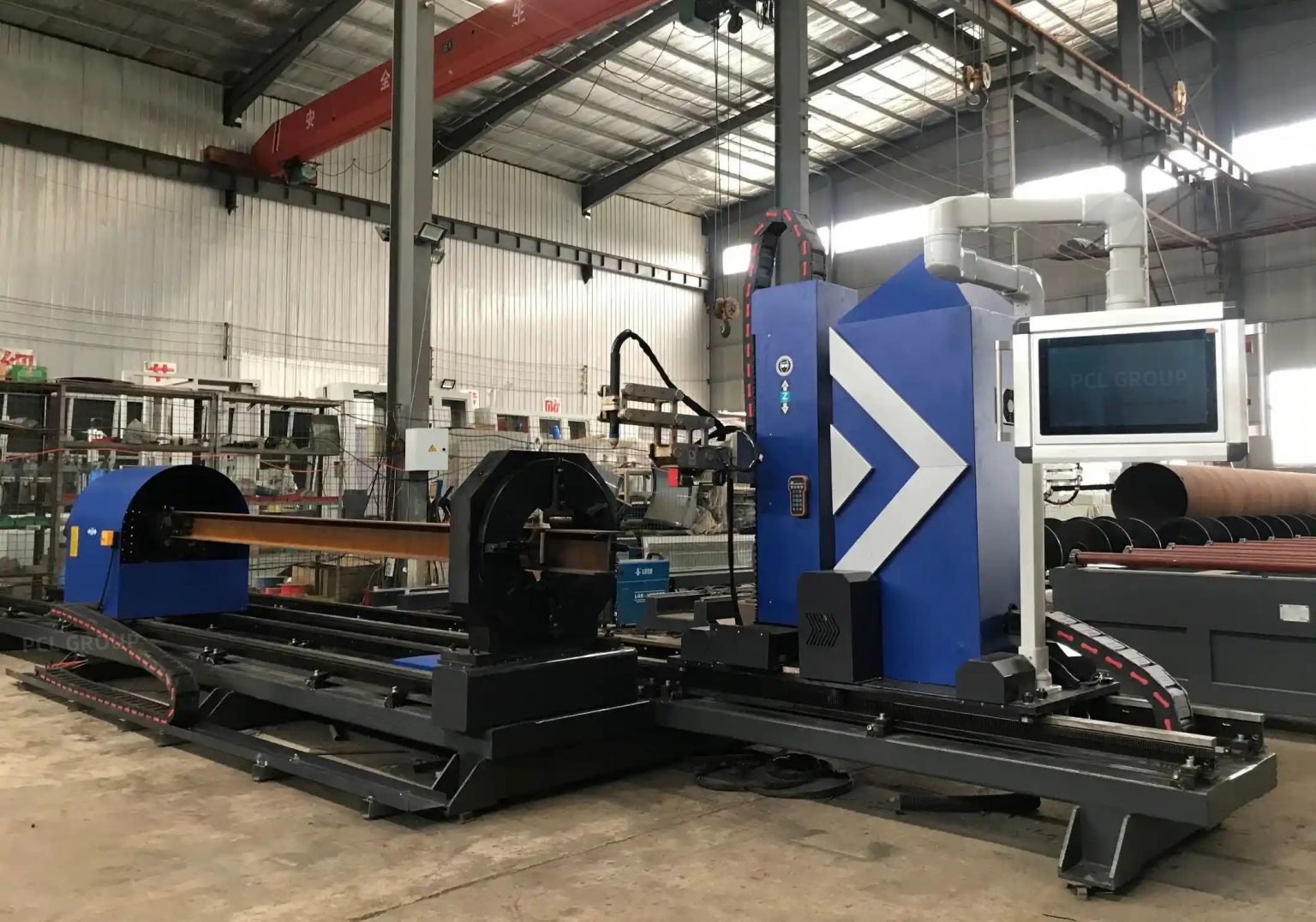
8-Axis Pipe and Beam Plasma Cutter
Pipe up to Ø800 mm and H-beams on one machine.
View machine →Frequently asked questions
What is a pipe profile cutting machine?
A CNC machine that cuts pipe into the shapes welded joints need: bevelled ends, mitres, branch holes, saddles and intersections. The pipe turns in a chuck while a plasma, oxy-fuel or laser torch follows a path calculated from the pipe sizes, so parts fit up without templates or grinding.
Is pipe profiling the same as pipe cutting?
No. Pipe cutting sets the length with a square or bevelled end. Pipe profiling also shapes the end or the wall for a joint, such as a saddle on a branch pipe or a hole in a header. A pipe profile cutting machine does both.
What is a saddle cut?
The shaped end of a branch pipe that sits on the curved surface of a main pipe. Its shape depends on both diameters, the branch angle and any offset. The closer the branch is to the main pipe size, the deeper the saddle.
What is the difference between set-on and set-in branches?
A set-on branch sits on the outside of the main pipe, so the branch end is shaped and the main pipe gets a hole about the size of the branch bore. A set-in branch passes through the main pipe wall, so the hole matches the branch outside diameter and the branch is shaped to the inside surface.
Why does the bevel angle change around a branch joint?
The angle between the branch wall and the main pipe surface changes all the way round the joint. To keep the weld groove even, the torch must tilt by a different amount at every point, which needs a machine with a tilting torch (5 axes or more).
What bevel is standard for pipe butt welds?
ASME B16.25 gives a 37.5° bevel with a 1.6 mm root face for walls up to 22 mm, and a compound bevel (37.5° then 10°) above that. The welding procedure for the job always decides the final preparation.
How many axes does a pipe profile cutting machine need?
3 axes cut saddles, holes and mitres with a square edge. To cut the weld bevel together with the profile you need a tilting torch: 5 axes for pipe and tube, 6 axes for large diameter pipe, and 8 axes when H-beams are cut on the same machine.
Plasma, oxy-fuel or laser for pipe profiling?
Plasma for carbon steel pipe up to about 50 mm wall, fast and able to bevel. Oxy-fuel for thicker carbon steel walls, more slowly. Fiber laser for thin-wall tube and stainless steel with fine detail.
Why does a profiled joint not fit?
The usual causes are pipe that is out of round or bent, the real wall thickness differing from the nominal value, a wrong main or branch diameter in the program, or kerf compensation not set. Measure the actual pipe and check the input data first.
Can square and rectangular tube be profiled?
Yes. Tube profile cutting works the same way: the same machines cut notches, mitres, holes and slots on any face of square and rectangular tube, and many also cut channel and angle. Corners need reduced speed to avoid over-burning.
What information does the software need?
For a branch joint: main pipe diameter and wall, branch diameter and wall, branch angle, offset and position. Add the bevel angle and root face from the welding procedure. Complex parts can be programmed from a 3D model.
Is a plasma profile cutting machine for plate the same as a pipe profiler?
No. A plasma profile cutting machine for plate is a gantry that cuts flat parts from sheet and plate. A pipe profile cutting machine rotates the pipe to cut saddles, branch holes and bevels. Some shops need both; PCL builds both.
Is a pipe profile cutting machine worth it for a small shop?
If you cut branch joints, saddles or bevels every week, yes: marking and grinding by hand takes far longer and the fit-up is less consistent. If you only cut pipe to length, a saw or simple cutter is enough.
Need a joint cut?
Send us the pipe sizes and joint type. We recommend the right machine and can cut a sample at our factory in Jinan.
What happens next
- An engineer checks your sizes and parts.
- You receive the recommended configuration and a quotation.
- If you want, we cut a sample and send you the video.