How to Cut a Pipe Saddle (Fish Mouth): Template, Formula and CNC
By the PCL Group engineering team, Jinan · Updated 2026-10-28
Short answer
- A saddle (fish mouth, cope) is the branch end shaped to sit on the curve of the main pipe.
- Its shape comes from two diameters, the branch angle and any offset; the formula is simple enough for a spreadsheet.
- Wrap a template from 16 or 32 ordinates, mark, cut with the torch radial, then check the fit before grinding.
- Thick walls change which diameter you lay out from. Bevelled saddles need a CNC cutter with a tilting torch.
On this page
- What is a pipe saddle (fish mouth)?
- The saddle formula
- Worked example: 4" branch on 8" main
- How to make and use a saddle template
- Wall thickness: which diameter to lay out from
- 45° laterals and other angles
- Offset (tangential) branches
- Ways to cut the saddle
- Bevelled saddles: why the angle has to change
- Checking the fit
- When to move saddles onto a CNC machine
- Machines mentioned in this article
- FAQ
What is a pipe saddle (fish mouth)?
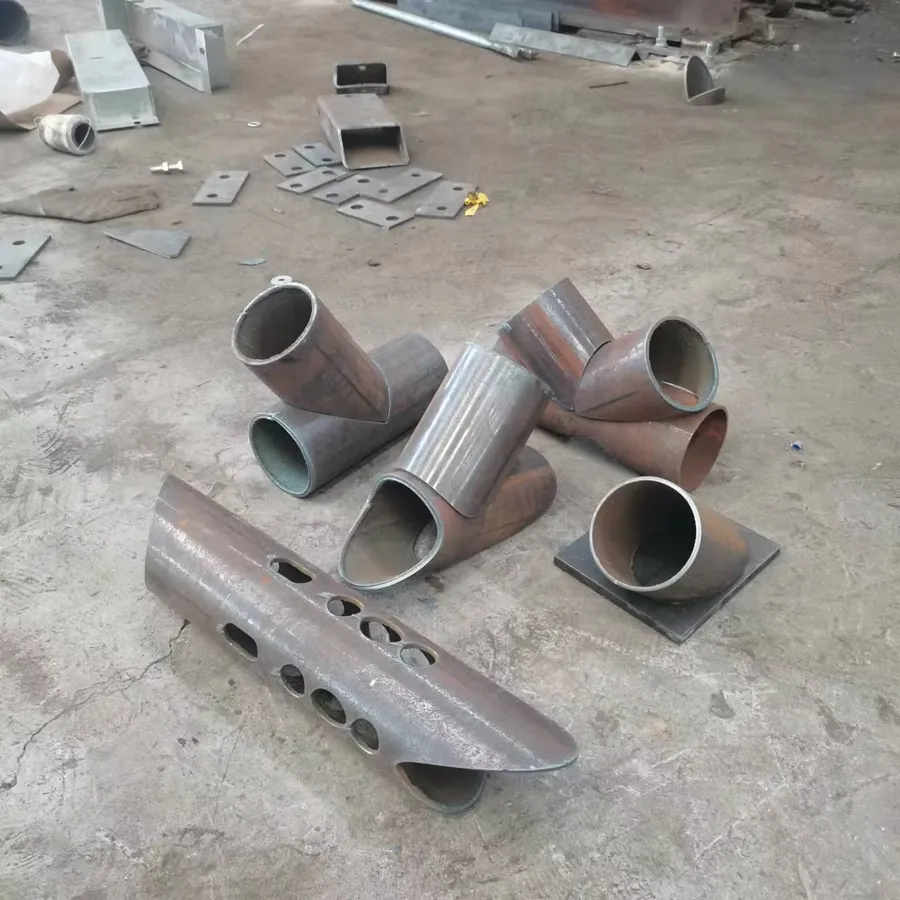
When one pipe joins another from the side, the end of the branch has to be shaped to the outside of the main pipe. That shaped end is called a saddle; fabricators also call it a fish mouth, a cope or a notch, and on small tube the job is often called tube coping or tube notching. The main pipe gets a matching hole (for a set-on branch) or the branch passes into it (set-in). A good saddle leaves an even gap all the way round, so the welder can make a sound root without filling gaps.
The saddle formula
For a branch of radius r meeting a main pipe of radius R at 90°, on the centreline, divide the branch circumference into equal parts and measure an angle θ round the branch from the top. The cut line drops below the top of the saddle by:
At θ = 0° (top and bottom of the main pipe) the drop is zero; at θ = 90° (the sides) it is deepest. For a size-on-size branch (r = R) the deepest point drops by the full radius of the main pipe, which is why equal-diameter tees are the hardest saddles to fit.
Worked example: 4" branch on 8" main
NPS 4 branch (OD 114.3 mm) on NPS 8 main (OD 219.1 mm), 90°, no offset, laid out on outside diameters:
| Angle round the branch | Drop h (mm) |
|---|---|
| 0° / 180° | 0.0 |
| 22.5° / 157.5° | 2.2 |
| 45° / 135° | 7.7 |
| 67.5° / 112.5° | 13.6 |
| 90° | 16.1 |
The branch circumference is π × 114.3 = 359.1 mm. With 16 divisions, each ordinate is 22.4 mm apart along the unrolled template. The drops repeat in each quarter, so you calculate four values and mirror them.
How to make and use a saddle template
- Draw a base line the length of the branch circumference on paper or thin card, and divide it into 16 equal parts (32 for pipe over about 8").
- Mark the drops from the table at each division and join the points with a smooth curve.
- Cut out the template and wrap it round the branch with the base line square to the pipe axis. Tape it tight: a loose wrap is the most common reason saddles do not fit.
- Line up the high points with the pipe’s top and bottom centrelines, and trace the curve with soapstone or a paint marker.
- Cut with the torch radial to the branch (pointing at the branch centre), then offer the branch up and check the gap before grinding.
Pipe-layout calculators and fitter’s apps print the same template from the diameters. The value of knowing the formula is that you can check a printout and lay out unusual joints that apps do not cover.
Wall thickness: which diameter to lay out from
On thin-wall tube the inside and outside are close enough to ignore. On thicker pipe they are not, and the layout has to follow the surfaces that will touch:
| Joint | Lay out from | Why |
|---|---|---|
| Set-on branch, bevelled for a full-penetration weld | Branch inside diameter on main outside diameter | The root of the weld sits at the inside of the branch wall |
| Set-on branch, fillet welded, thin wall | Outside diameters | The outside edge is what sits on the main pipe |
| Set-in branch | Branch outside diameter on main inside diameter | The branch passes through the wall and meets the bore |
The welding procedure sets the root gap and bevel; the template only decides the shape.
45° laterals and other angles
When the branch meets the main pipe at an angle α other than 90°, the cut line position along the branch becomes:
Subtract the smallest value to get the template ordinates. For the same 4" branch on an 8" main at 45°, the long point (heel) sits 114.3 mm further along the branch than the short point (toe), against only 16.1 mm of drop for the 90° tee. The template is no longer symmetrical top to bottom, so mark which end points toward the flow.
| Angle round the branch | 0° | 45° | 90° | 135° | 180° |
|---|---|---|---|---|---|
| 4" on 8", 45° lateral (mm) | 114.3 | 86.6 | 34.4 | 5.8 | 0.0 |
Offset (tangential) branches
If the branch centreline is moved sideways by an offset e from the main pipe centreline, replace r · sin θ with e + r · sin θ in the formula. The saddle becomes deeper on one side than the other. Offset branches are common on tangential inlets, cyclone and tank entries and handrails; they are also where hand-drawn templates go wrong most often, because the shape is not symmetrical.
Ways to cut the saddle
| Method | Best for | Limits |
|---|---|---|
| Hole-saw tube notcher | Thin tube up to about 2", frames and roll cages | Only round notches; walls of a few mm |
| Template and hand plasma or oxy-fuel | A few joints on any size | Fit depends on the wrap and the operator; grinding needed |
| Template and grinder | Small pipe, final fitting | Slow; noisy; abrasive dust |
| Portable CNC plasma cutter | Square-edged saddles and holes from the diameters, on site | No bevel |
| 5-axis CNC pipe cutter | Saddles and branch holes with the weld bevel in one pass | Workshop machine |
Bevelled saddles: why the angle has to change
On a bevelled saddle the angle between the branch wall and the main pipe surface changes as you go round the joint: it is open at the sides of the main pipe and closed at the top and bottom. A torch held at one angle leaves a groove that is too wide in some places and too tight in others. A CNC machine with a tilting torch changes the bevel continuously so the groove is even, which is the main reason fabricators of tees, headers and tube trusses move saddle work to CNC pipe cutting and beveling machines. The geometry is covered in more depth in our pipe profile cutting guide.
Checking the fit
- Even gap all round: offer the branch up and check the gap at the top, the sides and the bottom with a feeler or a filler rod of the right size.
- Gap at the sides only: the main pipe diameter used for layout is too small, or the pipe is oval. Measure the real OD.
- Gap at the top and bottom only: the template was wrapped loosely or not square to the pipe axis.
- Branch leans: the high points were not aligned with the pipe centrelines.
When to move saddles onto a CNC machine
A fitter with a good template can cut and fit a saddle, but each one takes layout, cutting and grinding time, and size-on-size or offset joints take longer still. When saddles, branch holes and laterals are a weekly job, a CNC pipe cutter calculates the shape from the two diameters, the angle and the offset, and cuts the main pipe hole and the branch saddle to match. For square-edged joints on site, see the portable CNC plasma pipe cutter; for bevelled saddles on pipe up to Ø600 mm, the 5-axis tube plasma cutting machine; for headers and branches on Ø200-1500 mm pipe, the roller-bed CNC plasma pipe cutting machine.
Have a pipe job in mind? Send the pipe size, wall and joint, and an engineer will tell you which method or machine fits.
Ask on WhatsAppMachines mentioned in this article
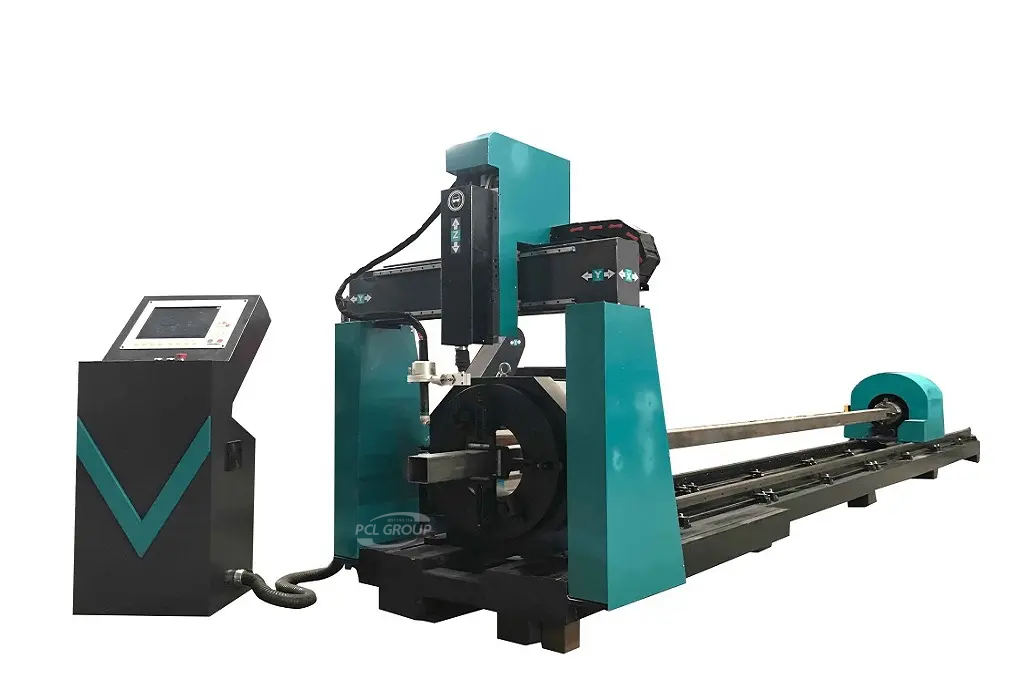
5-Axis CNC Tube Plasma Cutting Machine
Bevelled saddles and holes, pipe Ø40-600 mm.
Compare all models →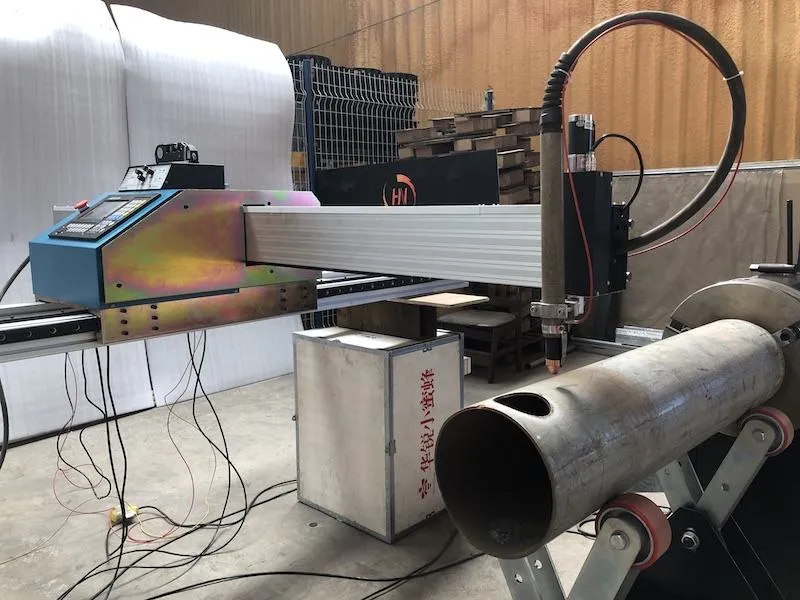
Portable CNC Plasma Pipe Cutter
Square-edged saddles on site.
View machine →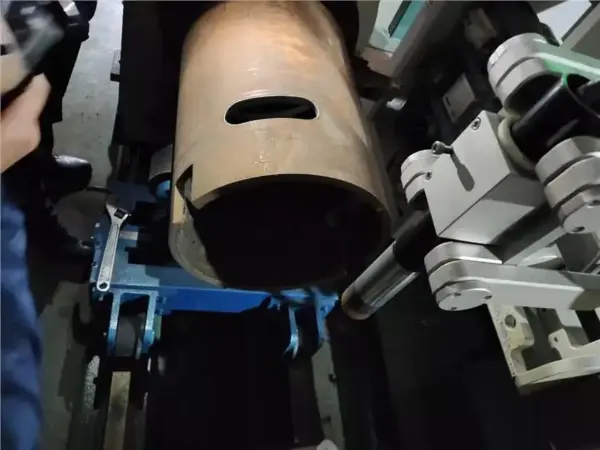
Roller-Bed CNC Plasma Pipe Cutting Machine
Headers and branches, Ø200-1500 mm.
View machine →CNC Pipe Cutting and Beveling Machines
All pipe cutting models compared.
View machine →FAQ
What is a fish mouth cut on pipe?
Another name for a saddle: the end of a branch pipe shaped to sit on the curved surface of the main pipe.
How do you calculate a pipe saddle?
For a 90 degree branch on the centreline, the drop at each point is R minus the square root of R squared minus (r times sin theta) squared, where R and r are the main and branch radii and theta is the angle round the branch.
How many divisions should a saddle template have?
16 divisions are enough for most pipe up to about 8 inch; use 32 on larger pipe so the curve between points stays accurate.
Do you use the inside or outside diameter for a saddle template?
Thin wall: outside diameters. Thick wall set-on branch with a full-penetration bevel: the branch inside diameter on the main outside diameter, because the weld root sits at the inside of the branch.
How do you cut a 45 degree lateral saddle?
Use the angled formula, which adds r cos theta cos alpha and divides by sin alpha. The template is no longer symmetrical; a 4 inch on 8 inch lateral at 45 degrees runs 114.3 mm from toe to heel.
Why does my saddle leave a gap at the sides?
Usually the main pipe diameter used for the layout is smaller than the real pipe, or the main pipe is oval. Measure the actual OD and redo the layout.
Can you cut a pipe saddle with a plasma cutter?
Yes. Trace a template and cut with the torch pointing at the branch centre, or let a CNC plasma pipe cutter calculate and cut the saddle from the diameters.
What is the difference between a saddle and a branch hole?
The saddle is cut on the end of the branch pipe; the branch hole is the matching opening in the main pipe. On a CNC machine both are cut from the same parameters so they match.
Can a tube notcher cut pipe saddles?
A hole-saw tube notcher works on thin tube up to about 2 inch. Larger or thicker pipe is cut by plasma or oxy-fuel.
How do you cut a bevelled saddle?
By hand it is ground after cutting. On a 5-axis CNC pipe cutter the torch tilts as it cuts, changing the bevel angle round the joint so the groove stays even.