H-Beam Production Line: 3-in-1 Assembling, Welding and Straightening Machine
Web 200-1800 mm · flange 150-800 mm · length 4-15 m
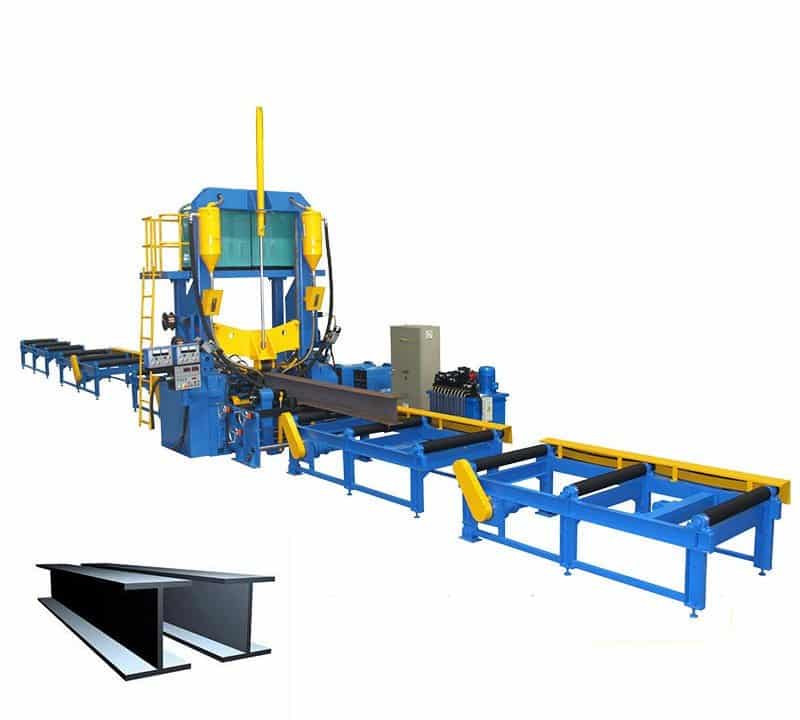
One machine that assembles, welds and straightens built-up H-beams. Web and flange plates are centred and clamped, the fillet seams are welded by submerged arc, and the flanges are straightened by hydraulic rollers, without moving the beam between three stations. It also makes T-beams.
- On-site installation and training
- 3-year machine warranty
- Installed in 80+ countries
- Factory direct since 2005
- Web height
- 200-1800 mm
- Flange width
- 150-800 mm
- Flange thickness
- 6-40 mm
- Beam length
- 4-15 m
- Welding
- SAW, 2 × 69 kW
What is a 3-in-1 H-beam machine?
Built-up H-beams are made from three plates: a web and two flanges. In a conventional H-beam welding line each step has its own machine: an H-beam assembly machine fits and tacks the plates, a gantry submerged arc welder runs the fillet seams, and an H-beam straightening machine corrects the flanges that welding has pulled out of square. Each move between them needs a crane and a crew. The 3-in-1 H-beam assembling, welding and straightening machine does all three at one station, which is why it is also sold as an H-beam assembly welding machine or an H-beam welding and straightening machine.
How a beam is made on the machine
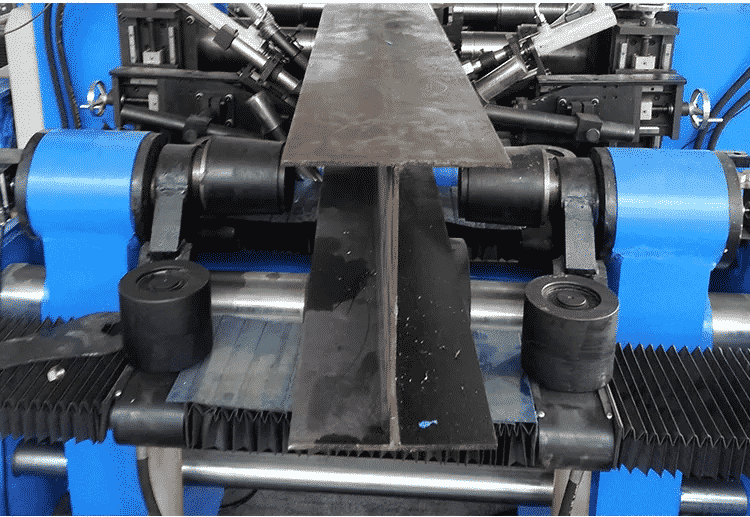
- Assemble: the web and flange plates are fed in, centred and clamped by the automatic positioning system, then tacked.
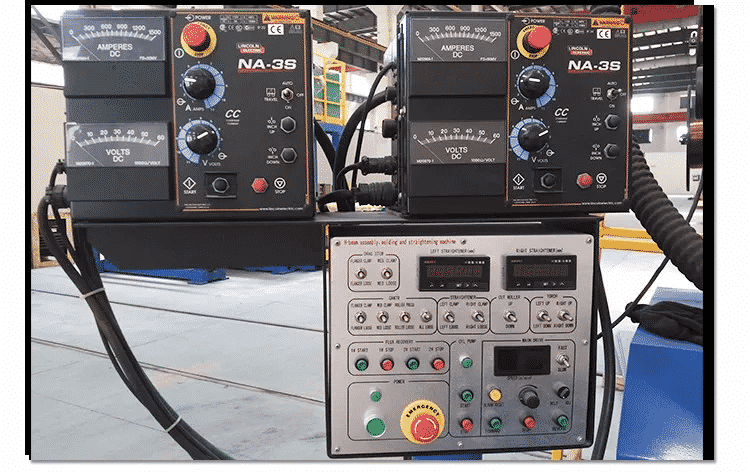
- Weld: two submerged arc heads on independent 2-axis torch mounts weld the fillet seams at 150-1500 mm/min, with flux recovered and returned.
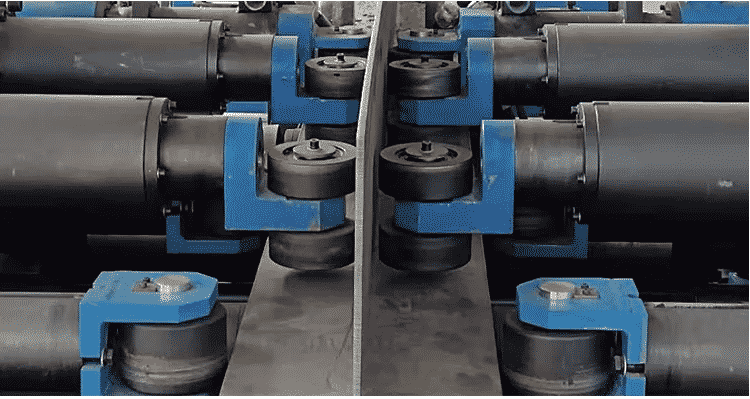
- Straighten: hydraulic correction rollers press the flanges back square to the web, correcting the angular distortion from welding.
- Out: the finished H-beam or T-beam leaves on the roller conveyor for cutting to length, holes and painting.
Specifications
- Web height
- 200-1800 mm
- Flange width
- 150-800 mm
- Flange thickness
- 6-40 mm
- Web thickness
- 6-32 mm
- Beam length
- 4-15 m
- Workpiece height
- 200-2000 mm
- Welding process
- submerged arc (SAW)
- Welding speed
- 150-1500 mm/min
- Assembly and welding travel speed
- 200-2000 mm/min
- Welding power sources
- 2 × 69 kW (138 kW)
- Main machine power
- 17.5 kW
- Roller conveyor power
- 4 × 0.75 kW
- Flux recovery power
- 2 × 3 kW
- Hydraulic pump station
- 4 kW
Get the price for your beam sizes
The configuration depends on your largest beam, plate thickness and beam length. Send them and an engineer replies with the configuration and quotation.
Features
| Feature | What it does |
|---|---|
| Heavy-duty assembly unit | Automatic centring and positioning of web and flanges for consistent fit-up |
| Independent welding torches | 2-axis adjustable mounts for torch position and angle, for even fillet welds and penetration |
| Open straightening design | Hydraulic rollers correct flange tilt while the operator can see the flange |
| Modular | The main unit can work alone as an assembly or welding station |
| Linear guideways | Imported linear guides for stable, repeatable positioning |
| Inverter welding sources | 25-35% lower energy use than conventional transformer sources |
On the line
H-beam production line video

3-in-1 machine or separate machines?
| 3-in-1 (this machine) | Separate assembly, welding and straightening | |
|---|---|---|
| Floor space | One station | Three stations plus transfer space |
| Crane moves per beam | Few | Between every station |
| Operators | Fewer | One or more per station |
| Output | Suits most fabricators | Higher in very large plants, with three beams in process at once |
| Investment | Lower | Higher |
The complete H-beam fabrication flow
| Step | Machine |
|---|---|
| 1. Cut web and flange strips from plate | Multi-torch CNC plate cutting machine, or the HFT laser |
| 2. Assemble, weld, straighten | This 3-in-1 H-beam machine |
| 3. Cut to length, copes, bolt holes, bevels | 8-axis robotic plasma beam cutter or H-beam laser |
| 4. Weld fittings and stiffeners | Robotic welding stations |
| 5. Shot blast and paint | Blasting and painting line |
Where it is used
Steel buildings
Columns, rafters and crane beams for factories and warehouses.
High-rise and bridges
Built-up girders larger than rolled sections.
Power and industrial plants
Boiler steelwork, pipe racks and equipment supports.
Prefabricated buildings
Repeat beams and columns for modular structures.
Before you order: what to check
| Check | Why it matters |
|---|---|
| Largest and smallest beam | Must fit web 200-1800 mm and flange 150-800 mm |
| Plate thickness | Flange 6-40 mm, web 6-32 mm; sets the weld size and speed |
| Longest beam | 4-15 m; sets the conveyor and building length |
| Power supply | About 170 kW installed including both welding sources |
| Upstream and downstream | Strip cutting before and beam cutting after keep the line balanced |
Related machines
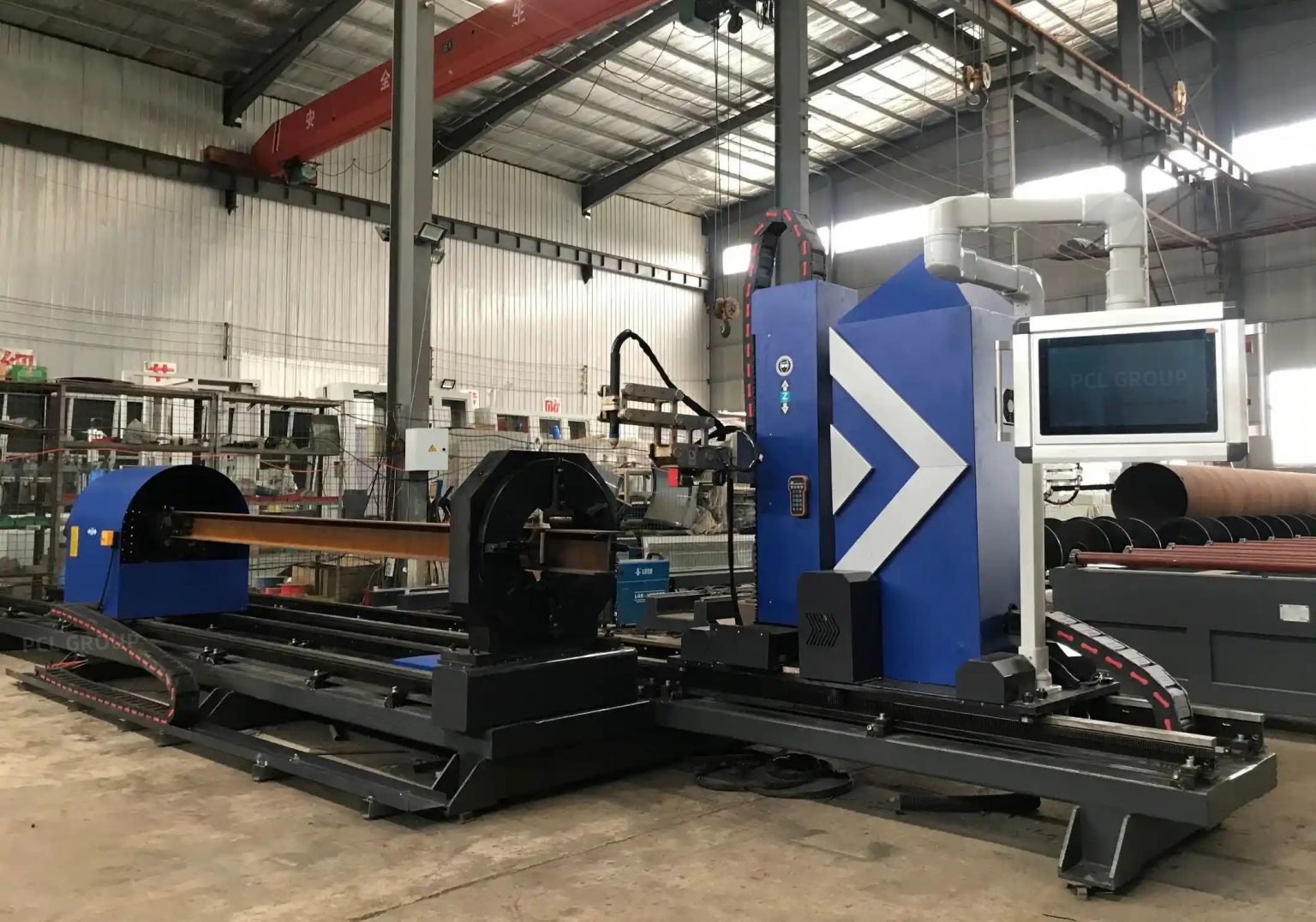
Beam Cutting Machines
All PCL beam cutting machines compared.
Compare all models →8-Axis Robotic Plasma Beam Cutter
Copes, bolt holes and bevels on finished beams.
View machine →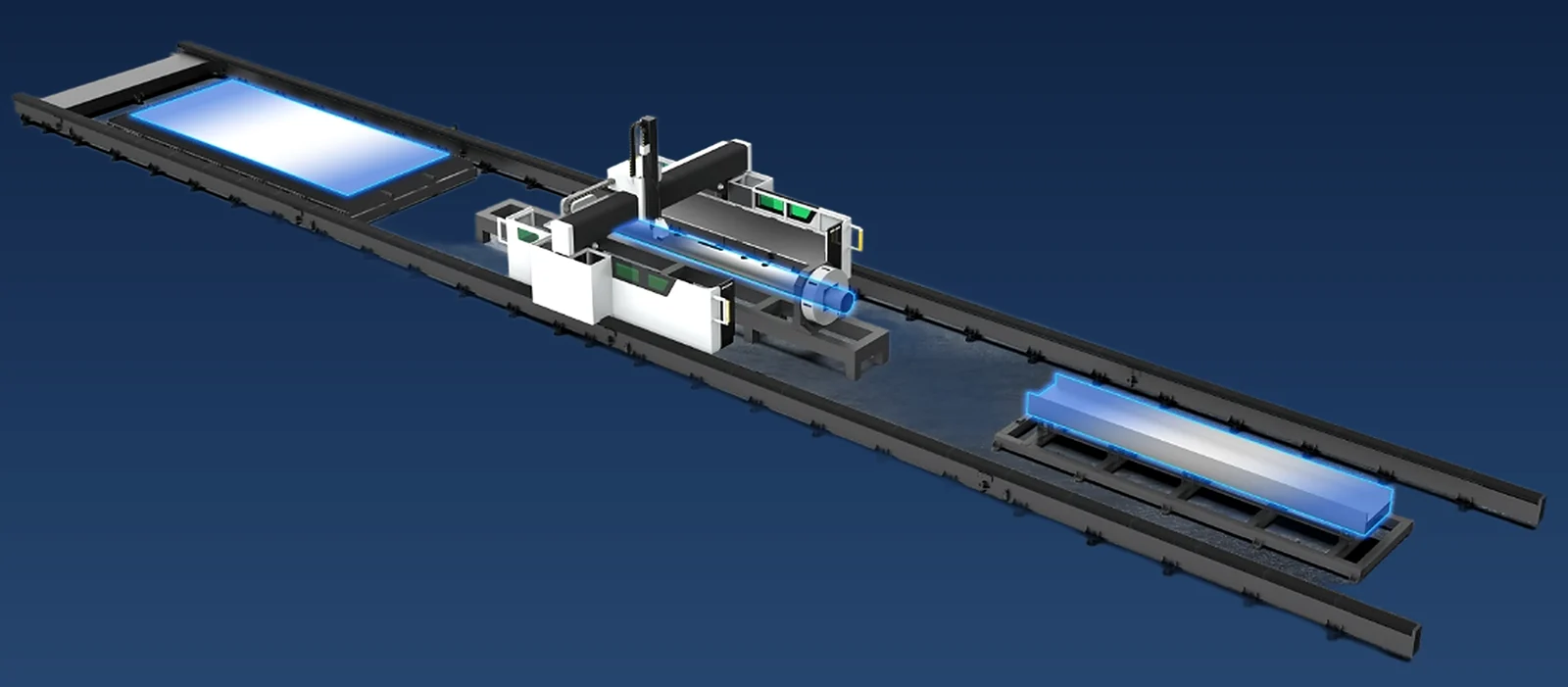
HFT Beam, Pipe and Plate Laser
Cuts web and flange plates and finished beams.
View machine →Frequently asked questions
What is an H-beam production line?
The set of machines that turns steel plate into finished welded H-beams: strip cutting of web and flanges, assembly (fit-up and tack welding), submerged arc welding of the fillet seams, and flange straightening. The PCL 3-in-1 machine does assembly, welding and straightening at one station.
What does 3-in-1 mean?
Assembly, welding and straightening in one machine. The web and flanges are centred and clamped, the fillet seams are welded by submerged arc, and the flanges are straightened by hydraulic rollers, without moving the beam between three separate machines.
What H-beam sizes can it make?
Web height 200-1800 mm, flange width 150-800 mm, flange thickness 6-40 mm, web thickness 6-32 mm and beam length 4-15 m.
What welding process does it use?
Submerged arc welding (SAW) with two welding power sources of 69 kW each. Welding speed is adjustable from 150 to 1500 mm/min to suit the weld size.
Can it make T-beams?
Yes. The same machine assembles and welds T-sections as well as H-beams.
Can the stations be used separately?
Yes. The main unit can be decoupled from the straightening section and used on its own as an automatic H-beam assembly machine or H-beam welding machine.
How does the straightening work?
Hydraulic correction rollers press the flanges back square to the web after welding, correcting the angular distortion that welding causes. The rollers are arranged so the operator can see the flange while it is corrected.
How much power does it need?
Main machine 17.5 kW, roller conveyors 4 x 0.75 kW, flux recovery 2 x 3 kW, hydraulic pump 4 kW and welding sources 2 x 69 kW.
3-in-1 machine or separate assembly, welding and straightening machines?
A 3-in-1 machine saves floor space, crane moves and operators, which suits most fabricators. Separate machines can give higher output in very large plants because each station works on a different beam at the same time.
What machines come before and after the line?
Before: plate cutting of web and flange strips, usually on a multi-torch CNC cutting machine. After: cutting to length, copes, bolt holes and bevels on a beam cutting machine, then shot blasting and painting.
Can I see the machine working?
Yes. Watch the video on this page, or ask for a video call from our factory in Jinan.
Get a quote
Send your beam sizes and plate thicknesses. We confirm the configuration and quote the machine.
What happens next
- An engineer checks your sizes and parts.
- You receive the recommended configuration and a quotation.
- If you want, we arrange a video call to show the machine running.