As the automotive manufacturing sector in Mexico continues its rapid expansion—driven by the “nearshoring” phenomenon in hubs like Querétaro, Monterrey, and Puebla—the demand for high-precision component fabrication has reached an all-time high. At PCL Group, we recognize that aluminum, valued for its strength-to-weight ratio, presents unique challenges during the thermal cutting process. To meet the rigorous standards of Tier 1 and Tier 2 automotive suppliers, a fiber laser cutting machine must transcend basic functionality and enter the realm of high-end industrial instrumentation. This analysis explores the technical imperatives of precision, structural integrity, and electrical stability required for aluminum sheet processing in the Mexican industrial landscape.
The Engineering Threshold: Achieving ±0.03mm Precision
In automotive manufacturing, tolerances are not merely suggestions; they are the boundary between a functional assembly and a costly rejection. For aluminum components such as heat shields, structural brackets, and interior paneling, PCL Group mandates a positioning accuracy of ±0.03mm.
Achieving this level of precision requires a holistic approach to the machine’s motion system. We utilize high-acceleration servo motors coupled with precision-ground rack and pinion systems. However, the hardware is only half the battle. The synchronization between the CNC controller and the laser head’s height sensor must be instantaneous. Aluminum’s high thermal conductivity means that even slight deviations in the focal point can lead to “dross” or kerf widening. By maintaining a ±0.03mm tolerance, we ensure that every bolt hole and intricate geometry aligns perfectly with the chassis or engine block, meeting the stringent ISO/TS 16949 standards prevalent in the Mexican automotive corridor.
Mechanical Stability and Vibration Damping
To sustain ±0.03mm precision over years of three-shift operations, the machine gantry must be constructed from aviation-grade extruded aluminum. This reduces the moving mass, allowing for high-speed direction changes without the “overshoot” common in heavier, less refined systems. When the gantry stops or changes direction at 1.2G acceleration, the rigidity of the PCL frame ensures that no residual vibration translates into the cut edge.
Structural Integrity: The 600°C Stress-Relief Bed Treatment
A fiber laser is only as accurate as the bed it sits upon. Many entry-level machines suffer from “frame memory,” where the internal stresses of the welded steel cause the bed to warp by fractions of a millimeter over time. For a machine destined for the heavy-duty environments of Mexico’s industrial parks, this is unacceptable.
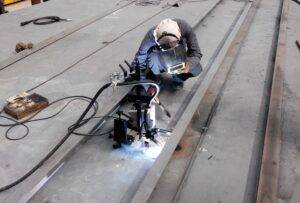
At PCL Group, our machine beds undergo a rigorous 600°C heat treatment process. The welded frame is placed in a specialized annealing furnace where the temperature is raised to 600°C and held for 24 hours. This process allows the molecular structure of the steel to reorganize, effectively “relaxing” the metal and removing the internal tension created during welding.
Why 600°C is the Magic Number
If the bed is not stress-relieved, the heat generated by the cutting process—combined with ambient temperature fluctuations in non-climate-controlled Mexican factories—will cause the frame to “creep.” A bed that was level on Day 1 will be skewed by Day 300. By applying the 600°C treatment, we guarantee that the machine frame will not deform for at least 20 years. This provides the stable foundation necessary for the linear guides to remain perfectly parallel, which is the prerequisite for our ±0.03mm precision guarantee.
Eliminating Secondary Processing: The “Ready-to-Assemble” Finish
One of the highest costs in aluminum fabrication is secondary processing—deburring, grinding, and polishing. Aluminum is a “sticky” metal; when melted by a laser, it tends to adhere to the underside of the sheet, creating sharp burrs.
PCL Group’s fiber laser technology utilizes advanced gas dynamics and high-frequency pulsing to ensure a clean, burr-free cut. By optimizing the nozzle design and using high-pressure nitrogen as an auxiliary gas, we blow away the molten aluminum before it has a chance to solidify on the edge.
Economic Impact for Mexican Manufacturers
In a high-volume automotive production line, eliminating the need for a deburring station can save a manufacturer up to 30% in labor costs and reduce the production cycle time by 40%. Our machines deliver parts that can go directly from the laser bed to the welding robot or the assembly jig. For the competitive Mexican market, where speed-to-market is critical, this “one-step” fabrication is a significant competitive advantage.
The Mexico Factor: Critical Need for Industrial Voltage Regulators
As a Senior Mechanical Engineer, I cannot overstress the importance of electrical stability. Mexico’s industrial power grid, while improving, is notorious for voltage fluctuations, brownouts, and “noise.” Fiber laser sources—the heart of the machine—are incredibly sensitive electronic components. A sudden spike of even 10% in voltage can fry the diode modules in a 3kW or 6kW laser source, leading to weeks of downtime and tens of thousands of dollars in repair costs.
In Mexico, an Industrial Voltage Regulator (AVR) is not an “optional accessory”; it is a mandatory insurance policy.
Protecting the Laser Source
The fiber laser source requires a constant, “clean” stream of electricity. Fluctuations cause the laser beam quality to oscillate, which directly affects the cutting precision and edge quality. If the voltage drops, the laser power weakens, resulting in incomplete cuts or increased dross. If the voltage spikes, the sensitive optics and electronics are at risk. PCL Group integrates high-capacity, fast-response industrial regulators with our Mexican installations to ensure that the machine receives a steady 220V or 440V (depending on the facility), regardless of the grid’s instability.
Conclusion: Engineering Excellence for the Mexican Automotive Sector
The transition to aluminum in the automotive industry requires a shift in fabrication philosophy. It is no longer enough to simply “cut metal.” The modern manufacturer in Mexico needs a system that offers surgical precision, long-term structural reliability, and the ability to produce finished parts without the bottleneck of secondary processing.
By combining a ±0.03mm precision motion system, a 600°C stress-relieved bed, and robust electrical protection tailored for the Mexican grid, PCL Group provides more than just a machine—we provide a turnkey solution for automotive excellence. As we look toward the future of electric vehicles (EVs) and lightweighting, these technical standards will become the baseline for any shop looking to compete on the global stage.
Investing in high-end fiber laser technology is an investment in the future of Mexican manufacturing. At PCL Group, we are proud to be the engineering partner that makes that future possible.
This is an AlertSome dealers steal our photos and videos to provide customers with copycat machines, so pay attention to prevent fraud, purchase from original manufacturer
ONE MACHINE CUT ALL
5 axis cnc tube laser cutting machine
8 Axis cnc plasma cutting machine
HF H beam plate laser cutting machine
PCL TV
Global Delivery & Logistics
From our high-tech manufacturing facility directly to your global site. PCL WeldCut ensures secure packaging, professional handling, and reliable international logistics to safeguard your equipment throughout the entire journey.