
Introduction: High-Precision Aluminum Processing in the Mexican Industrial Sector
The manufacturing landscape in Mexico, particularly within the automotive, aerospace, and electronics sectors, has seen a significant shift toward lightweight materials. Aluminum, prized for its strength-to-weight ratio and corrosion resistance, presents unique challenges in thermal cutting due to its high reflectivity and thermal conductivity. For Mexican fabricators, the objective is clear: achieve high-speed production without sacrificing dimensional accuracy. PCL Group’s Fiber Laser Cutting Machines are engineered specifically to address these variables, providing a turnkey solution that transitions raw aluminum sheets into finished components with zero requirement for secondary processing.

Structural Foundations: The 600°C Heat Treatment Process
Stress Relief for Long-Term Geometric Stability
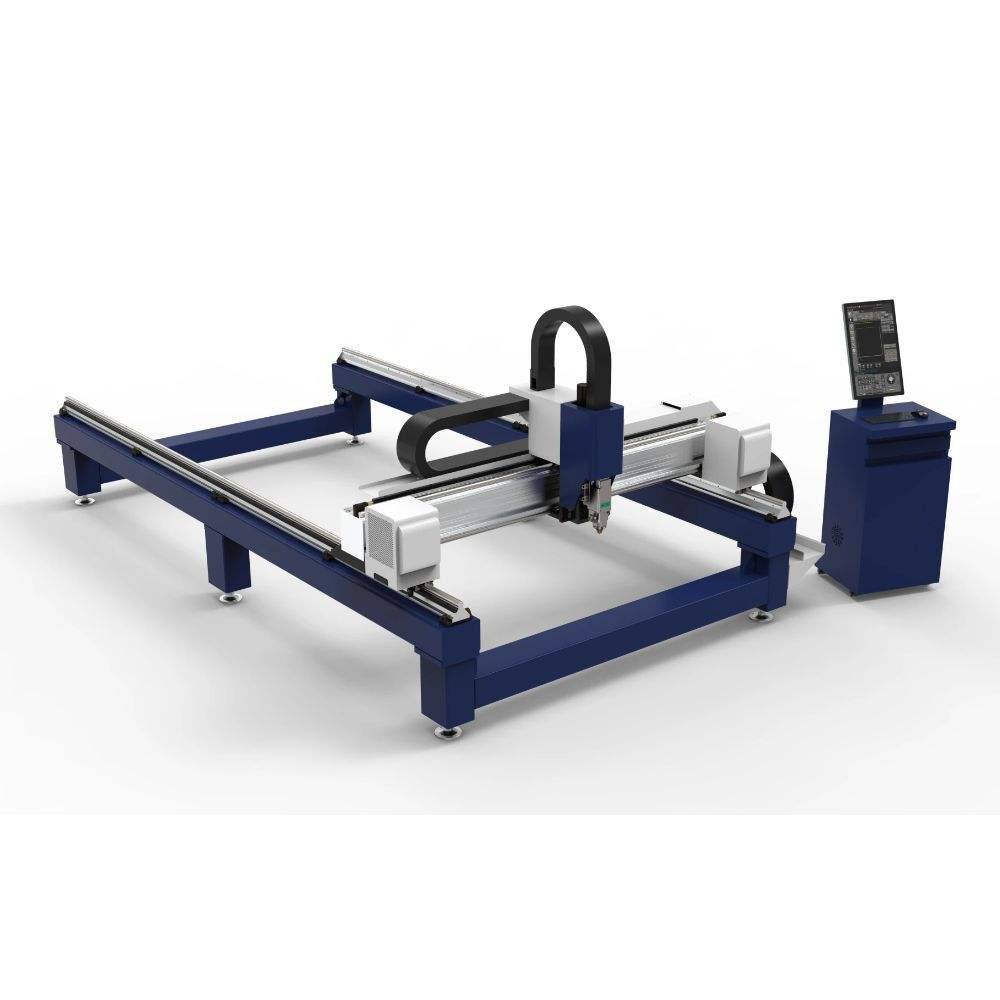
The accuracy of a fiber laser is only as reliable as the frame upon which it moves. PCL Group utilizes a heavy-duty carbon structural steel plate-welded bed. However, the critical differentiator lies in our thermal processing. Each machine bed undergoes a rigorous 600°C high-temperature annealing treatment within a specialized furnace. This process is maintained for 24 hours to eliminate internal stresses generated during the welding phase.
In the context of the Mexican climate—where temperature fluctuations in industrial warehouses can be significant—this 600°C treatment ensures that the machine bed will not deform over 20 years of continuous operation. Without this treatment, the bed would experience microscopic shifts, leading to a loss of perpendicularity and a gradual decline in cutting precision. By stabilizing the molecular structure of the steel, we guarantee a rigid platform capable of supporting the high-speed acceleration of the gantry system.
Vibration Dampening and Gantry Dynamics
Aluminum cutting requires high-frequency oscillations to be minimized. The mass of our heat-treated bed acts as a natural vibration dampener. Coupled with an aerospace-grade aluminum gantry—which offers high rigidity at a fraction of the weight of steel—the machine achieves the necessary agility to execute complex geometries in aluminum sheets without the “ghosting” effects often seen in lower-tier equipment.
Precision Engineering: Achieving ±0.03mm Positioning Accuracy
Mechanical Synchronization and Motion Control
For industries such as aerospace components in Querétaro or automotive parts in Puebla, a tolerance of ±0.03mm is non-negotiable. PCL Group achieves this through a combination of high-precision components and rigorous calibration. We utilize imported Japanese Yaskawa or Fuji servo motors paired with high-precision helical rack and pinion systems. Unlike ball screws, which can limit speed over long distances, the helical rack provides a larger contact surface, ensuring smoother motion and higher load-bearing capacity.
The positioning accuracy of ±0.03mm and repeatability of ±0.02mm are verified using laser interferometry. This ensures that every hole diameter and every contour edge is consistent from the first sheet to the thousandth. This level of precision is vital when cutting aluminum for interlocking assemblies where manual filing or adjustment is not an option.
Optical Path Integrity
The fiber laser source (available in 1kW to 30kW configurations) transmits the beam via a flexible fiber cable directly to the cutting head. This eliminates the need for mirrors and complex optical alignments. For aluminum, which is highly reflective, our machines incorporate back-reflection protection technology. This prevents damaged modules by redirecting reflected laser light away from the resonator, a common failure point when processing 5000 and 6000 series aluminum alloys.
Eliminating Secondary Processing: The “No-Burr” Advantage
Optimized Gas Dynamics
One of the primary overhead costs in aluminum fabrication is the labor required for deburring and edge cleaning. PCL Group’s fiber lasers utilize high-pressure Nitrogen (N2) as the assist gas for aluminum. The Nitrogen serves two purposes: it rapidly expels the molten aluminum from the kerf and prevents oxidation of the cut edge. The result is a bright, silver finish that is ready for welding or painting immediately after cutting.
Focus Control and Surface Finish
The integration of auto-focus cutting heads (such as Precitec or Raytools) allows the machine to adjust the focal point dynamically based on the material thickness and real-time sensor feedback. When cutting aluminum sheets, maintaining a consistent standoff distance is crucial because of the material’s tendency to expand slightly under heat. Our capacitive sensors detect height changes within milliseconds, ensuring the laser focus remains at the optimal depth to produce a dross-free bottom edge. By eliminating the need for grinding, sanding, or chemical cleaning, Mexican manufacturers can reduce their “time-to-market” by up to 40%.
Critical Infrastructure: Voltage Regulation for Mexico’s Power Grid
Addressing Power Instability
A significant technical hurdle for industrial machinery in Mexico is the stability of the electrical grid. Voltage fluctuations, brownouts, and transient surges are common in many industrial parks. Fiber laser sources are highly sensitive electronic instruments; even a minor voltage spike can damage the diode modules, leading to expensive repairs and downtime.
PCL Group mandates the use of a high-precision, three-phase automatic voltage regulator (AVR) and an isolation transformer for all installations in Mexico. The regulator must meet the following criteria:
- Response Time: Less than 1.5ms to counteract sudden surges.
- Voltage Accuracy: ±1.5% output stability regardless of input swings.
- Harmonic Filtering: To remove electrical “noise” that can interfere with the CNC controller’s logic signals.
By stabilizing the 220V or 440V 60Hz supply, we ensure that the laser beam power remains constant. This consistency is vital for maintaining the ±0.03mm precision; if the power fluctuates, the kerf width changes, which directly impacts the dimensional accuracy of the aluminum part.
Technical Specifications Matrix
The following specifications represent the standard configuration for PCL Group’s aluminum-optimized fiber laser systems:
| Feature | Specification |
|---|---|
| Positioning Accuracy | ±0.03 mm |
| Repeatability | ±0.02 mm |
| Bed Treatment | 600°C High-Temp Annealing (24 Hours) |
| Max Acceleration | 1.2G – 1.5G |
| Assist Gas Control | Dual-Proportional Valves (O2/N2) |
| Cooling System | Dual-Circuit Industrial Chiller (±0.5°C Stability) |
Operational Efficiency and Software Integration
CypCut CNC System
The hardware is managed by the CypCut control system, which features specialized nesting algorithms for aluminum. These algorithms optimize the lead-in and lead-out paths to prevent “heat accumulation” at the start and end of a cut, which is where burrs typically form. The software also includes a “FlyCut” mode for thin aluminum sheets, allowing the laser to cut lines in a single continuous motion without stopping at each corner, drastically increasing throughput.
Maintenance and Local Support
Reference: High-speed Aluminum Sheet processing solutions in Mexico.
















