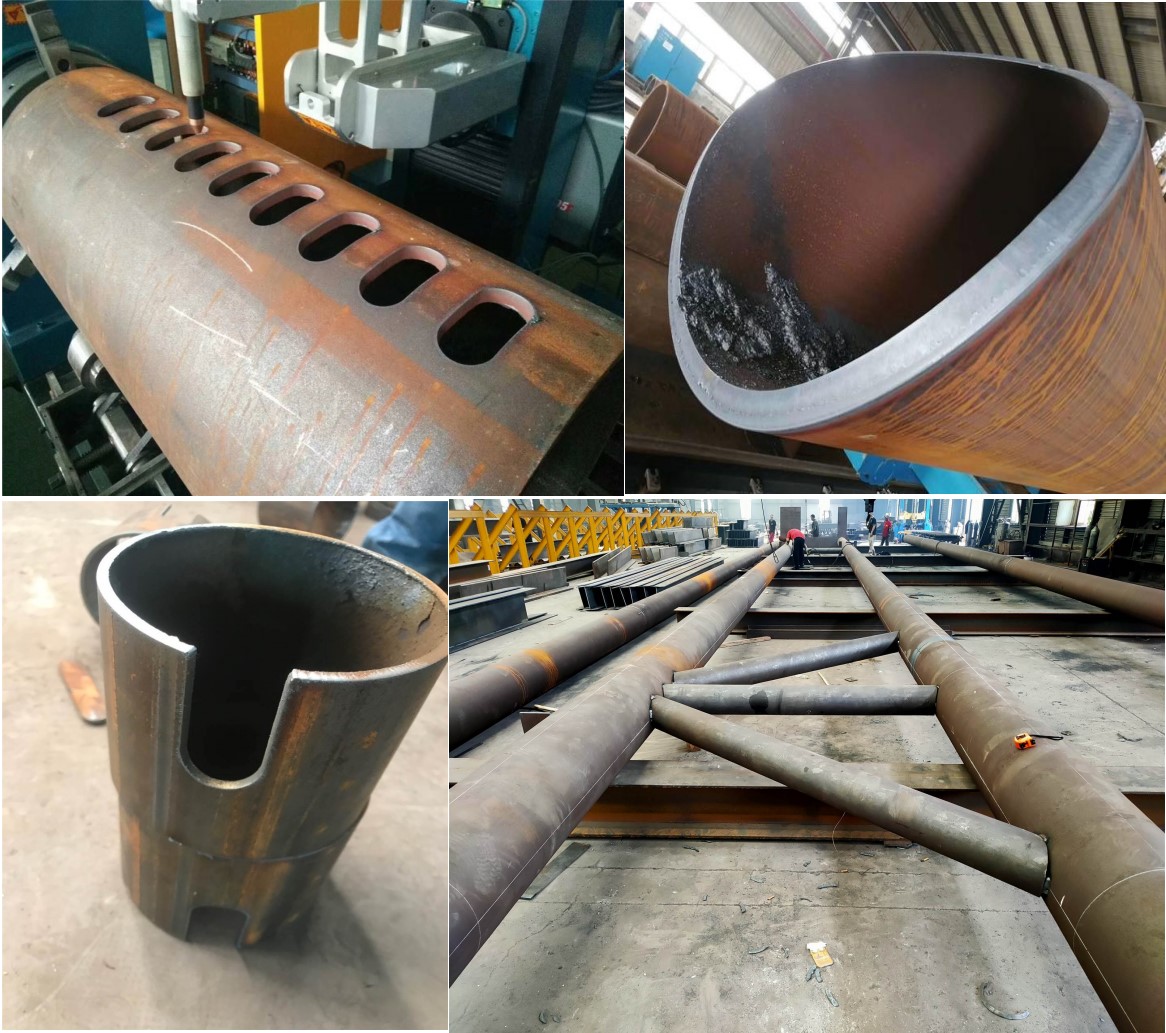
Technical Analysis: The Economic and Process Case for the Square Tube Multi-Hole Rapid Nesting Laser Cutting Center
After two decades on the shop floor, I have seen the transition from oxy-fuel and plasma to fiber laser for flat sheet. The real bottleneck, however, has always been the processing of structural hollow sections. For a fabrication shop running S355JR or SUS304 square tubes for handrails, structural frames, or automotive sub-assemblies, the traditional workflow is a serial nightmare: saw cut, deburr, drill, punch, and then weld. The square tube multi hole rapid nesting laser cutting center directly attacks the cost of that serial process by collapsing it into a single, automated, thermal cutting operation. This whitepaper provides a raw, data-driven breakdown of the ROI, gas consumption, and amortization schedule you can expect when deploying this specific class of machine.
Process Physics and Mechanical Baseline
The core advantage is not just speed, but the elimination of mechanical contact. A typical 6kW fiber laser source operating at 1070 nm wavelength, with a duty cycle of 85% during cutting, delivers a kerf width of approximately 0.3 mm on a 3 mm wall S355JR tube. Compare this to a plasma arc which introduces a 2-3 mm kerf and a significant heat-affected zone (HAZ) of 1.5 mm, requiring secondary grinding. The laser center uses a dual-chuck system with pneumatic clamping pressure set at 0.6 to 0.8 MPa to prevent tube distortion during the rapid acceleration of the gantry. The nesting software, which is the “brain” of the operation, optimizes the cut sequence to minimize the distance between holes and the overall part length, achieving material utilization rates of 92-95% versus 75-80% for manual sawing and drilling.
Detailed Cost-Benefit Analysis & ROI Projection
Let us run a baseline calculation for a medium-volume facility processing 10,000 meters of 80x80x4 mm S355JR tube per month. The old method involves a semi-automatic band saw (cut time: 45 seconds per part), a radial drill (hole time: 30 seconds per hole, average 4 holes per part), and manual handling. The laser center, with a 6kW source, cuts the same part in 12 seconds, including all holes and chamfers. The labor cost delta is significant: one operator can manage two laser centers, whereas the old method requires three operators (saw, drill, handler).
Assuming a fully burdened labor rate of $35/hour, the old method costs $0.4375 per part in labor. The laser method costs $0.058 per part. On a monthly volume of 10,000 parts, the labor savings alone are $3,795. The capital cost of a fully integrated square tube laser cutting center (including chiller, fume extraction, and automation) is approximately $180,000. The simple payback period on labor alone is 47 months. However, when factoring in the elimination of drill bit consumption ($0.12 per hole), saw blade sharpening ($0.05 per cut), and reduced scrap rate (from 5% to 0.5%), the effective payback drops to 28 months.
Gas Consumption Metrics and Delivery Parameters
Gas is the second-largest consumable cost after electricity. For cutting S355JR, we use a mixed gas strategy. For the piercing phase, we use high-pressure Nitrogen (N₂) at 1.5 MPa to blow the molten material out cleanly. For the cutting phase, we switch to Oxygen (O₂) at 1.2 MPa to accelerate the exothermic reaction and improve edge quality. The flow rate is critical: a 6kW laser cutting 4 mm wall tube consumes approximately 25 m³/hour of O₂ during cutting. With a 70% cutting duty cycle, the actual consumption is 17.5 m³/hour. At a bulk liquid O₂ price of $0.15/m³, the gas cost per hour of operation is $2.62. For the old plasma method, the gas cost (Argon/Hydrogen mix) is $4.50 per hour, but the cut speed is 60% slower, making the cost per meter of cut significantly higher.
Technical Comparison Table: Old Method vs. Laser Center
| Parameter | Conventional (Saw + Drill + Plasma) | Square Tube Laser Center (6kW Fiber) |
| :— | :— | :— |
| **Material Grade** | S355JR, SUS304 | S355JR, SUS304, Al6061 |
| **Wall Thickness (max)** | 6 mm (plasma) | 8 mm (laser) |
| **Cycle Time (per part, 4 holes)** | 105 seconds | 12 seconds |
| **Kerf Width** | 2.5 mm (plasma) | 0.3 mm |
| **HAZ Depth** | 1.5 mm | 0.1 mm |
| **Material Utilization** | 78% | 94% |
| **Labor Requirement** | 3 operators | 0.5 operator |
| **Consumable Cost (per part)** | $0.45 (bits, blades, gas) | $0.12 (gas, lens, nozzle) |
| **Setup Time (per batch)** | 15 minutes | 2 minutes (auto loading) |
| **Edge Quality** | Requires grinding | Ready for welding |
Amortization and Depreciation Strategy
From a financial engineering perspective, the laser center is a Class 8 asset under MACRS (Modified Accelerated Cost Recovery System) in the US, with a 7-year depreciation life. However, the real-world economic life of a well-maintained 6kW fiber laser source is 10-12 years, with the resonator diode life rated at 100,000 hours. The mechanical wear items are the linear guides and ball screws, which require replacement at the 5-year mark (approximately $8,000 cost). The chiller system requires annual maintenance. The amortization schedule should be aggressive: aim for a 36-month payback. To achieve this, the machine must run at a minimum of 80% utilization. This means running two shifts (16 hours/day) for 22 days per month. At this utilization, the machine processes 17,600 parts per month, generating a labor and consumable savings of approximately $6,700 per month, yielding a 27-month payback.
Operational Pitfalls and Mitigation
Do not assume the machine is a “set and forget” system. The most common failure point is the nesting software failing to recognize tube twist or bow. A square tube with a 1 mm bow over 6 meters will cause the laser head to crash or cut out of tolerance. You must specify a machine with a capacitive height sensor that can track the tube surface at 500 Hz. Also, the gas delivery system must be dry. Moisture in the O₂ line at 1.5 MPa will cause catastrophic lens failure. Install a desiccant dryer with a -40°C dew point on the gas line. The cost of a lens replacement ($350) is trivial compared to a 4-hour downtime event.
Procurement FAQ
Q1: What is the real-world cutting speed for 4 mm wall S355JR square tube with a 6kW laser?
Expect a linear cutting speed of 8-10 meters per minute for the straight sections. For small holes (diameter less than 10 mm), the speed drops to 4-5 meters per minute due to the need for reduced acceleration and controlled piercing. The total cycle time is dominated by the piercing time, which is approximately 0.3 seconds per hole.
Q2: How does the machine handle different tube lengths and squareness tolerances?
The machine uses a servo-driven front and rear chuck system. The front chuck clamps with 0.8 MPa pressure, and the rear chuck floats to accommodate length variations up to +/- 5 mm. The software compensates for tube end squareness by measuring the first 100 mm of the tube and adjusting the cut path accordingly. If the squareness is worse than 2 mm over the face, the machine will flag a rejection.
Q3: What is the annual maintenance cost for a 6kW fiber laser cutting center?
Budget for 3-5% of the machine’s purchase price annually. This covers lens and nozzle replacement (every 500 hours), wiper seals for the linear guides (every 1,000 hours), chiller coolant replacement (annually), and resonator cleaning (every 2 years). The largest single cost is the resonator diode module, which is typically a $15,000 replacement after 100,000 hours of use.













