Steel Channel Laser Cutting: C Channel and UPN Sizes, Laser Power, Clamping and Machine Choice
By John Zhao, Service Engineer, PCL Group · Updated 2026-10-29
Short answer
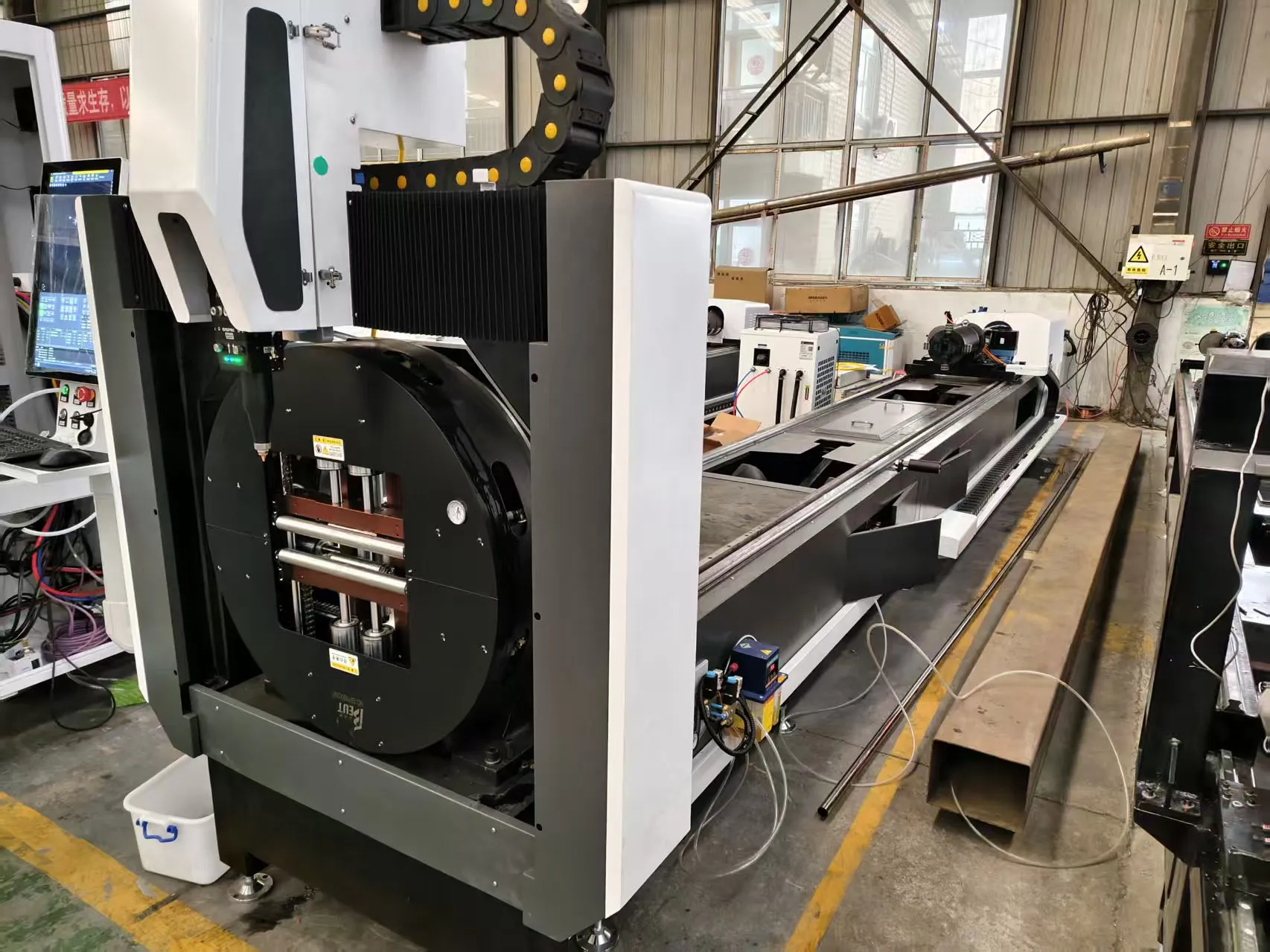
- A CNC tube laser cuts channel to length and adds holes, slots, copes and notches on the web and both flanges in one clamping.
- The channel must fit the square chuck: section depth up to 240, 360 or 520 mm on the LT240, LT360 and LT520.
- Flange thickness sets the laser power: about 3 kW up to 10 mm flanges, 6 kW to 16 mm, 12 kW above that for production speed.
- UPN channel has tapered flanges; holes in the flanges are placed by the software from the measured section, not from the nominal drawing.
On this page
- What steel channel laser cutting is
- Channel sizes, chuck fit and laser power
- Laser power and flange thickness
- What can be cut on a channel
- How the tube laser holds and measures a channel
- Strut channel and cable tray
- Laser, plasma, saw or punch for channel?
- Which machine for channel cutting
- Checks on the first part
- Machines mentioned in this article
- FAQ
What steel channel laser cutting is
Steel channel laser cutting means processing C channel, U channel and UPN or UPE sections on a CNC fiber laser tube cutting machine instead of a band saw and a drill line. The channel is held in the chucks of the tube laser, rotated to bring the web or either flange under the cutting head, and fed forward while the laser cuts the length, the bolt holes, slots, copes, notches and end shapes. The finished part comes off ready for welding or assembly, with the marks of the next operation already on it.
For fabricators the change is mostly in the number of handling steps. Sawing, marking out, drilling the web, turning the bar and drilling each flange becomes one program. The same machine also cuts round tube, square tube and angle, so a channel cutting machine is rarely bought for channel alone.
Channel sizes, chuck fit and laser power
Two numbers decide whether a channel can be laser cut on a given machine: the section depth, which must fit the square chuck, and the flange thickness, which sets the laser power. The tables give both for the common standards. Dimensions are nominal; power is the size that cuts the flange at a production speed, not the maximum it can cut.
UPN channel (EN 10365, formerly DIN 1026-1)
| Section | h × b, mm | Web tw, mm | Flange tf, mm | kg/m | Smallest LT model | Laser power |
|---|---|---|---|---|---|---|
| UPN 80 | 80 × 45 | 6 | 8 | 8.64 | LT240 | 3 kW |
| UPN 100 | 100 × 50 | 6 | 8.5 | 10.6 | LT240 | 3 kW |
| UPN 120 | 120 × 55 | 7 | 9 | 13.4 | LT240 | 3 kW |
| UPN 140 | 140 × 60 | 7 | 10 | 16.0 | LT240 | 3 kW |
| UPN 160 | 160 × 65 | 7.5 | 10.5 | 18.8 | LT240 | 6 kW |
| UPN 180 | 180 × 70 | 8 | 11 | 22.0 | LT240 | 6 kW |
| UPN 200 | 200 × 75 | 8.5 | 11.5 | 25.3 | LT240 | 6 kW |
| UPN 220 | 220 × 80 | 9 | 12.5 | 29.4 | LT240 | 6 kW |
| UPN 240 | 240 × 85 | 9.5 | 13 | 33.2 | LT240 | 6 kW |
| UPN 260 | 260 × 90 | 10 | 14 | 37.9 | LT360 | 6 kW |
| UPN 280 | 280 × 95 | 10 | 15 | 41.8 | LT360 | 6 kW |
| UPN 300 | 300 × 100 | 10 | 16 | 46.2 | LT360 | 6 kW |
American standard C channel (ASTM A6)
| Section | d × b, mm | Web, mm | Flange (avg), mm | kg/m | Smallest LT model | Laser power |
|---|---|---|---|---|---|---|
| C3×4.1 | 76 × 36 | 4.3 | 6.9 | 6.1 | LT240 | 3 kW |
| C4×5.4 | 102 × 40 | 4.7 | 7.5 | 8.0 | LT240 | 3 kW |
| C6×8.2 | 152 × 49 | 5.1 | 8.7 | 12.2 | LT240 | 3 kW |
| C8×11.5 | 203 × 57 | 5.6 | 9.9 | 17.1 | LT240 | 3 kW |
| C10×15.3 | 254 × 66 | 6.1 | 11.1 | 22.8 | LT360 | 6 kW |
| C12×20.7 | 305 × 75 | 7.2 | 12.7 | 30.8 | LT360 | 6 kW |
| C15×33.9 | 381 × 86 | 10.2 | 16.5 | 50.4 | LT520 | 12 kW |
Chinese hot-rolled channel (GB/T 707)
| Section | h × b, mm | Web, mm | Flange, mm | Smallest LT model | Laser power |
|---|---|---|---|---|---|
| 8# | 80 × 43 | 5.0 | 8 | LT240 | 3 kW |
| 10# | 100 × 48 | 5.3 | 8.5 | LT240 | 3 kW |
| 12.6# | 126 × 53 | 5.5 | 9 | LT240 | 3 kW |
| 14a | 140 × 58 | 6 | 9.5 | LT240 | 3 kW |
| 16a | 160 × 63 | 6.5 | 10 | LT240 | 3 kW |
| 18a | 180 × 68 | 7 | 10.5 | LT240 | 6 kW |
| 20a | 200 × 73 | 7 | 11 | LT240 | 6 kW |
| 22a | 220 × 77 | 7 | 11.5 | LT240 | 6 kW |
| 25a | 250 × 78 | 7 | 12 | LT360 | 6 kW |
| 28a | 280 × 82 | 7.5 | 12.5 | LT360 | 6 kW |
Sections at the exact chuck limit, such as UPN 240 on an LT240, are worth confirming with a test cut; the next model up gives more room for flange tolerance and twist. Sections deeper than 520 mm go on the H-beam laser cutting machine.
Laser power and flange thickness
A channel is thickest at the root of the flange, so that is where the cut is slowest. Power figures from the fiber laser cutting speed chart for carbon steel:
| Laser power | Maximum carbon steel | Typical channel work |
|---|---|---|
| 1.5-2 kW | 12-16 mm | Cold-formed and strut channel, light C channel |
| 3 kW | 20 mm | UPN 80-180, C3-C8, flanges up to about 10 mm |
| 4-6 kW | 22 mm | UPN 200-300, C10-C12, flanges 11-16 mm |
| 12 kW | 35 mm | Heavy channel and fast production on thick flanges |
Cutting near the maximum is possible but slow and sensitive to plate quality and gas purity. For daily production, choose the power that puts your thickest flange at about half the maximum.
What can be cut on a channel
| Feature | Where | Notes |
|---|---|---|
| Cut to length, square or mitred | Whole section | Mitres for frames and picture-frame corners |
| Round and slotted bolt holes | Web and both flanges | Hole diameter not less than the material thickness for a clean hole |
| Copes and notches | Flanges and web | For fitting into beams or columns; radius re-entrant corners |
| Slots and tabs | Web and flanges | Tab-and-slot joints locate parts for welding without jigs |
| Weight-saving and cable openings | Web | Any contour from the drawing |
| Part marks | Web | Laser marking at low power |
How the tube laser holds and measures a channel
Channel is an open, asymmetric section, so it behaves differently from tube in the chucks:
- Clamping. The square chuck jaws grip the back of the web and the flange tips. The section sits off-centre, and the software uses the profile from the library (UPN, C, U or user-defined) to know where each face is.
- Flange taper. UPN and American C channel have tapered inner flange faces; UPE and many cold-formed channels are parallel. The cutting head height follows the actual surface, and holes in the flange are positioned on the gauge line, not on the nominal edge.
- Rolling tolerances. EN 10279 allows hot-rolled channel to vary in depth, flange width, out-of-square and straightness. Before cutting, the machine touches or scans the section and corrects the program, so holes land where the drawing puts them on the real bar. Channel parts can also be imported as DSTV files; see CNC tube cutting software.
- Bow and twist. Long channels are rarely straight. Supports between the chucks, and on the LT3 a middle chuck, keep the section steady near the cut.
Strut channel and cable tray
Cold-formed strut channel, such as the 41 × 41 mm section used for pipe and cable supports, and cable tray side rails are some of the most common laser cut channel parts. They are thin, usually 1.5-2.5 mm galvanized or stainless steel, and carry long rows of slots. A 1.5-3 kW tube laser cuts these slot patterns faster than a punch line can be retooled for a new pattern, and changing the slot pitch is a change in the program rather than a new die. Galvanized coatings cut cleanly with nitrogen; zinc fume extraction should be sized for the job.
Laser, plasma, saw or punch for channel?
| Tube laser | Plasma beam cutter | Saw and drill line | Punch line | |
|---|---|---|---|---|
| Best flange range | Up to about 16 mm (to 25 mm with high power) | 10 mm and up | Any | Thin to medium |
| Hole quality | Close tolerance, small holes possible | Larger holes only, some taper | Drilled, best for fitted bolts | Good, fixed shapes |
| Copes and slots | Any shape | Any shape, rougher edge | No | Tooling needed |
| Changeover | New program | New program | Stops and tooling | New dies |
| Machine | LT series, LT3 | 8-axis plasma | — | — |
For a wider comparison on angle and other profiles, see cutting angle iron: plasma vs laser.
Which machine for channel cutting
| Your channel | Machine |
|---|---|
| Strut channel, C channel and UPN up to 240 mm deep | LT240 tube laser, 1.5-6 kW |
| UPN 260-300, C12 channel, up to 360 mm deep | LT360, up to 12 kW |
| Channel up to 520 mm deep, C15 | LT520 or LT3-520 |
| Long or heavy channel, zero tail, weld bevels | LT3 three-chuck series, 6-30 kW |
| Mostly thick structural sections with channel | H-beam laser or 8-axis plasma beam cutter |
| Thousands of identical strut or rail parts | Automatic loading tube laser |
Checks on the first part
- Length on the web and on both flange tips.
- Hole positions from the back of the web and on the flange gauge lines.
- Hole diameter at the top and bottom of the cut on the thickest flange, to check taper.
- Copes and notches: depth, length and corner radius.
- Edge condition: dross on the underside of the flanges, burn-through at corners.
- Coating: on galvanized channel, check the zinc at the cut edge if the part will not be painted.
Have a cutting job in mind? Send the section size, wall thickness and a drawing, and an engineer will tell you which method or machine fits.
Ask on WhatsAppMachines mentioned in this article
LT Series Tube Laser
Channel, tube and angle up to 520 mm.
Compare all models →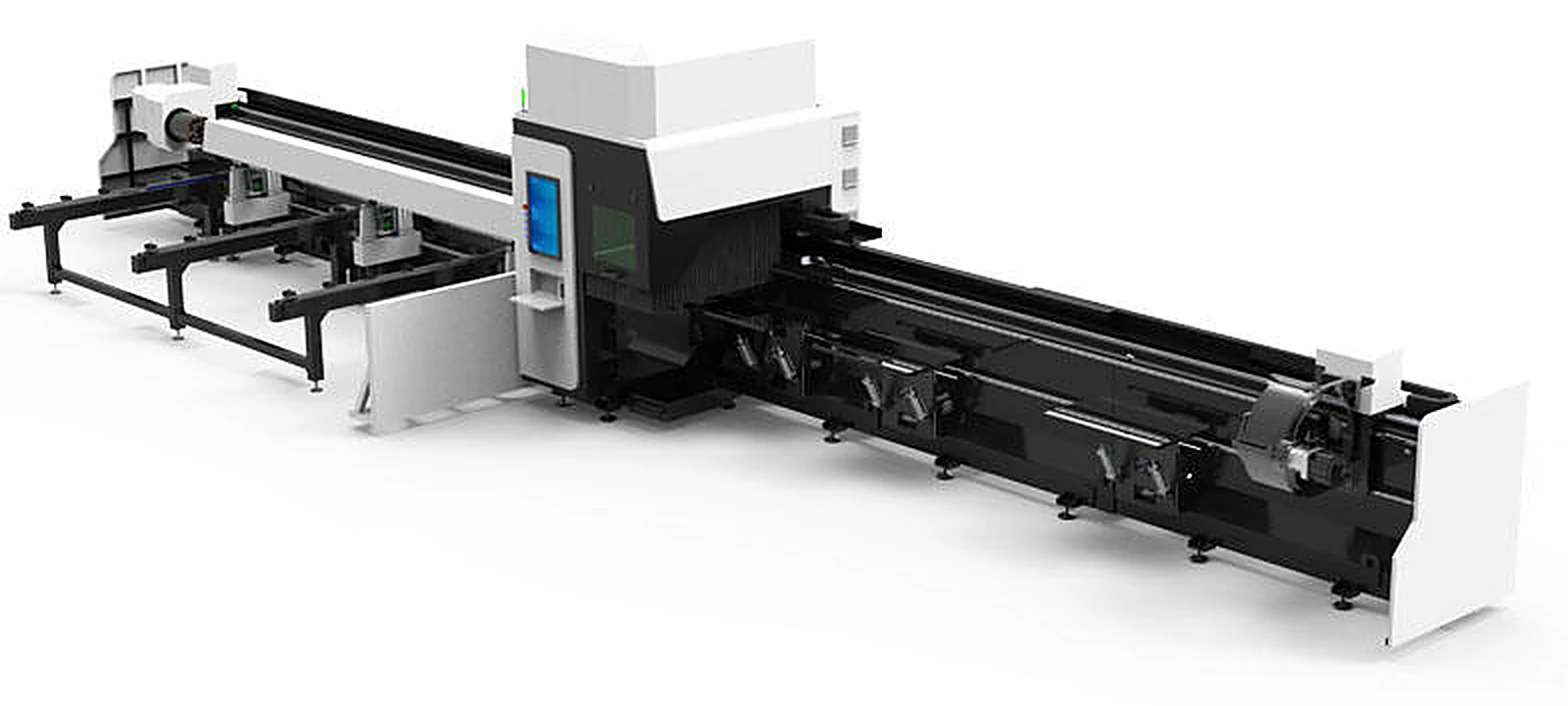
LT3 Three-Chuck Heavy Tube Laser
Zero tail, 6-30 kW, optional bevel.
View machine →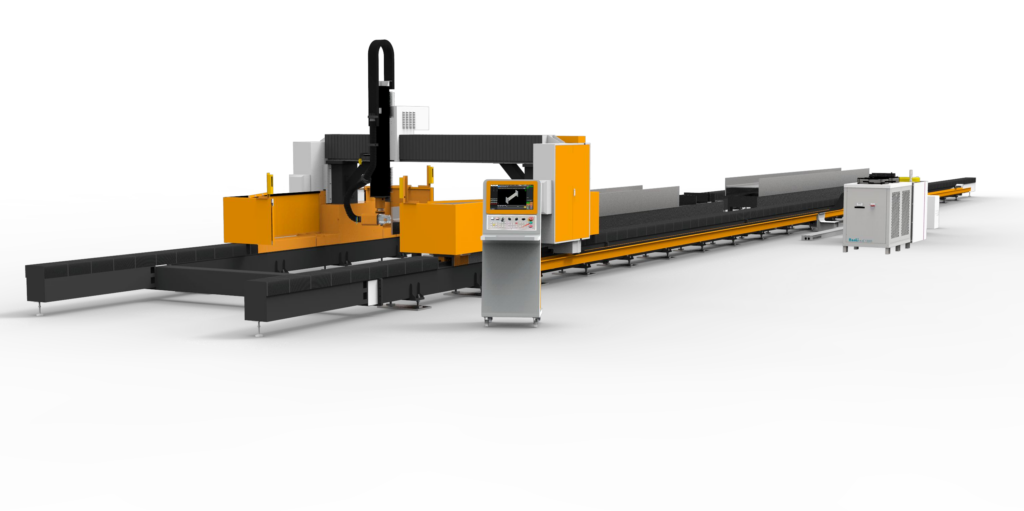
H-Beam Laser Cutting Machine
Sections over 520 mm.
View machine →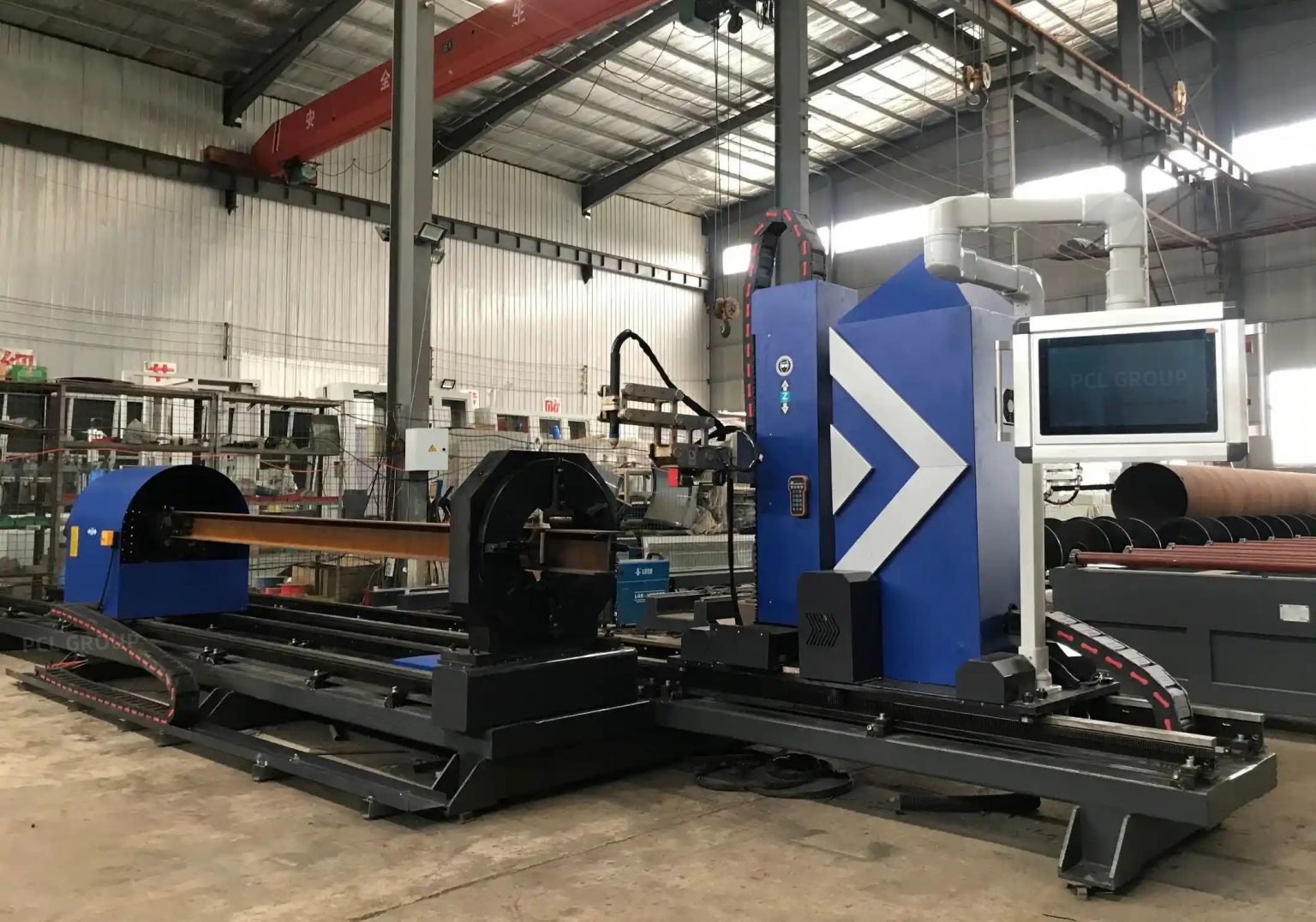
8-Axis Plasma Beam Cutter
Thick structural channel and beams.
View machine →FAQ
Can a tube laser cut steel channel?
Yes. A CNC tube laser with square chucks clamps C, U and UPN channel and cuts holes, slots, copes and ends on the web and both flanges, up to the chuck size.
What size channel fits a 240 mm chuck?
Channel up to 240 mm deep, for example UPN 80 to UPN 220 comfortably and UPN 240 at the limit, or American C3 to C8. Deeper channel needs the LT360 or LT520.
What laser power do I need to cut UPN 200?
UPN 200 has an 11.5 mm flange. A 3 kW laser cuts it; 4-6 kW gives a production speed.
Can you laser cut C channel?
Yes, American C channel from C3 to C15 fits the LT240 to LT520 chucks, with 3-6 kW for most sizes.
How do you cut holes in the flanges of a tapered channel?
The machine measures the section and the software places each hole on the flange gauge line of the real bar. The cutting head follows the tapered surface.
Is laser or plasma better for channel?
Laser for thin to medium flanges and accurate small holes; plasma for thick structural channel where speed and machine cost matter more than hole finish.
Can a laser cut strut channel slots?
Yes. Slot rows in 41 × 41 mm strut channel and cable tray rails are a common tube laser job on 1.5-3 kW machines.
How long a channel can be loaded?
6 m, 9 m or 12 m on the LT series and 6 m or 12 m on the LT3.
Does laser cutting damage galvanized channel?
It leaves a narrow uncoated edge at the cut. Parts that will not be painted can be touched up; nitrogen cutting keeps the edge bright and clean.
What file do I send for a channel part?
A 3D model (STEP or IGES) or a PDF drawing with section size, length and hole positions. We can return a test cut and video.