The Dawn of Ultra-High Power: Why 30kW Matters for Istanbul
In the heart of Turkey’s industrial corridors, from the bustling workshops of Dudullu to the massive fabrication yards of Dilovası, the demand for structural steel has evolved. Istanbul, a city characterized by its ambitious infrastructure projects and world-class sports arenas, requires steel that is not only strong but geometrically complex. The transition from 10kW or 12kW systems to a 30kW fiber laser source is not merely an incremental upgrade; it is a fundamental shift in processing capability.
At 30kW, the laser’s power density allows for the “lightning speed” processing of carbon steel thicknesses up to 50mm and beyond, which are common in the base plates and primary support columns of stadium structures. In Istanbul’s seismic environment, stadium steel must adhere to stringent Eurocode standards. The high power of a 30kW source ensures a smaller Heat Affected Zone (HAZ), preserving the metallurgical integrity of the S355 or S460 high-strength steel often used in these massive projects. This prevents micro-cracking and ensures that the structural integrity of the stadium’s “skeleton” remains uncompromised during its lifespan.
Mastering the Third Dimension: 3D Processing for Complex Trusses
Stadium roofs are rarely flat. They are masterpieces of curves, angles, and interlaced hollow sections. Traditional 2D laser cutting is insufficient for the round, square, and rectangular tubes that form the aesthetic and functional “bird’s nest” or “canopy” designs seen in modern Turkish arenas. A 30kW 3D Structural Steel Processing Center utilizes a specialized multi-axis head and a rotating chuck system to treat the steel beam as a three-dimensional object.
This 3D capability allows the laser to follow the contour of a curved H-beam or a large-diameter circular hollow section (CHS) with surgical precision. For Istanbul’s engineers, this means that the complex intersections where five or six beams meet at a single node can be cut with perfect “fish-mouth” joints. The fit-up is so tight that manual grinding is eliminated, and the structural load is distributed exactly as the CAD model intended.
The Game Changer: ±45° Bevel Cutting and Weld Preparation
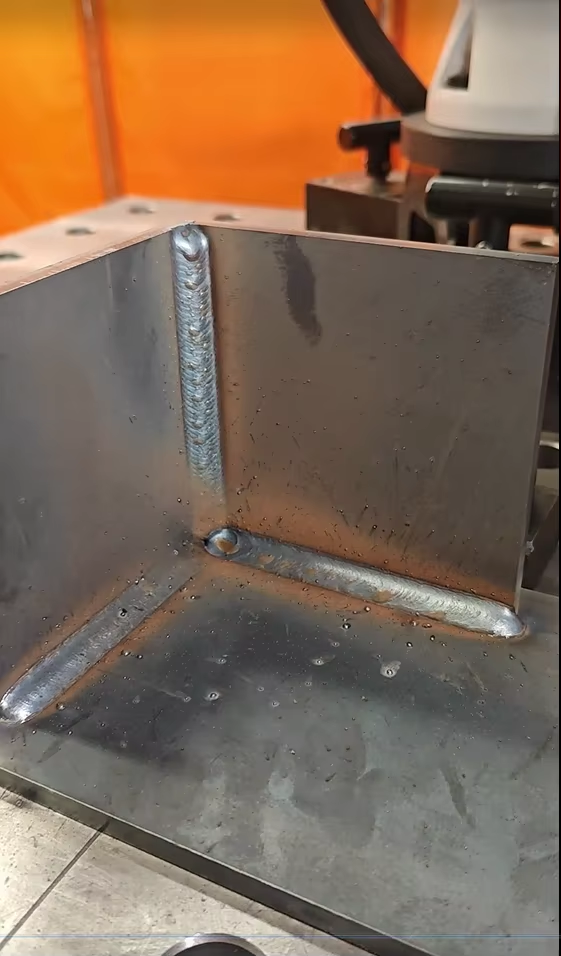
In heavy structural steel, the cut is only half the battle. The real labor cost lies in the “beveling”—the process of angling the edge of the steel to create a “V,” “Y,” or “K” shaped groove for welding. Traditionally, this was done by hand with plasma torches or mechanical milling, a process that is slow, loud, and prone to human error.
The 30kW 3D processing center features a sophisticated five-axis cutting head capable of ±45° tilting. As the laser traverses the steel, it can change its angle dynamically. This allows the machine to cut the shape and the weld bevel simultaneously. In the context of a stadium project, where thousands of tons of steel require deep-penetration welds, the ability to produce a machine-perfect bevel directly on the laser bed is a massive economic advantage. It ensures that when the steel arrives at the construction site in Istanbul, the pieces fit together like Lego blocks, and the robotic or manual welding teams can begin immediately without further edge preparation.
Precision Engineering for Istanbul’s Iconic Stadiums
Istanbul’s geography presents unique challenges for stadium construction—variable wind loads from the Bosphorus and high seismic activity. This necessitates steel structures that are both flexible and incredibly rigid. The precision of a 30kW fiber laser is measured in microns, far surpassing the tolerances of plasma or oxy-fuel cutting.
When fabricating the massive cantilevered trusses that support the roofs of stadiums like the Vodafone Park or the Türk Telekom Arena, even a 2mm deviation at the base can lead to a half-meter error at the tip of the overhang. The 30kW laser’s ability to precision-cut bolt holes and slot-and-tab connectors ensures that the geometric stiffness of the structure is maintained. Furthermore, the 30kW power enables “air cutting” on medium thicknesses, which significantly reduces the cost per part compared to using expensive oxygen or nitrogen, making Istanbul-based fabricators more competitive on the global stage.
The Synergy of Automation and Software Integration
A 30kW 3D processing center in Istanbul is more than a machine; it is a node in a digital ecosystem. These systems are powered by advanced nesting and CAM software that integrates directly with TEKLA or AutoCAD structural models. For a stadium project, the software can take the entire 3D model of the roof structure and automatically generate the cutting paths for every individual beam, including the complex bevels required for the nodes.
This “Digital Twin” approach means that before a single spark is thrown in an Istanbul workshop, the entire cutting process has been simulated to prevent collisions and optimize material usage. In an era where steel prices fluctuate, the ability to minimize scrap through intelligent nesting at 30kW speeds is the difference between a profitable project and a loss. The high-speed piercing technology of the 30kW source also means that thousands of holes can be punched in a fraction of the time, further accelerating the production timeline for time-sensitive sports infrastructure projects.
Technical Maintenance and the Fiber Advantage
As an expert, it is crucial to highlight why fiber technology—specifically at the 30kW level—is superior for the Istanbul market. Unlike CO2 lasers, which require complex mirror alignments and gas mixtures, fiber lasers deliver the beam through a flexible glass fiber. This makes them exceptionally robust in industrial environments.
However, 30kW of power generates immense heat. The processing centers in Istanbul are equipped with high-capacity dual-circuit chilling systems to maintain the stability of the laser source and the cutting head. The optical components must be of the highest quality (often using fused silica with specialized coatings) to withstand the “thermal lensing” effect that can occur at such high wattages. For the Istanbul fabricator, this means investing in a system with a dust-proof, pressurized cutting head to ensure that the maritime humidity of the city doesn’t interfere with the sensitive optics.
Economic and Environmental Impact on the Turkish Steel Sector
The move to 30kW laser processing is also a move toward a “greener” Istanbul. Compared to plasma cutting, fiber lasers produce fewer fumes and require less secondary processing (which usually involves noisy grinding and chemical cleaning). The energy efficiency of a fiber laser—converting over 40% of electrical energy into light—is significantly higher than older technologies.
Economically, the speed of a 30kW machine allows one Istanbul-based facility to do the work of three traditional shops. This consolidation of production capacity is vital for Turkey’s goal of becoming the primary steel fabricator for Europe, the Middle East, and Africa. By specializing in the ±45° beveling of complex stadium components, local firms can offer a “one-stop-shop” service that includes everything from raw beam processing to site-ready assembly kits.
Conclusion: Setting the Global Standard from the Bosphorus
The 30kW Fiber Laser 3D Structural Steel Processing Center is the ultimate tool for the modern architectural age. In Istanbul, where the skyline is constantly being redefined by bold engineering, this technology is no longer a luxury—it is a necessity. By mastering the art of the ±45° bevel and the speed of ultra-high-power cutting, Turkish fabricators are not just building stadiums; they are crafting the future of structural expression. The precision, efficiency, and sheer power of these systems ensure that the next generation of Istanbul’s landmarks will be built faster, safer, and with a level of geometric complexity that honors the city’s rich architectural heritage.