The Dawn of High-Power Laser Fabrication in Charlotte’s Infrastructure
Charlotte, North Carolina, has long been a logistical and engineering powerhouse in the American Southeast. As the city expands and its infrastructure ages, the demand for sophisticated bridge engineering solutions has reached a fever pitch. Traditional methods of fabricating bridge components—involving plasma cutting, mechanical drilling, and manual oxy-fuel beveling—are increasingly viewed as bottlenecks. The introduction of the 30kW Fiber Laser Universal Profile Steel Laser System changes the calculus entirely.
In the realm of bridge engineering, “massive” is the standard. We are dealing with structural members that must support thousands of tons while enduring decades of environmental stress and vibration. A 30kW fiber laser source provides the “thermal punch” necessary to pierce and cut through the thick-gauge carbon steels common in bridge girders and diaphragms. Unlike lower-power systems, the 30kW threshold allows for high-speed processing of materials up to 50mm (2 inches) or more, maintaining a narrow kerf and a minimal heat-affected zone (HAZ).
Unlocking Geometric Freedom: The Infinite Rotation 3D Head
Perhaps the most transformative component of this system is the infinite rotation 3D head. In conventional 3D laser cutting, the cutting head is often limited by “cable wrap,” meaning it must eventually rotate back to its starting position after a certain degree of travel. This creates “dead time” and complicates the cutting paths for complex profiles.
An infinite rotation head eliminates these mechanical constraints. In the context of bridge engineering, this is critical for preparing complex weldments. Modern bridge designs often utilize intricate intersections of hollow structural sections (HSS) or complex bevels on I-beam flanges to ensure full-penetration welds. The 3D head can move seamlessly around a stationary or rotating profile, executing A, V, Y, and X-type bevels in a single pass. This level of precision ensures that when components reach the job site or the welding floor, the fit-up is perfect, virtually eliminating the need for on-site grinding or “making it fit.”
Processing Universal Profiles: Beyond the Flat Plate
While flat-bed lasers have been a staple of manufacturing for years, “Universal Profile” systems are designed to handle the three-dimensional reality of bridge components. Bridges are rarely built from flat plates alone; they are assemblies of channels, angles, bulb flats, and heavy wide-flange beams.
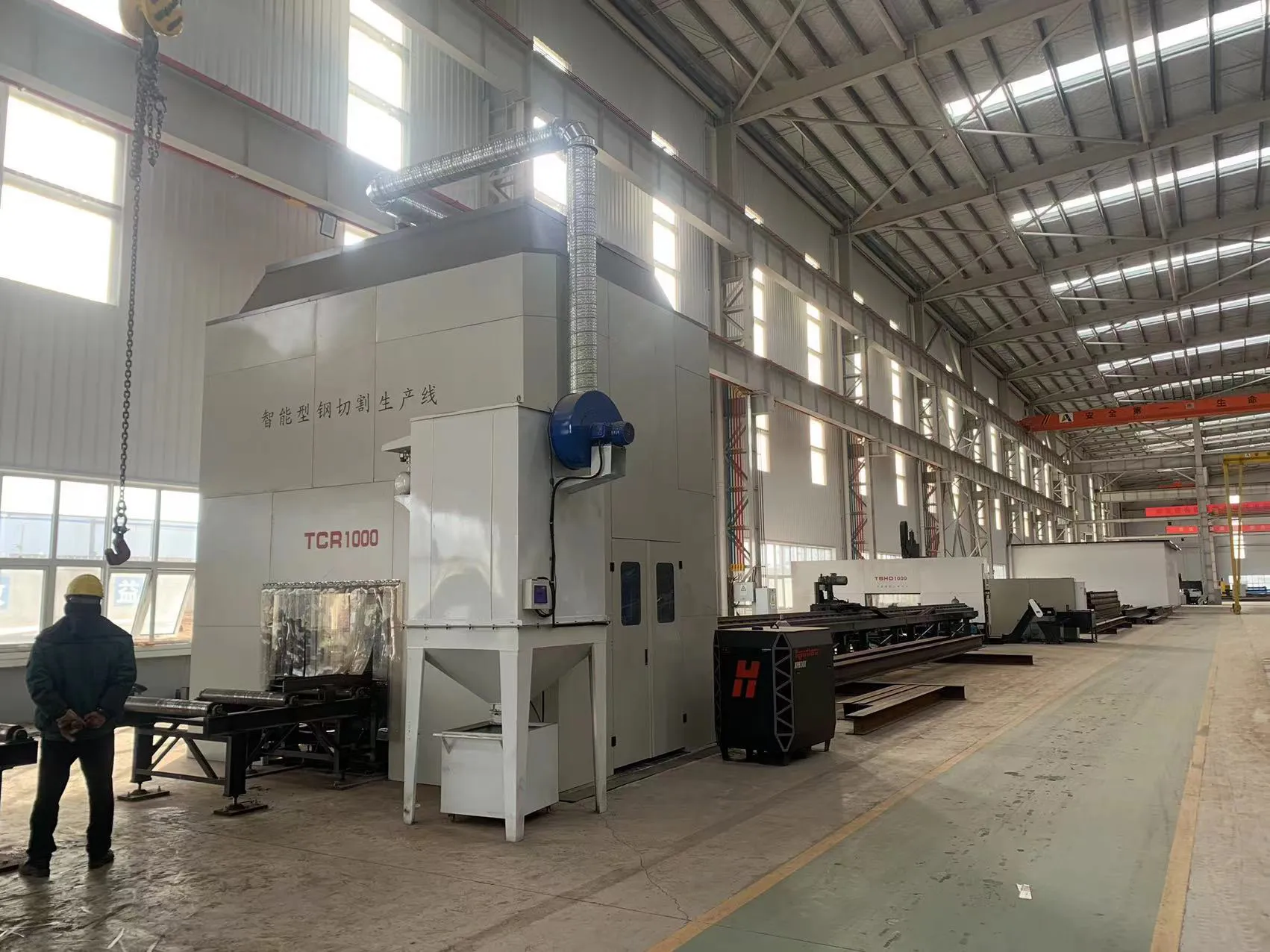
The 30kW system in Charlotte is engineered with sophisticated chucking and material handling systems that can support the weight of a 12-meter (or longer) bridge chord. As the laser head maneuvers, the system’s software—integrated with BIM (Building Information Modeling) and TEKLA structures—translates complex architectural drawings into precise cutting instructions. This allows for the automated cutting of bolt holes, cope slots, and utility pass-throughs with a tolerance of +/- 0.1mm. Such accuracy is unattainable with manual layout and mag-drilling, which have been the industry standard for over a century.
Thermal Management and Structural Integrity
As a fiber laser expert, I must emphasize the importance of the Heat Affected Zone (HAZ) in bridge engineering. Bridges are fatigue-critical structures. Every cut made into a steel member introduces heat, which can alter the grain structure of the metal, potentially creating brittle points where cracks could initiate over decades of service.
The 30kW fiber laser utilizes a high-energy density beam that moves at significantly higher velocities than plasma or oxy-fuel systems. Because the beam moves so fast, the total heat input into the surrounding material is actually lower. This results in a much narrower HAZ. Furthermore, the laser-cut edge is smoother (lower surface roughness), which is a key factor in improving the fatigue life of the steel. In the humid, variable climate of North Carolina, ensuring the structural integrity of bridge steel against stress-corrosion cracking is paramount, and laser technology provides a superior starting point compared to legacy methods.
Economic Impact on Charlotte’s Construction Landscape
The deployment of a 30kW laser system in Charlotte provides local fabricators with a massive competitive advantage. Bridge projects are often plagued by delays and cost overruns. A significant portion of these costs stems from the labor-intensive nature of preparing structural steel.
By utilizing a 30kW system with an infinite rotation head, a shop can reduce the “man-hours per ton” of steel fabricated. What used to take a team of three people two days to layout, drill, and bevel can now be completed by a single machine operator in under an hour. This efficiency allows Charlotte-based firms to bid more competitively on federal and state DOT (Department of Transportation) projects, keeping the economic benefits of infrastructure spending within the region. Moreover, the reduction in scrap—thanks to advanced nesting algorithms optimized for profiles—further drives down the environmental and financial cost of the project.
The Role of Software and Digital Twin Integration
The “intelligence” of the 30kW system is as important as its power. These systems are now fully integrated into the digital workflow of bridge engineering. When a bridge is designed in Charlotte, the engineer creates a digital twin. This data is fed directly into the laser’s controller.
The infinite rotation 3D head relies on real-time sensing technology. As it processes a massive H-beam, it uses capacitive sensors to detect any slight deviations or “bowing” in the raw material, adjusting the cutting path in milliseconds to ensure the geometry remains true to the design. This “smart fabrication” is the backbone of the next generation of accelerated bridge construction (ABC) techniques, where pre-fabricated components are moved to the site and assembled like a precision-engineered kit.
Sustainability and the Future of Bridge Engineering
Sustainability is no longer an afterthought in civil engineering. The 30kW fiber laser is a remarkably efficient tool. Fiber lasers have a wall-plug efficiency of about 30-40%, which is significantly higher than CO2 lasers or many mechanical processes when considering the entire lifecycle.
Furthermore, the precision of the infinite rotation head means less weld filler material is required because the joint fit-up is so tight. This reduces the carbon footprint associated with welding consumables and the energy-intensive welding process itself. In a city like Charlotte, which is increasingly focused on green building and sustainable urban development, the adoption of high-efficiency laser technology aligns perfectly with broader environmental goals.
Conclusion: A New Standard for the Queen City
The 30kW Fiber Laser Universal Profile Steel Laser System with Infinite Rotation 3D Head is more than just a piece of machinery; it is an industrial revolution housed within a fabrication shop. For Charlotte’s bridge engineering sector, it represents the move from the “sledgehammer and torch” era into the “photon and silicon” era.
By providing the power to cut through the thickest structural steels and the agility to navigate complex 3D geometries without interruption, this technology ensures that the bridges of tomorrow will be safer, more aesthetic, and built with a level of efficiency previously thought impossible. As Charlotte continues to position itself as a hub of American infrastructure excellence, the 30kW fiber laser will undoubtedly be the tool that shapes the skyline and the spans that connect the region.