The Dawn of Ultra-High Power: Why 30kW Matters
In the realm of fiber laser technology, the move from 10kW to 20kW was significant, but the leap to 30kW marks the entry into a territory previously dominated by plasma and oxy-fuel cutting. As a fiber laser expert, I have witnessed the evolution of beam quality and power density, and the 30kW threshold is where we see the “Universal Profile” capability truly shine.
At 30kW, the energy density at the focal point is immense. This power allows for the efficient processing of carbon steel up to 80mm and stainless steel up to 100mm. For airport construction in Queretaro, where structural integrity is non-negotiable, the 30kW fiber laser provides a “cold” cut compared to traditional methods. While it sounds paradoxical—given the heat of a laser—the speed at which a 30kW beam traverses the material (often exceeding 2 meters per minute on thick plates) means the Heat Affected Zone (HAZ) is remarkably narrow. This preserves the metallurgical properties of the high-tensile steel used in airport spans and seismic-resistant frames.
Universal Profile Processing: Beyond Flat Sheets
A “Universal Profile” system is not restricted to flat plate processing. In the context of the Queretaro airport project, the architecture requires complex geometries—I-beams, H-beams, C-channels, and heavy-walled square tubing. Traditional fabrication involves multiple machines: a saw for length, a drill for bolt holes, and a plasma torch for notches.
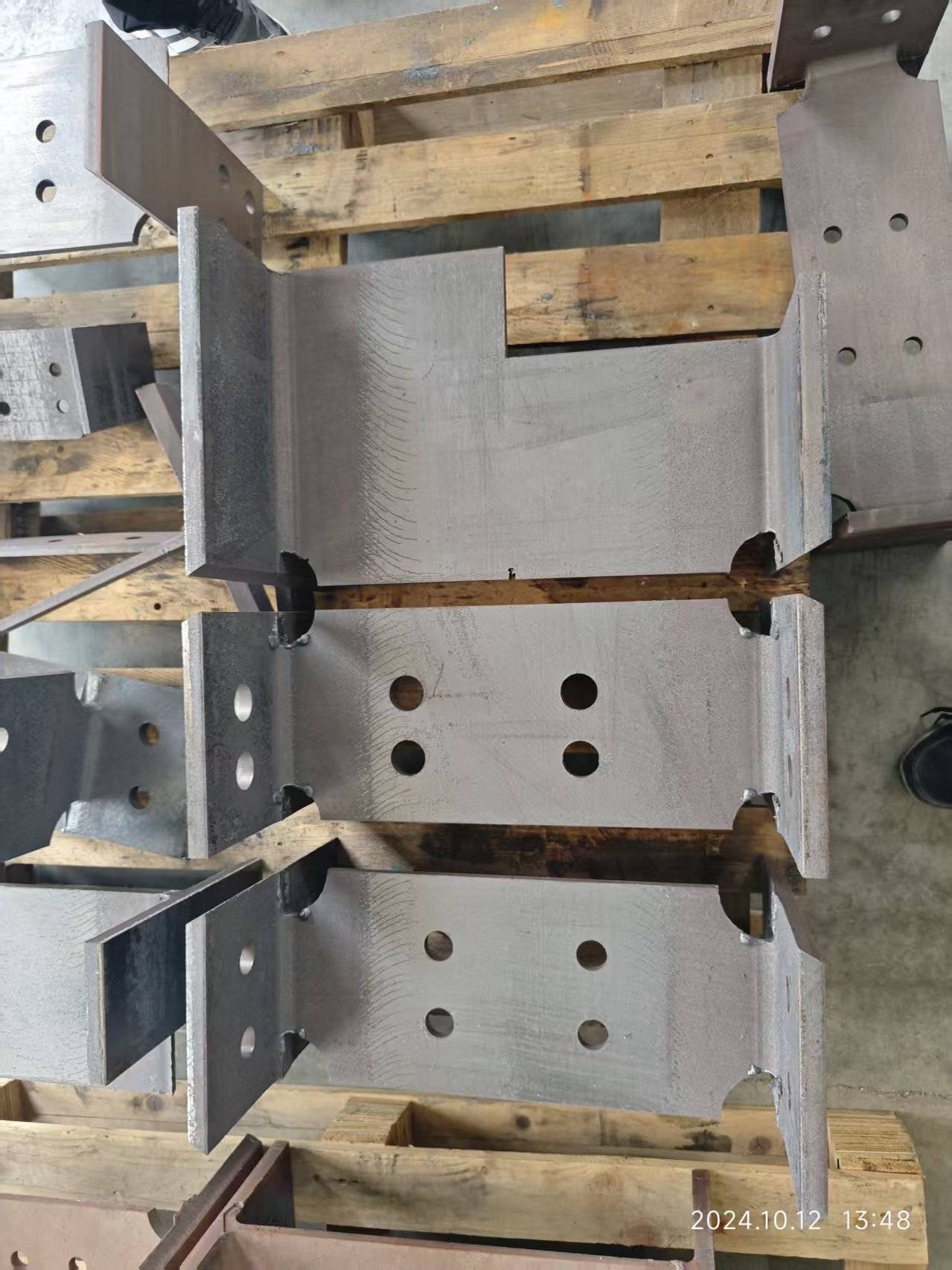
The 30kW Universal Profile system integrates all these functions into a single pass. Equipped with 3D five-axis cutting heads and rotary chucks, the system can perform complex beveling for weld preparation on heavy profiles. For airport hangars that require massive long-span trusses, the ability to laser-cut precise interlocking joints directly into the beams ensures that on-site assembly is faster and requires significantly less corrective welding. This “Lego-like” precision is only possible when the laser can maintain its focal integrity across the varying surfaces of a structural profile.
Zero-Waste Nesting: The Algorithm of Sustainability
In high-stakes infrastructure projects, material cost is the largest variable. Steel prices fluctuate, and on a project the size of an international airport, even a 5% waste margin can equate to millions of dollars in lost revenue. This is where Zero-Waste Nesting (ZWN) technology becomes the silent hero of the Queretaro installation.
ZWN isn’t just about fitting shapes together; it’s an advanced AI-driven optimization process. Traditional nesting leaves a “skeleton” of scrap material. Our 30kW system utilizes “Common Line Cutting,” where two parts share a single cut path. At 30kW, the kerf (the width of the cut) is so precise and stable that the software can calculate paths that eliminate the space between parts entirely.
Furthermore, the system employs “Remnant Management.” When a sheet or profile is partially used, the laser automatically scans the remaining material and stores the coordinates in a digital library. For the next small bracket or connector needed for the airport terminal, the system fetches a remnant rather than starting a new sheet. In a city like Queretaro, which is positioning itself as a leader in “Green Industry,” this reduction in scrap metal aligns perfectly with regional sustainability goals.
Queretaro: The Strategic Hub for Aerospace and Infrastructure
Queretaro has emerged as the “Silicon Valley” of Mexican aerospace and advanced manufacturing. The decision to house a 30kW Universal Profile system here is strategic. The local workforce is already highly skilled in CNC operations and photonics, providing the necessary human capital to maintain such a sophisticated machine.
The airport construction project serves as the primary catalyst. Airport terminals are unique structures; they require vast open spaces with minimal pillar interference, necessitating heavy-gauge structural steel that can support immense roof loads. By utilizing a 30kW laser locally in Queretaro, contractors can source raw steel and process it just kilometers from the construction site, rather than importing pre-fabricated components from overseas. This slashes logistics costs and reduces the carbon footprint associated with heavy transport.
Technical Challenges: Gas Dynamics and Thermal Management
Operating a 30kW system is not without its challenges. At these power levels, the physics of the “assist gas” becomes as important as the laser beam itself. When cutting thick structural steel for the airport, we typically use High-Pressure Nitrogen or Oxygen. Nitrogen provides a clean, oxide-free edge that is ready for immediate painting or galvanizing—essential for the aesthetic and durational requirements of airport architecture.
However, 30kW generates significant back-reflection and heat. To protect the delicate optical components, the system in Queretaro utilizes a gold-plated internal shutter and real-time monitoring of the protective window. If the system detects even a speck of dust or a thermal shift in the lens, it shuts down in milliseconds to prevent a catastrophic “thermal runaway.” As an expert, I emphasize that the 30kW system is not just about raw power; it is about the sophisticated sensors that allow that power to be harnessed safely.
Impact on Airport Structural Integrity
The structural demands of an airport are rigorous. Every bolt hole and every weld prep must meet stringent safety codes. Traditional mechanical drilling can introduce micro-cracks around the hole periphery due to physical stress. Plasma cutting can cause localized hardening of the steel edge, making it brittle.
The 30kW fiber laser avoids these pitfalls. The precision of the laser-cut hole is within microns, ensuring a perfect “interference fit” for structural bolts. For the massive cantilevered roofs common in modern airport design, this level of precision ensures that the load distribution is exactly as the engineers modeled it in their BIM (Building Information Modeling) software. The “digital twin” of the airport becomes a reality because the 30kW laser can execute the digital design with zero deviation.
The Economic Multiplier of Fiber Laser Adoption
Beyond the immediate construction of the airport, the presence of this 30kW system in Queretaro creates an economic multiplier effect. It raises the technical ceiling for the entire region. Local fabrication shops can now bid on international-grade projects that were previously out of reach.
The “Zero-Waste” aspect also changes the bidding math. When a fabricator can guarantee 95% material utilization versus the industry-standard 75%, they can offer more competitive pricing while maintaining higher margins. This efficiency attracts more investment, further solidifying Queretaro’s reputation as a center for industrial excellence.
Conclusion: The Future of Global Infrastructure
The 30kW Fiber Laser Universal Profile Steel Laser System in Queretaro is more than a machine; it is a blueprint for the future of global infrastructure. By combining the raw power of 30,000 watts with the surgical precision of AI-driven nesting, we are entering an era where we can build bigger, faster, and more sustainably.
For the airport construction project, this means a terminal that is safer, completed sooner, and built with a fraction of the traditional waste. As we look toward the next decade of industrial growth, the integration of ultra-high-power fiber lasers will be the defining factor in which regions lead and which regions follow. Queretaro, through this investment, has firmly placed itself in the lead, proving that the future of heavy fabrication is light—laser light.