The Dawn of High-Power Fiber Lasers in Structural Fabrication
For decades, the fabrication of structural steel—specifically H-beams and I-beams—relied on a fragmented workflow of sawing, mechanical drilling, and manual oxy-fuel or plasma torching. While functional, these methods introduced cumulative errors and significant labor costs. The introduction of the 6000W fiber laser has fundamentally altered this trajectory. As an expert in laser physics and industrial application, I have observed that the 6kW threshold is the “sweet spot” for structural steel. It provides the necessary power density to penetrate thick-walled H-beams (up to 20mm or more) with a narrow kerf and minimal heat-affected zone (HAZ).
In the context of Mexico City, a central hub for engineering and logistics, the adoption of this technology is not merely an upgrade; it is a competitive necessity. The 6000W source offers a wavelength of 1.06 microns, which is absorbed more efficiently by carbon steel than the longer wavelengths of CO2 lasers. This leads to cutting speeds that are three to five times faster than traditional methods, particularly when processing the complex geometries of structural beams used in power tower lattice structures.
Precision Engineering for Power Tower Integrity
Power towers (transmission towers) are the backbone of the electrical grid. They must withstand extreme environmental stresses, from high-altitude winds in the Valley of Mexico to seismic activity. The structural integrity of these towers depends entirely on the precision of the connection points—the bolt holes and notches in the H-beams and angle steels.
A 6000W H-Beam laser cutting Machine provides a level of precision that mechanical drilling cannot match. When drilling, bits can dull or wander, leading to misaligned bolt holes that require expensive field corrections. The laser, guided by high-precision CNC systems, maintains a positional accuracy of ±0.05mm. This ensures that every H-beam arrives at the construction site ready for perfect assembly, eliminating the need for reaming or “forcing” fits, which can compromise the structural steel’s galvanization and long-term corrosion resistance.
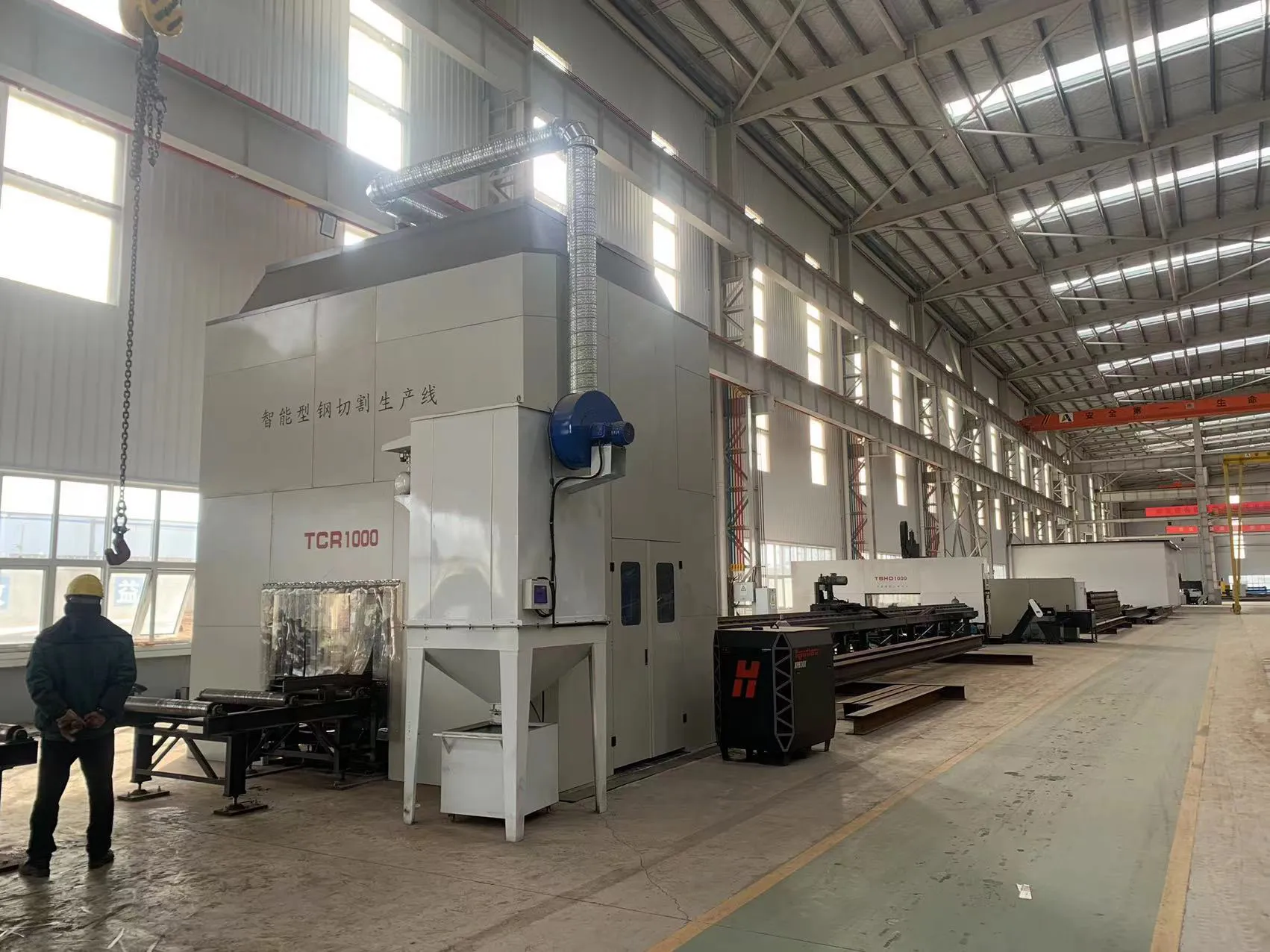
The Mechanics of H-Beam Processing: Beyond Flat Cutting
Cutting an H-beam is significantly more complex than cutting a flat sheet. It requires a multi-axis system—often 5-axis or 7-axis—that allows the laser head to maneuver around the flanges and the web of the beam. The 6000W machines currently being deployed in Mexico City utilize sophisticated chuck systems that rotate the beam with synchronized precision.
The “H” geometry presents unique challenges, such as the “shadowing” of the web by the flanges. Advanced fiber lasers solve this through a specialized 3D cutting head that can tilt and rotate. This allows for complex beveling, which is essential for welding preparations. In power tower fabrication, where many beams meet at oblique angles, the ability to laser-cut precise bevels directly on the machine saves hundreds of man-hours traditionally spent on manual grinding.
Automatic Unloading: The Key to Continuous Production
In a high-output environment like Mexico City’s industrial zones, the bottleneck is rarely the cutting speed itself; it is the material handling. An H-beam can weigh several hundred kilograms. Manual unloading via overhead cranes is slow, dangerous, and prone to damaging the finished part. This is where the automatic unloading system becomes transformative.
Modern 6000W H-beam lasers are integrated with heavy-duty conveyor systems and hydraulic lifting arms. Once the laser completes the final cut, the unloading system identifies the part’s center of gravity and safely transitions it to a sorting area. This allows the machine to immediately begin processing the next raw beam. For a power tower manufacturer, this translates to a “lights-out” capability where the machine can operate through shifts with minimal human intervention, maximizing the Return on Investment (ROI) of the 6kW laser source.
Why Mexico City? Strategic and Environmental Factors
Mexico City sits at an elevation of approximately 2,240 meters. For many industrial processes, this altitude introduces variables—primarily regarding air density and cooling efficiency. As a laser expert, I emphasize that 6000W fiber lasers are ideal for this environment because they are solid-state systems. Unlike CO2 lasers, which require complex gas mixtures and are sensitive to atmospheric pressure, fiber lasers are sealed and cooled by high-efficiency chillers.
Furthermore, the strategic location of Mexico City allows fabricators to serve both the domestic expansion of the CFE (Comisión Federal de Electricidad) and export markets in North and Central America. The “Nearshoring” trend has pushed Mexican fabricators to adopt Tier-1 technology to meet the quality demands of international developers. A 6000W laser with automatic unloading ensures that a shop in Tlalnepantla or Vallejo can produce components that meet or exceed global ASTM and ISO standards.
Software Integration: From Tekla to the Laser Head
The “intelligence” of the 6000W H-beam machine lies in its software. In the power tower industry, most designs are created in specialized BIM (Building Information Modeling) software like Tekla Structures. In the past, translating these designs into machine instructions was a tedious process of manual data entry.
Current laser systems in the Mexican market feature direct CAD/CAM integration. The machine software reads the DSTV or STEP files directly from the engineering department. It automatically calculates the nesting to minimize scrap—a critical factor when the price of structural steel is volatile. The software also manages the 6000W power modulation, slowing down for tight corners to prevent over-melting and ramping up on straight flange cuts to maintain maximum velocity.
Safety and Sustainability in Modern Fabrication
Safety is a paramount concern in Mexico’s evolving industrial regulations. Traditional H-beam processing is loud, produces significant dust, and involves heavy manual lifting. The 6000W laser machine is fully enclosed, protecting operators from Class 4 laser radiation and significantly muffling the noise of the cutting process. High-capacity dust extraction systems capture the particulate matter generated by the 6kW beam, creating a much cleaner work environment than traditional plasma stations.
From a sustainability perspective, the fiber laser is remarkably efficient. It converts electricity to light with high wall-plug efficiency, consuming significantly less power per meter of cut than plasma or older laser technologies. For power tower fabricators looking to reduce their carbon footprint—a metric becoming increasingly important in government contracts—the fiber laser is the greenest choice available for heavy structural work.
The Economic Impact: ROI and Market Competitiveness
Investing in a 6000W H-beam laser with automatic unloading is a significant capital expenditure. However, the ROI is typically realized within 18 to 24 months for high-volume fabricators in Mexico City. The savings come from three primary sources:
- Labor Reduction: One operator can manage a machine that replaces the work of a five-person drilling and sawing crew.
- Elimination of Secondary Processes: The “ready-to-weld” and “ready-to-bolt” finish of the laser cut eliminates the need for deburring, grinding, and re-drilling.
- Material Yield: Advanced nesting software reduces “end-of-bar” waste, which, when scaled over thousands of tons of steel for a regional power grid expansion, amounts to millions of pesos in savings.
Conclusion: Powering the Future of Mexico
As Mexico continues to modernize its energy infrastructure, the demand for transmission towers will only accelerate. The transition to 6000W H-Beam laser cutting machines with automatic unloading represents the pinnacle of current fabrication technology. For manufacturers in Mexico City, this technology provides the precision of a surgeon with the power of a locomotive. By embracing these systems, the industry is not just cutting steel; it is building a more reliable, efficient, and robust future for the nation’s power grid. The synergy of high-wattage fiber optics and automated logistics is, without question, the new standard for excellence in structural steel fabrication.













