The Dawn of High-Power Laser Processing in Casablanca
Casablanca has long served as the industrial gateway between Africa and Europe. As the offshore energy sector—encompassing both traditional oil and gas and the burgeoning offshore wind market—expands along the Atlantic coast, the demand for structural steel that can withstand extreme marine environments has reached an all-time high. Enter the 20kW H-Beam fiber laser cutting machine.
For decades, the fabrication of heavy H-beams was dominated by plasma cutting or mechanical sawing and drilling. While functional, these methods often lacked the precision required for the modular “Lego-block” assembly style of modern offshore platforms. The introduction of 20kW fiber laser technology to Casablanca’s fabrication yards represents a quantum leap. At this power level, the laser is no longer restricted to thin sheet metal; it becomes a surgical tool for massive structural members, capable of piercing and profiling heavy-gauge carbon steel with a speed and edge quality that was previously unthinkable.
The Physics of 20kW: Why Power Matters for Offshore Steel
In the world of fiber lasers, power equates to more than just speed; it dictates the quality of the Heat Affected Zone (HAZ). For offshore platforms, the HAZ is a critical factor. High-strength structural steels (such as S355 or S460) can experience metallurgical changes if exposed to excessive heat for prolonged periods, leading to brittleness and potential stress fractures in the harsh, corrosive environment of the sea.
A 20kW laser source allows for “high-speed sublimation” and efficient melt-expulsion. Because the laser moves so quickly through the H-beam’s flange and web, the total heat input into the material is significantly lower than that of a 6kW or 10kW system. The result is a narrower kerf, a microscopic HAZ, and an edge finish that often requires zero secondary grinding before welding. In Casablanca’s high-output environments, this eliminates hundreds of man-hours spent on edge preparation, directly accelerating the timeline of platform construction.
Zero-Waste Nesting: The Economic Imperative
Offshore platforms require specialized, high-grade alloys and treated steels that are significantly more expensive than standard construction-grade material. In a traditional fabrication workflow, the “scrap rate” for H-beams can be as high as 15% to 20% due to the complexities of 3D cutting and the limitations of manual layout.
Zero-waste nesting software, integrated directly into the 20kW laser’s control system, uses advanced heuristic algorithms to arrange parts along the H-beam with mathematical precision. In Casablanca, where resource efficiency is a key pillar of the “Green Morocco” industrial strategy, this technology is transformative.
The software considers the 3D geometry of the beam—the flanges and the web—and utilizes “common line cutting.” This technique allows two parts to share a single cut path, not only saving time but also eliminating the sliver of scrap that usually exists between parts. Furthermore, the nesting engine can identify “remnant” spaces to cut smaller brackets, gussets, or washers from the web of the beam that would otherwise be discarded. For a major offshore project involving thousands of tons of steel, a reduction in waste from 15% to 2% represents millions of Dirhams in savings.
Precision Engineering for Complex H-Beam Geometries
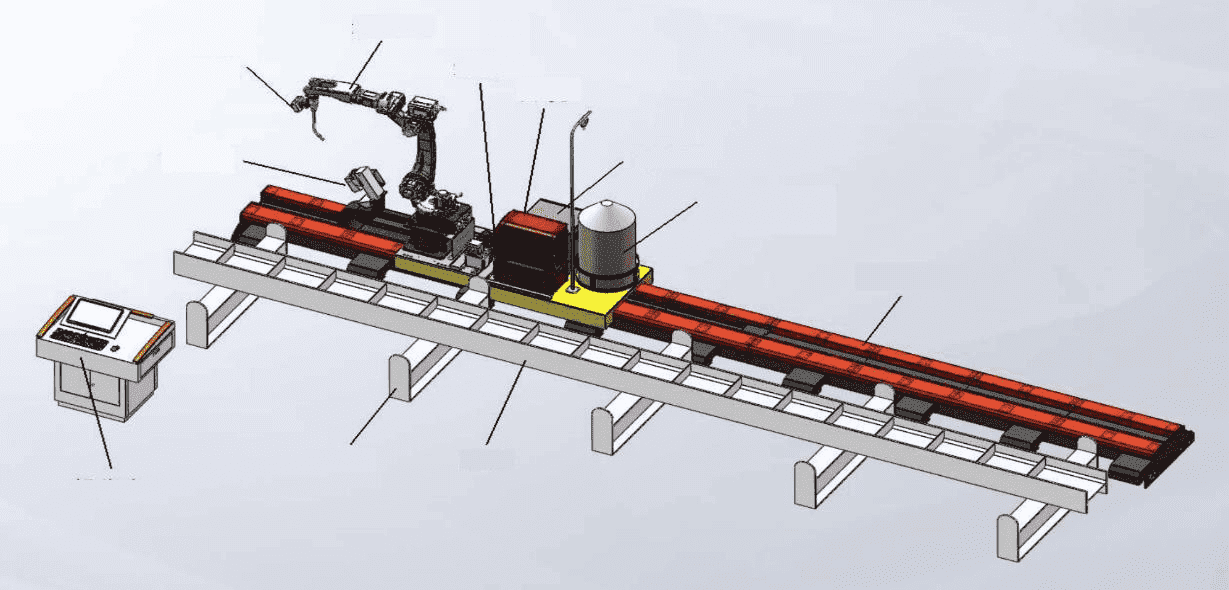
H-beams are not simple shapes to process. They require simultaneous control of multiple axes to handle the thickness of the flanges and the relatively thinner web, often necessitating 5-axis or even 6-axis robotic laser heads. The 20kW machines deployed in Casablanca feature sophisticated sensing technology that compensates for “beam twist” or dimensional deviations common in hot-rolled structural steel.
As the H-beam moves through the machine on a series of precision chucks and rollers, the laser head uses non-contact capacitive sensors to maintain a constant focal point. This is crucial when cutting complex miters, cope holes, or bolt patterns required for offshore jackets and topsides. The accuracy of these cuts—often within tolerances of +/- 0.1mm—ensures that when these massive components are barged out into the Atlantic for assembly, they fit together perfectly the first time. In offshore construction, there is no room for “field adjustments”; everything must be right at the port of Casablanca.
Sustainability and the Casablanca Advantage
The transition to 20kW fiber lasers also aligns with global shifts toward sustainable manufacturing. Compared to CO2 lasers or plasma cutters, fiber lasers are incredibly energy-efficient, boasting wall-plug efficiencies of over 40%. When combined with zero-waste nesting, the carbon footprint per ton of fabricated steel drops dramatically.
Casablanca’s strategic location provides a unique advantage for this technology. The proximity to the Port of Casablanca and the nearby Jorf Lasfar industrial complex means that raw materials can be imported, processed with high-efficiency laser technology, and exported to offshore sites in the North Sea, the Gulf of Guinea, or the Mediterranean with minimal logistical friction. The city is becoming a center of excellence, training a new generation of Moroccan engineers and technicians in CAD/CAM optimization and laser physics.
Overcoming the Challenges of the Marine Environment
Offshore platforms face the relentless force of salt-spray corrosion. The 20kW laser contributes to the longevity of these structures in a way that is often overlooked: surface integrity. Because laser cutting is a non-contact process, there is no mechanical stress or micro-cracking introduced to the edge of the H-beam.
Moreover, the precision of the 20kW beam allows for the cutting of incredibly clean “weld preps” (bevels). Whether it’s a V-prep, X-prep, or K-prep, the laser can execute these angles with a consistency that manual torches cannot match. A perfect weld prep leads to a perfect weld, which is the primary defense against the structural fatigue caused by wave action and wind loads on an offshore rig.
The Future: AI and Real-Time Optimization
The next evolution of H-beam cutting in Casablanca involves the integration of Artificial Intelligence with the 20kW laser. Future systems will utilize real-time vision sensors to adjust nesting patterns on the fly if a defect is detected in the raw steel. As Moroccan industry moves toward “Industry 4.0,” the 20kW laser becomes a data node, reporting on gas consumption, cutting speeds, and material utilization in real-time.
For offshore platform developers, this means total traceability. Every cut on every H-beam can be logged, timestamped, and verified against the digital twin of the platform. This level of quality assurance is becoming a prerequisite for insurance and safety certification in the offshore sector.
Conclusion
The deployment of 20kW H-Beam Laser Cutting Machines with zero-waste nesting is more than just a mechanical upgrade for Casablanca’s industrial sector; it is a vital component of the region’s maritime future. By marrying extreme power with extreme efficiency, Moroccan fabricators are positioning themselves at the forefront of the global offshore energy supply chain. As we look toward the horizon, the precision cuts made in the workshops of Casablanca today will form the resilient, high-performance skeletons of the offshore platforms that will power the world tomorrow. The 20kW fiber laser is not just cutting steel; it is carving out a new era of industrial dominance for the region.