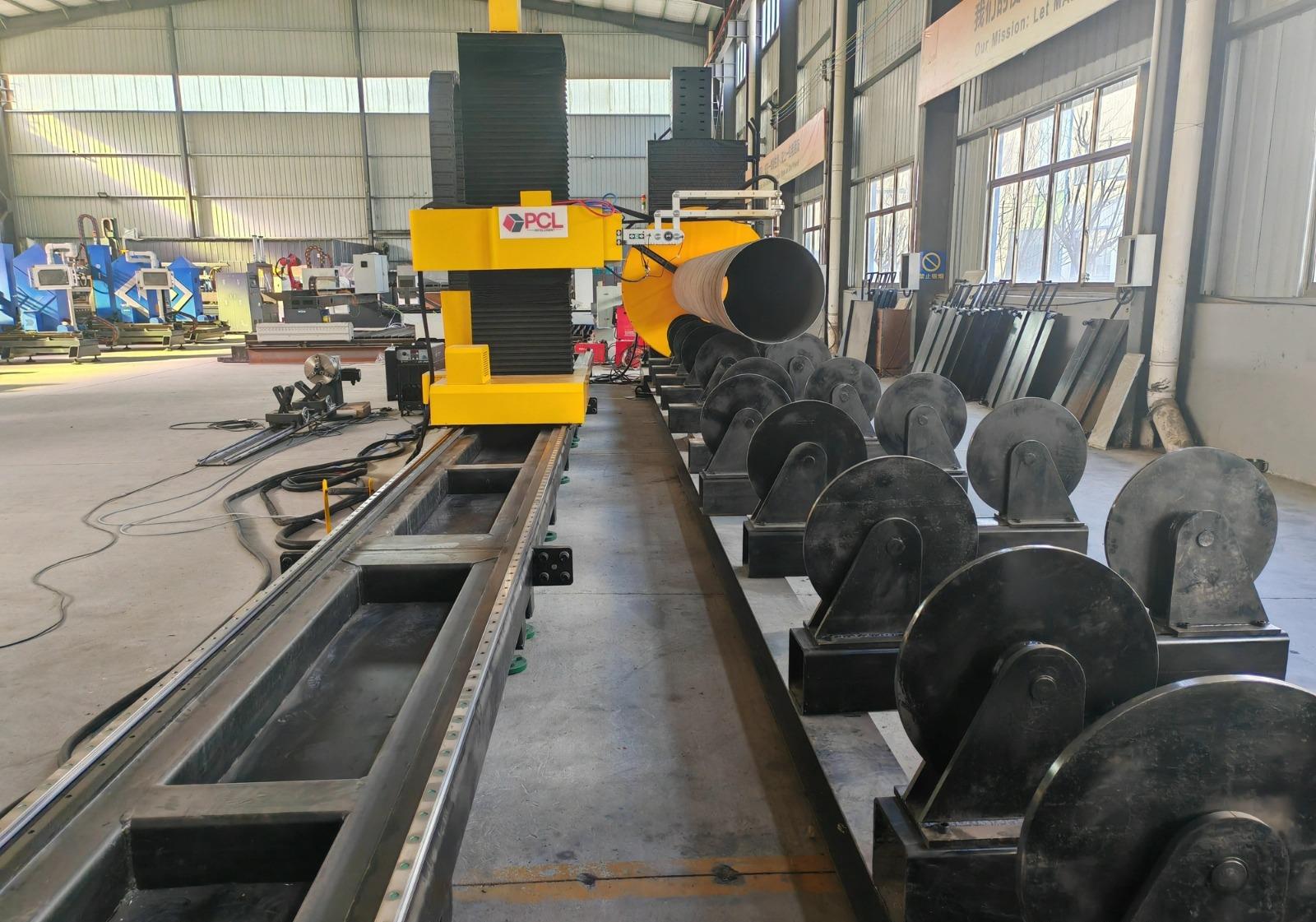
The Industrial Powerhouse: Why Houston is the Epicenter for High-Power Laser Adoption
Houston has long been recognized as the energy capital of the world, but its role as a manufacturing and logistics hub for heavy machinery is equally significant. The proximity to the Port of Houston and a robust network of steel suppliers makes it the ideal theater for the deployment of 20kW H-Beam laser cutting Machines. For the mining machinery sector, which requires massive structural components capable of enduring extreme stress, the arrival of ultra-high-power fiber lasers in the Texas region marks a new era of competitiveness.
In the past, fabricating H-beams for mining equipment involved a fragmented workflow: mechanical sawing to length, radial drilling for bolt holes, and manual oxy-fuel or plasma torching for weld preparations. Houston’s leading fabricators are now consolidating these steps into a single workstation. The 20kW fiber laser doesn’t just cut faster; it redefines the throughput capacity of a facility, allowing Houston-based OEMs (Original Equipment Manufacturers) to meet global mining demands with shorter lead times and higher structural integrity.
Decoding the 20kW Fiber Laser Source
At the heart of this machine is a 20,000-watt fiber laser resonator. To a layperson, this is simply “more power,” but to a laser expert, it represents a profound change in the physics of the cut. A 20kW source provides a power density that allows for “high-speed fusion cutting” even in thick-walled structural steel.
For mining machinery, which often utilizes H-beams with web and flange thicknesses exceeding 20mm, the 20kW source ensures that the “keyhole”—the vaporized channel created by the beam—remains stable. This stability results in a significantly reduced Heat-Affected Zone (HAZ). In the mining industry, where fatigue failure is a constant threat, maintaining the metallurgical integrity of the steel is paramount. By minimizing the HAZ, the laser ensures that the structural steel retains its engineered tensile strength, unlike traditional plasma cutting which can “cook” the edges and lead to micro-cracking over time.
The Engineering Marvel: Infinite Rotation 3D Head
The most critical component for H-beam processing is the Infinite Rotation 3D Cutting Head. Standard 2D laser heads move on an X-Y plane, which is insufficient for the multi-surface geometry of an H-beam. A 3D head introduces the A and B axes, allowing the nozzle to tilt and swivel.
The term “Infinite Rotation” is the true game-changer. Traditional 3D heads are often limited by internal cabling, requiring a “rewind” after 360 or 720 degrees of rotation. In the context of a complex H-beam—where the laser may need to cut a circular bolt hole on a flange, then move to a bevel cut on the web, and then wrap around to the underside—infinite rotation allows for continuous cutting. This eliminates the “dwell time” associated with head repositioning, resulting in a seamless cut surface. For mining machinery, this means that complex interlocking joints and precision bevels for weld preparation can be executed in one continuous motion, ensuring that the fit-up during assembly is perfect to the millimeter.
Advanced Weld Preparation: The 45-Degree Bevel
Mining equipment, such as underground loaders and massive conveyor systems, relies on deep-penetration welds to survive constant vibration and heavy loads. Traditionally, preparing an H-beam for these welds required manual grinding or secondary machining to create a “V” or “K” shaped bevel.
The 20kW 3D laser head automates this entirely. It can execute precise bevel cuts at angles up to 45 degrees (and sometimes more) directly during the primary cutting phase. Because the 20kW laser maintains high speeds even when the “effective thickness” increases due to the tilt of the head, the bevels are clean, slag-free, and ready for the welding robot or manual welder immediately. This “Weld-Ready” output is the single greatest factor in reducing the total cost of ownership for mining machinery manufacturers in Houston.
Precision Processing of H-Beams and Profiles
The H-beam is the backbone of mining infrastructure, but its shape presents unique challenges. The transition from the flange to the web (the “root” of the beam) is notoriously difficult to process. A 20kW machine equipped with advanced 5-axis software can calculate the varying thickness and the necessary beam compensation in real-time as it traverses these transitions.
Furthermore, these machines are equipped with sophisticated sensing technology. Heavy structural steel is rarely perfectly straight; it often has “mill scale” and slight bows or twists. The 3D head utilizes capacitive height sensing and often integrated laser scanning to map the actual geometry of the beam before the cut begins. This ensures that every hole, notch, and bevel is placed with absolute precision relative to the beam’s actual dimensions, rather than its theoretical CAD model.
Economic Impact on the Mining Machinery Sector
In the competitive landscape of mining equipment—where companies like those found in the Houston industrial corridor compete globally—efficiency is survival. The 20kW H-beam laser machine addresses the “bottleneck” of the fabrication shop.
1. **Labor Reduction:** Tasks that previously required a team of three (sawyer, layout technician, and torch operator) are now handled by a single laser operator.
2. **Material Savings:** Advanced nesting software for 3D profiles allows manufacturers to squeeze the maximum number of parts out of a single length of H-beam, significantly reducing scrap rates.
3. **Elimination of Consumables:** Unlike mechanical drilling, which requires expensive bits and coolants, the fiber laser uses light and nitrogen/oxygen, which are far more cost-effective at high volumes.
4. **Assembly Speed:** Because the laser-cut parts are so precise, the “hammer and shim” assembly method is replaced by “click-together” fabrication. This speeds up the downstream welding and assembly phases by as much as 30-40%.
The Houston Advantage: Localized Innovation and Support
The deployment of such high-end machinery in Houston is supported by a local ecosystem of laser experts, gas suppliers, and software integrators. For a mining machinery manufacturer, downtime is catastrophic. Being in Houston means having access to a specialized workforce capable of maintaining the sophisticated optics and CNC systems inherent in a 20kW system.
Furthermore, the local expertise in Houston is increasingly focused on the “Digital Twin” philosophy. Manufacturers are using the data generated by the laser—cutting speeds, gas pressures, and job times—to feed into their ERP systems. This level of data integration allows mining companies to predict their production costs with a degree of accuracy that was previously impossible.
Conclusion: The Future of Heavy Fabrication
The 20kW H-Beam Laser Cutting Machine with an Infinite Rotation 3D Head is more than a tool; it is a catalyst for a new philosophy in heavy manufacturing. For the mining machinery industry in Houston, it represents the transition from “heavy-duty” to “heavy-precision.”
As we look toward the future, the ability to process massive structural members with the same accuracy as a medical device will allow for lighter, stronger, and more efficient mining equipment. By eliminating the friction between design and finished part, Houston’s fabricators are not just keeping pace with the world; they are setting the gold standard for how the world’s most rugged machinery is built. The 20kW fiber laser has arrived, and for the mining sector, the possibilities are as infinite as the rotation of its cutting head.