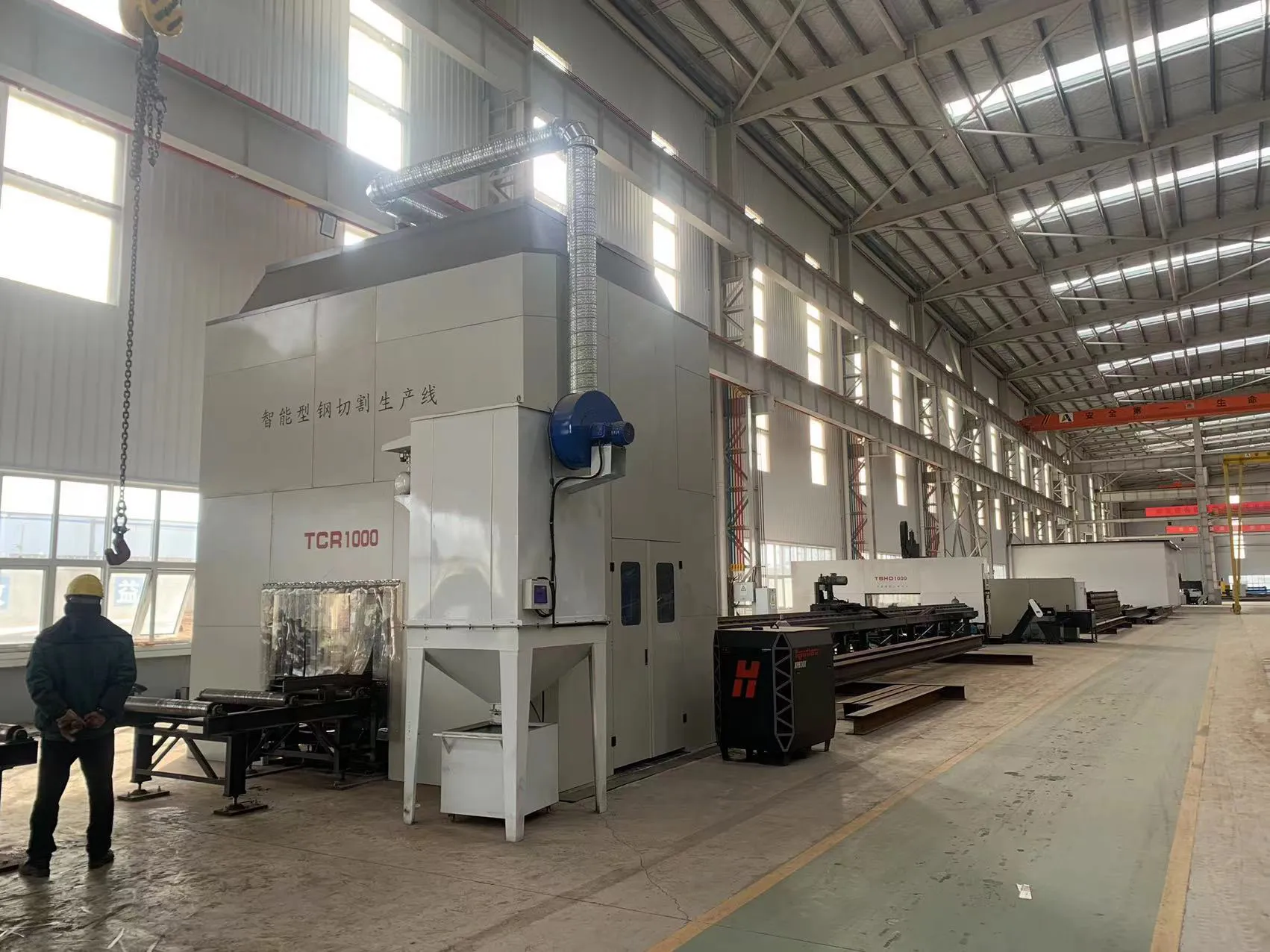
The Evolution of Structural Steel Fabrication in Edmonton
Edmonton has long been recognized as a cornerstone of Canada’s manufacturing and fabrication industry. Traditionally focused on the oil and gas sector, the region’s expertise is increasingly being pivoted toward large-scale infrastructure and marine components. The introduction of a 6000W 3D Structural Steel Processing Center marks a significant technological leap. Unlike traditional plasma cutting or mechanical sawing, the fiber laser provides a level of precision that was previously unattainable for large-form factors like H-beams, I-beams, and C-channels.
For a shipbuilding yard, where the curvature of a hull and the complexity of internal bulkheads require exact tolerances, the transition to 3D laser processing is transformative. This machine is not merely a cutter; it is a comprehensive machining center that handles the work of five separate traditional stations. In Edmonton’s competitive labor market, the ability to automate these processes is not just an advantage—it is a necessity for economic viability.
The Power of 6000W Fiber Laser Technology
The 6000W power rating is often considered the “sweet spot” for structural steel. In the realm of fiber lasers, wattage dictates both the speed of the cut and the maximum thickness of the material. At 6000W, the system can effortlessly pierce and profile carbon steel up to 25mm or 30mm with a clean, weld-ready edge.
Fiber laser technology operates at a wavelength of approximately 1.06 microns, which is absorbed much more efficiently by metals than the 10.6 microns of a CO2 laser. This efficiency translates to faster cutting speeds—often 3 to 4 times faster in mid-range thicknesses—and lower operational costs. For a shipyard, this means that the massive volumes of structural ribs and supports can be produced in a fraction of the time, allowing the assembly berths to stay fed with a constant supply of precision-cut parts.
3D Cutting: Mastering Complex Geometries
Shipbuilding is rarely a linear affair. It involves complex intersections, beveling for weld preparations, and intricate cutouts for piping and electrical runs. The “3D” aspect of this processing center refers to the multi-axis cutting head. Equipped with a high-precision 5-axis or 6-axis robotic arm or a specialized chuck-fed gantry, the laser can tilt and rotate around the structural profile.
This capability allows for:
– **Beveling:** Creating V, U, and Y-type bevels in a single pass. This is critical for shipbuilding where full-penetration welds are a regulatory requirement for structural integrity.
– **Miter Cuts:** Precision angled cuts for frames that must meet at non-90-degree angles.
– **Hole Processing:** Instead of drilling, the laser can cut bolt holes with a tolerance of +/- 0.1mm, ensuring that when modules are shipped from Edmonton to the coast for final assembly, they bolt together perfectly without the need for on-site “burning” or modification.
Automatic Unloading: The Key to Continuous Throughput
A high-speed laser is only as efficient as the material handling system that supports it. In many shops, the laser finishes a part in two minutes, but the operator takes five minutes to manually clear the bed and load the next piece. The Automatic Unloading system integrated into this center solves this inefficiency.
The system utilizes a series of synchronized conveyors and hydraulic lifters. Once a structural member—be it a 12-meter H-beam or a 6-meter angle iron—is processed, the unloading module automatically detects the finished part and moves it to a sorting zone. This process is handled without human intervention, significantly reducing the risk of workplace injuries associated with heavy lifting. Furthermore, the automatic system ensures that finished parts are not scratched or deformed, preserving the surface quality required for marine-grade coatings and primers.
Meeting Shipbuilding Standards in an Inland Hub
Operating a shipbuilding-focused fabrication center in Edmonton requires a deep understanding of marine certifications such as Lloyd’s Register, ABS (American Bureau of Shipping), or DNV GL. The 6000W 3D laser assists in meeting these standards by minimizing the “Heat Affected Zone” (HAZ).
Traditional plasma or oxy-fuel cutting introduces massive amounts of heat into the steel, which can alter the grain structure and lead to embrittlement or warping. The concentrated energy of the fiber laser limits the HAZ to a microscopic area. This preserves the mechanical properties of the high-tensile steel (such as DH36 or EH36) commonly used in hull construction. By maintaining the steel’s integrity, the shipyard ensures that the vessel can withstand the extreme stresses of maritime environments.
Digital Integration and the “Digital Twin”
One of the most profound benefits of this processing center is its integration with modern CAD/CAM software. In the Edmonton facility, engineers can import 3D models directly from marine architectural software like Aveva or ShipConstructor. The software automatically generates the nesting patterns and toolpaths for the 3D laser.
This creates a “Digital Twin” workflow. Every cut made by the machine in Edmonton is an exact replica of the digital model. This level of synchronization is vital for modular shipbuilding, where different sections of a ship may be built in different locations. When the Edmonton-fabricated structural modules arrive at the shipyard, their dimensional accuracy ensures a “perfect fit” assembly, drastically reducing the “man-hours per ton” metric that defines shipyard profitability.
Economic and Environmental Impact in Alberta
The installation of a 6000W 3D Structural Steel Processing Center also reflects a commitment to sustainable manufacturing. Fiber lasers are significantly more energy-efficient than their CO2 predecessors. Additionally, the precision nesting software minimizes scrap metal waste. In a province like Alberta, where industrial efficiency is tied to environmental stewardship, reducing the carbon footprint of steel fabrication is a major selling point.
Furthermore, this technology keeps high-value manufacturing jobs in Edmonton. By automating the repetitive and dangerous aspects of steel processing, the workforce can focus on high-level programming, quality assurance, and complex assembly. It transforms the fabrication shop from a traditional “heavy metal” environment into a high-tech center of excellence.
Technical Challenges and Solutions
Implementing such a system is not without challenges. Edmonton’s climate requires specialized climate control for the laser resonators and chillers. A 6000W laser generates significant heat that must be managed by a high-capacity industrial chiller. In the winter, the facility must ensure that the water-cooled systems do not freeze and that the structural steel being fed into the machine is acclimated to a consistent temperature to prevent thermal expansion/contraction errors during cutting.
Additionally, the sheer size of structural steel requires a robust “Chuck System.” The 3D processing center uses a series of pneumatic or hydraulic chucks that rotate the beam with zero backlash. For shipbuilding components that can weigh several tons, the synchronization between the chuck rotation and the laser head movement must be flawless to ensure that a hole cut on one side of a beam aligns perfectly with a slot on the opposite side.
The Future of Marine Fabrication
Looking ahead, the 6000W 3D Structural Steel Processing Center with Automatic Unloading is just the beginning. As AI and machine learning continue to evolve, these systems will soon be able to perform real-time visual inspections of cuts, automatically adjusting parameters to compensate for variations in steel composition.
For the Edmonton-based yard, this technology is a statement of intent. It says that the city is capable of contributing to the most sophisticated marine projects in the world. Whether it is icebreakers for the Arctic, naval frigates, or offshore energy platforms, the precision of 3D laser cutting ensures that the backbone of these vessels is built to a standard of excellence.
Conclusion
The marriage of 6000W fiber laser power with 3D robotic precision and automated logistics represents the pinnacle of modern steel fabrication. For an Edmonton facility serving the shipbuilding industry, this processing center is more than just a tool; it is a strategic asset. It reduces lead times, eliminates manual errors, and provides a level of structural integrity that is paramount in the maritime world. As the industry moves toward more modular and complex designs, the ability to process structural steel with this level of sophistication will remain the defining factor of successful marine engineering and construction.