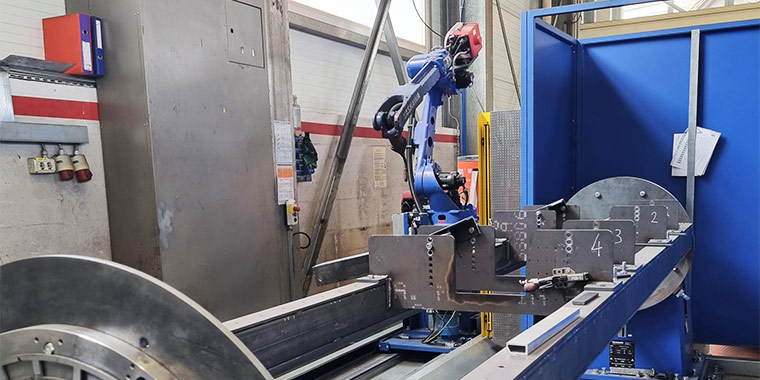
The Industrial Evolution: Riyadh’s Crane Manufacturing Landscape
Riyadh has rapidly transformed into a focal point for large-scale infrastructure and industrial expansion. As the heart of Saudi Arabia’s construction boom, the demand for overhead cranes, gantry cranes, and specialized lifting equipment has surged. Traditionally, crane manufacturing relied on plasma cutting, oxy-fuel torches, and manual mechanical drilling—processes that are labor-intensive and often lack the tolerances required for modern high-performance lifting systems.
The introduction of the 6000W Universal Profile Steel Laser System changes the calculus of production. Fiber laser technology, once reserved for thin sheet metal in the electronics or automotive sectors, has matured. At 6000W, the laser possesses the “energy density” required to pierce and slice through thick structural steels (up to 25mm or more depending on the alloy) with a precision that plasma cannot match. For Riyadh-based manufacturers, this means moving from a “rough cut and grind” workflow to a “precision cut and weld” workflow, drastically reducing the time-to-market for critical infrastructure components.
Demystifying the 6000W Fiber Laser Powerhouse
The choice of a 6000W (6kW) resonator is strategic for crane manufacturing. In the world of structural steel—where S235, S355, and high-tensile S700 grades are common—power is synonymous with throughput. A 6kW laser provides the optimal balance between investment cost and cutting capability.
From an expert perspective, the 6000W laser offers a high-quality beam with a narrow kerf width. This is vital when cutting the long, straight sections of crane girders. Minimal heat input ensures that the metallurgical properties of the high-strength steel remain intact. Unlike oxy-fuel, which creates a large Heat Affected Zone (HAZ), the fiber laser’s concentrated energy minimizes thermal distortion. This ensures that a 12-meter long I-beam remains straight after cutting, preventing the structural “bowing” that plagues traditional thermal cutting methods.
The Infinite Rotation 3D Head: A Mechanical Masterpiece
The “Infinite Rotation 3D Head” is the crowning jewel of this system. Conventional 3D laser heads are often limited by internal cabling; they can rotate 360 degrees but must eventually “unwind” to avoid snapping the fiber optic cable or gas lines. An infinite rotation head utilizes advanced slip-ring technology and sophisticated beam-delivery optics to allow the cutting head to spin indefinitely in any direction.
In crane manufacturing, this is a game-changer for two reasons:
1. **Complex Beveling:** Modern crane components require weld preparations (V, Y, K, and X-type bevels). The 3D head can tilt up to 45 degrees while rotating, allowing the laser to cut the profile and the weld bevel simultaneously.
2. **Continuous Path Processing:** When cutting around the corners of a rectangular hollow section or the flanges of an H-beam, the head can maintain a continuous motion. This results in smoother transitions, higher accuracy, and significantly faster processing times compared to heads that must stop and reset their orientation.
Processing Universal Profile Steel: Beyond Flat Sheets
Crane manufacturing is rarely about flat plates alone. It involves a massive amount of “Universal Profiles”—I-beams, H-beams, C-channels, and L-angles. A Universal Profile Steel Laser System is equipped with specialized chucks and a heavy-duty bed designed to handle these irregular geometries.
The system uses a 4-chuck or 3-chuck “through-hole” design that allows the beam to be fed through the machine. As the profile moves, the 3D laser head moves around it. This allows for the cutting of bolt holes, utility pass-throughs, and complex interlocking tabs directly into the structural members. In Riyadh’s industrial zones, where space and efficiency are at a premium, having one machine that can process a 12-meter H-beam and a 10mm gusset plate represents an incredible consolidation of the production line.
The Impact on Structural Integrity and Weld Quality
In crane manufacturing, safety is non-negotiable. A failure in a weld or a stress fracture in a girder can be catastrophic. The 6000W laser system enhances safety through precision.
When a laser cuts a hole for a high-strength bolt, the hole is perfectly cylindrical with a mirror-like finish. Traditional drilling or punching can leave micro-fissures or burrs that act as stress concentrators. Furthermore, because the laser creates a perfect bevel for welding, the fit-up between two structural components is airtight. This “zero-gap” fit-up allows for deeper weld penetration and a much stronger joint. For Riyadh’s engineers, this means cranes can be designed with higher safety factors and lower dead weight, as the reliability of the joints is mathematically superior.
Operational Resilience in the Riyadh Climate
Operating high-power lasers in the Middle East presents unique environmental challenges. Riyadh’s high ambient temperatures and dust require a system designed for resilience.
A professional-grade 6000W system in this region must be equipped with:
* **Dual-Circuit High-Capacity Chillers:** These maintain the resonator and the 3D head at a constant temperature, even when the external temperature exceeds 45°C.
* **Positive Pressure Enclosures:** To prevent fine desert dust from entering the optical path, the entire machine housing and the laser source are often kept under positive pressure with filtered air.
* **Advanced Gas Regulation:** Since laser cutting requires high-purity Oxygen or Nitrogen, integrated gas mixers and high-pressure piping are essential to handle the heavy consumption rates typical of thick-section steel processing.
Economic ROI and Efficiency for Saudi Manufacturers
The capital expenditure for a 6000W 3D laser system is significant, but the Return on Investment (ROI) in the crane sector is driven by the “Secondary Process Elimination” factor.
In a traditional setup:
1. Sawing to length.
2. Drilling holes on a separate CNC drill line.
3. Manual grinding for weld bevels.
4. Manual marking for layout.
With the 6000W Universal Profile Laser:
1. All four steps are performed in a single “nesting” operation.
By reducing the number of times a 2-ton beam must be moved by a forklift or overhead crane across the shop floor, the manufacturer reduces “non-value-added” time. In Riyadh, where labor costs and the need for specialized technicians are rising, the ability to do more with fewer, more highly-skilled operators is a significant competitive advantage.
Software Integration: The Digital Twin of Steel
The hardware is only as capable as the software that drives it. These systems utilize advanced CAD/CAM suites (such as Lantek or SigmaTube) that allow crane designers to import 3D models of an entire crane assembly. The software then “unwraps” the profiles, calculates the 5-axis toolpaths for the infinite rotation head, and optimizes the nesting to minimize scrap.
This digital workflow allows Riyadh-based manufacturers to offer “bespoke” crane solutions. Whether it is a specialized crane for a petrochemical plant in Jubail or a standard overhead crane for a warehouse in Sudair, the laser system can switch between different profiles and designs with a simple file load, eliminating the need for expensive jigs and fixtures.
Conclusion: Lifting the Future of the Kingdom
The 6000W Universal Profile Steel Laser System with Infinite Rotation 3D Head is more than just a cutting tool; it is a fundamental shift in how heavy structures are built in Saudi Arabia. By integrating this technology, Riyadh’s crane manufacturers are no longer just assemblers of components—they are precision engineers.
As the Kingdom continues its journey toward becoming a global logistics and manufacturing hub, the ability to produce world-class lifting equipment locally is essential. The speed, precision, and versatility offered by 6kW 3D fiber laser technology provide the backbone for this growth, ensuring that the cranes building the future of Riyadh are as advanced as the city they are helping to create. In the hands of Saudi engineers, this system is a powerful instrument of progress, turning raw steel into the high-performance skeletons of a modern nation.