The Dawn of Ultra-High Power: Why 20kW Matters for Structural Steel
In the realm of fiber lasers, the move from 12kW to 20kW is not merely an incremental upgrade; it is a fundamental shift in the physics of material interaction. For a shipbuilding yard, where the thickness of structural members and the sheer volume of steel are immense, 20kW provides the “velocity overhead” required to maintain clean cuts without excessive heat accumulation.
At 20kW, the laser’s power density allows for high-speed fusion cutting even in thick-walled channels and beams. This is critical because shipbuilding relies on structural integrity. Traditional oxy-fuel or plasma cutting methods often leave a significant Heat Affected Zone (HAZ), which can alter the metallurgical properties of the steel, potentially leading to brittleness in the weld seams. The 20kW fiber laser, however, moves so quickly that the heat is dissipated almost instantly, leaving a narrow kerf and a pristine edge that requires zero secondary grinding. In the context of Edmonton’s rigorous quality standards for industrial fabrication, this ensures that every beam meets the structural specifications required for maritime environments.
Mastering the Geometry: CNC Beam and Channel Processing
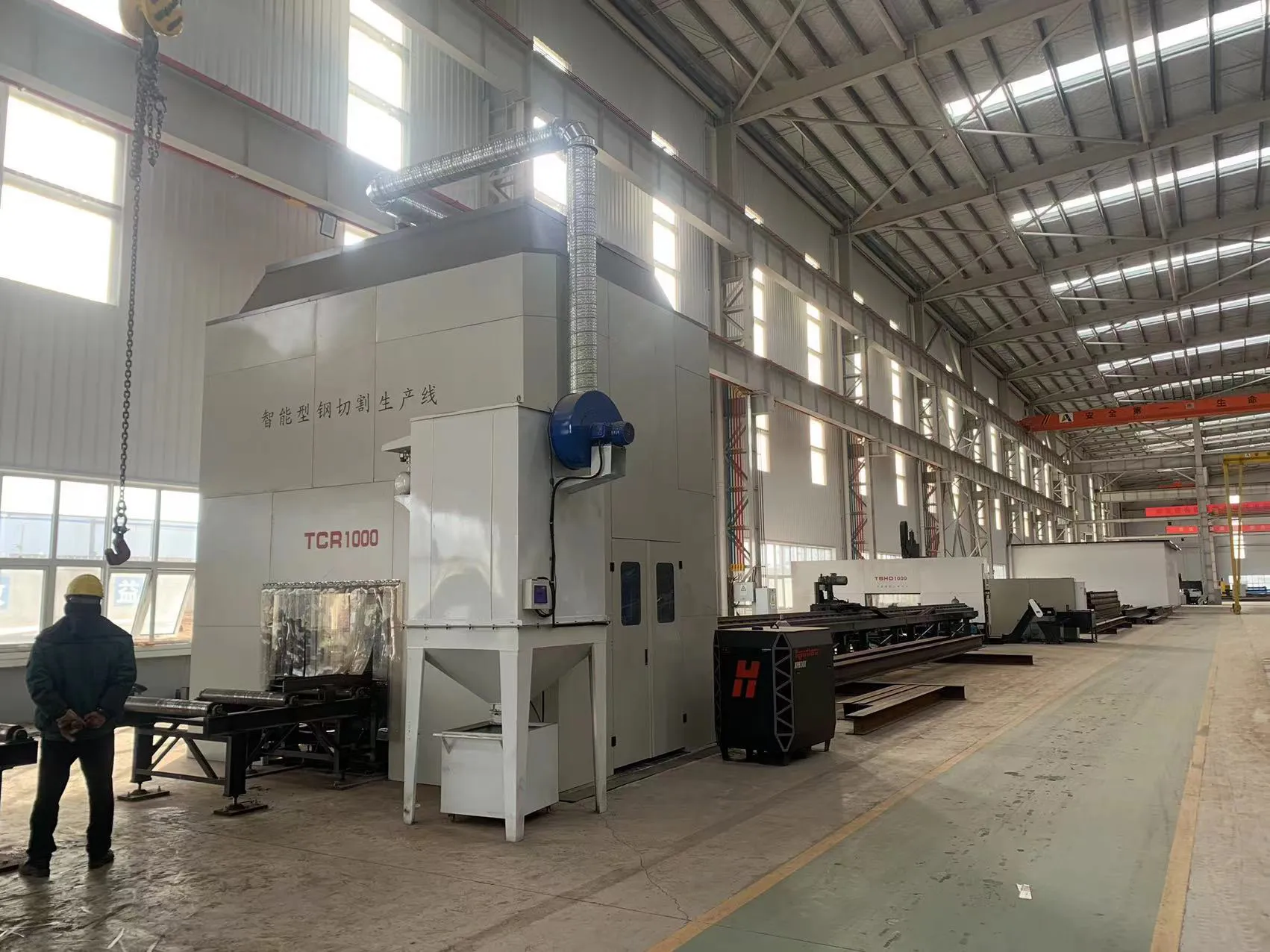
Cutting a flat plate is one thing; cutting a 12-inch C-channel or a heavy-duty I-beam is another entirely. A 20kW CNC Beam Laser Cutter utilizes a specialized 3D cutting head mounted on a multi-axis robotic arm or a high-precision gantry with a rotary chuck system.
For shipbuilding, this allows for the “six-sided” processing of structural members. The machine can rotate the beam, allowing the laser to cut bolt holes, cope ends, and complex bevels for welding preparations on all faces of the material in a single setup. In Edmonton’s shipbuilding yards—which often focus on modular components for icebreakers, barges, or offshore platforms—this capability allows for “lock-and-key” assembly. Instead of measuring and welding on-site, components are cut with such precision that they snap together, significantly reducing the time spent on the assembly floor.
Zero-Waste Nesting: The Mathematical Edge
One of the most significant costs in shipbuilding is the raw material. Steel prices are volatile, and in a massive project, scrap rates of 15% to 20% can represent millions of dollars in lost revenue. This is where “Zero-Waste Nesting” algorithms change the game.
Zero-waste nesting goes beyond simple shape-fitting. It utilizes advanced CAD/CAM integration to perform “common-line cutting.” In this process, the laser uses a single cut to create the edges of two adjacent parts, effectively sharing a border. For long structural channels and beams, the software calculates the optimal sequence to minimize the “skeleton” or remnant material left behind.
Furthermore, the software can manage “remnant tracking.” If a 40-foot beam is only partially used, the system logs the exact dimensions of the remaining 12-foot section into a digital library. When the next project requires a shorter member, the 20kW laser automatically prioritizes the use of that remnant. In Edmonton’s high-output yards, where hundreds of beams are processed weekly, this digital material management creates a closed-loop system that pushes material utilization toward 98%.
Shipbuilding Precision: From Bulkheads to Hull Ribs
Shipbuilding is an exercise in complex curvature and structural reinforcement. The hull of a vessel requires ribs (frames) and longitudinal stiffeners that must perfectly match the curvature of the outer plating.
The 20kW CNC laser allows for “bevel cutting” on the fly. As the laser processes a channel, it can tilt to create a 45-degree V-prep or a J-groove weld preparation. This is a massive advantage for Edmonton-based fabricators who must ship modular sections to the coast. When these sections arrive, the weld prep is already perfect, ensuring that the robotic welding systems at the shipyard can operate without manual intervention. The accuracy of the 20kW laser—often within +/- 0.1mm—means that even in a 100-foot modular section, the cumulative error is virtually non-existent.
Edmonton’s Industrial Advantage: Logistics and Climate
Operating a 20kW fiber laser in Edmonton presents unique advantages and challenges. Edmonton is a primary hub for the Western Canadian supply chain, providing easy access to high-grade structural steel and a workforce that is already deeply familiar with CNC technology from the oil and gas sector.
However, the climate requires specific engineering considerations for high-power lasers. A 20kW laser generates significant heat within the resonator and the cutting head. Our systems in Edmonton utilize advanced dual-circuit industrial chillers with glycol-integrated systems to ensure stable operation during both the +30°C summer peaks and the -30°C winter lows. Moreover, the 20kW laser’s efficiency in terms of “wall-plug” power is superior to CO2 lasers. It converts more electricity into light, which reduces the overall load on the facility’s power grid—a vital consideration for large-scale fabrication shops in the Nisku and Acheson industrial zones.
Reducing the Carbon Footprint of Heavy Fabrication
Sustainability is becoming a core requirement in modern shipbuilding contracts. The combination of 20kW fiber technology and zero-waste nesting offers a twofold environmental benefit. First, the fiber laser is roughly 3-4 times more energy-efficient than traditional CO2 lasers. Second, by significantly reducing steel scrap, the “embedded carbon” of the project is lowered.
In Edmonton, where industry is under increasing pressure to decarbonize, the ability to produce more with less material is a competitive advantage. Every ton of steel saved by the zero-waste nesting algorithm represents a direct reduction in the carbon emissions associated with steel production and transportation. For shipbuilders, this data can be quantified and included in their ESG (Environmental, Social, and Governance) reporting, making them more attractive to global clients who prioritize green manufacturing.
Maintenance and Reliability in a High-Demand Environment
A 20kW laser is a precision instrument, but it is also a workhorse. In a shipbuilding yard, downtime is not an option. The latest generation of 20kW fiber lasers features modular “lasing banks.” If one 2kW module requires service, the system can often continue to operate at a reduced power (e.g., 18kW), ensuring that production doesn’t grind to a halt.
For Edmonton fabricators, local support and the availability of “consumables” (nozzles, protective windows, and ceramic rings) are crucial. As experts, we emphasize the importance of a clean-room environment for the fiber delivery cable connections. Given the dust and particulate matter inherent in heavy fabrication, our CNC beam cutters are equipped with pressurized cabins and advanced HEPA filtration systems to protect the optical path. This ensures that the 20kW beam remains focused and coherent, providing the same cut quality in year five as it did on day one.
Conclusion: The Future of Alberta’s Maritime Fabrication
The deployment of a 20kW CNC Beam and Channel Laser Cutter in Edmonton is more than an equipment purchase; it is a strategic investment in the future of Canadian manufacturing. By marrying the brute force of 20,000 watts of light with the surgical precision of AI-driven nesting, Edmonton’s shipbuilders can transcend the limitations of traditional fabrication.
This technology eliminates waste, slashes labor costs, and produces structural components of unparalleled quality. As the global shipbuilding industry moves toward more complex, modular, and sustainable designs, the 20kW fiber laser stands as the foundational tool that will allow Edmonton’s industrial heartland to lead the way. Whether it’s for Arctic patrol vessels or inland industrial barges, the future of the yard is fast, precise, and zero-waste.