The Industrial Renaissance in Katowice: Why 20kW Matters
Katowice has long been the beating heart of the Polish industrial sector, particularly regarding coal mining and heavy engineering. For decades, the fabrication of mining machinery—equipment that must withstand thousands of tons of pressure and highly abrasive environments—relied on massive mechanical shears, plasma cutters, and labor-intensive manual welding preparation. However, as global demand for more efficient, durable, and lighter (yet stronger) mining equipment grows, these traditional methods have reached their physical limits.
The arrival of the 20kW fiber laser marks the beginning of a new era. In the context of fiber lasers, power is not just about speed; it is about the ability to process “heavy-duty” materials with surgical precision. A 20kW source provides the energy density required to pierce and cut through thick-walled carbon steels (up to 50mm and beyond) used in the frames of mining loaders and tunnel boring machines. For the manufacturers in the Silesian region, this means the ability to replace multiple slower machines with a single high-speed laser profiler that maintains a negligible heat-affected zone (HAZ), preserving the structural integrity of specialized high-tensile steels like Hardox or S690QL.
The Architecture of Power: Heavy-Duty I-Beam Profiling
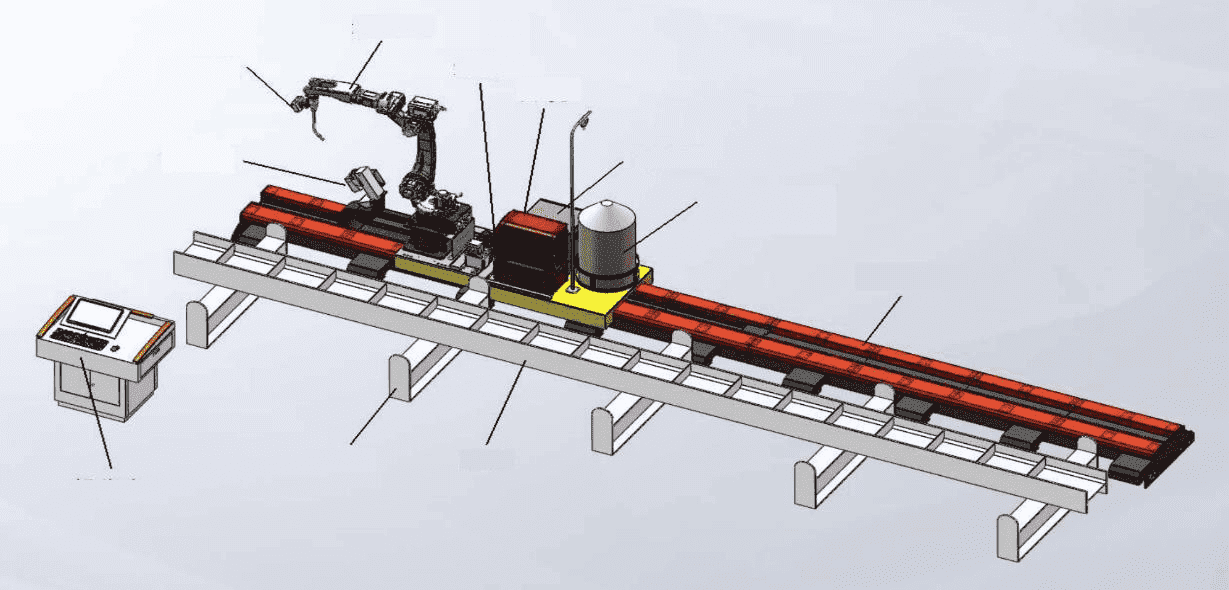
Mining machinery is built on a foundation of structural profiles—I-beams, H-beams, U-channels, and large rectangular hollow sections. Traditional flatbed lasers are insufficient for these three-dimensional components. The 20kW Heavy-Duty I-Beam Laser Profiler is a massive machine tool designed to handle workpieces that can weigh several tons and extend up to 12 meters in length.
The engineering challenge of profiling an I-beam lies in the geometry. To cut through the flange and the web of a beam accurately, the laser head must navigate complex paths while maintaining a constant focal distance. The heavy-duty nature of these machines involves reinforced beds and advanced chucking systems that can rotate massive beams with sub-millimeter precision. In the Katowice workshops, where space and efficiency are at a premium, the ability to perform holes, slots, and complex end-cuts on a single machine—without moving the beam to a separate drill line—drastically reduces the internal logistics and lead times for complex mining assemblies.
The Game Changer: ±45° Bevel Cutting for Weld Preparation
Perhaps the most significant technological advancement in this 20kW system is the integration of a five-axis 3D cutting head capable of ±45° beveling. In the manufacturing of mining equipment, pieces are rarely joined at simple 90-degree angles. To ensure deep weld penetration and structural soundness, the edges of thick steel plates and beams must be beveled into V, X, K, or Y shapes.
Historically, this was a multi-stage process: the part was cut to size, moved to a milling machine or ground by hand, and then welded. This “secondary processing” is where most errors occur and where significant time is lost. The ±45° beveling head allows the 20kW laser to cut the part and create the weld prep profile simultaneously.
The precision of a 20kW laser bevel is unmatched. Because the laser beam is controlled by high-speed galvanometers and synchronized with the machine’s five-axis motion, the bevel angle remains consistent even as the head rounds the corners of an I-beam or navigates the irregular surface of a hot-rolled channel. For Katowice’s mining engineers, this translates to “perfect-fit” assemblies where parts snap together with minimal gaps, reducing the volume of expensive welding wire required and significantly lowering the risk of weld failure underground.
Optimizing Mining Machinery Production
The specific applications of this technology in the mining sector are vast. Consider the construction of a longwall roof support. These structures are subjected to immense geological pressures and must be fabricated from high-strength steel. The 20kW laser can profile the thick side plates and internal stiffeners with precision holes for pivot pins, all while applying the necessary bevels for the heavy-duty welds that will hold the unit together.
Furthermore, the production of underground transport systems—conveyors and rail systems—requires thousands of meters of structural beams. The automated nesting software accompanying these laser profilers allows manufacturers to optimize the use of raw materials, minimizing scrap in a time when steel prices are volatile. The 20kW power also enables the use of nitrogen as a cutting gas for thinner sections (up to 20mm), which results in an oxide-free edge that is ready for immediate painting or galvanizing, a critical factor for equipment destined for the corrosive environments of deep-level mines.
The Role of Katowice as a Technical Hub
Katowice’s selection as a primary site for such advanced machinery is no accident. The region possesses a unique ecosystem of technical universities, such as the Silesian University of Technology, and a concentrated workforce of expert welders and engineers. However, the “expert” gap is narrowing as the laser’s software takes over the most complex calculations.
The modern 20kW profiler utilizes sophisticated CAD/CAM interfaces. An engineer in a Katowice office can design a complex I-beam junction in a 3D environment and send the file directly to the laser. The machine’s onboard sensors then compensate for any “bow” or “twist” in the physical beam—common in heavy structural steel—ensuring that the cut matches the digital model exactly. This level of cyber-physical integration is what defines Industry 4.0 in the heart of Poland’s mining district.
Maintenance, Cooling, and the 20kW Ecosystem
Operating a 20kW laser is not without its challenges. The sheer amount of energy requires a sophisticated infrastructure. The chiller units must dissipate massive amounts of heat to keep the fiber resonator and the cutting head stable. In Katowice, where industrial facilities are often being retrofitted, the installation of these machines involves significant electrical and cooling upgrades.
As an expert, I must emphasize the importance of the optical chain. At 20kW, even a tiny speck of dust on a protective window can lead to “thermal lensing,” where the lens heats up and shifts the focal point, potentially ruining a costly I-beam. The heavy-duty profilers used in mining fabrication are equipped with “smart” cutting heads that monitor the health of the optics in real-time, alerting the operator before a failure occurs. This predictive maintenance is vital for maintaining the 24/7 production cycles required to meet mining contract deadlines.
Economic and Environmental Impact
The move to 20kW laser profiling offers a compelling ROI for Polish manufacturers. While the initial capital expenditure is high, the reduction in labor hours per ton of fabricated steel is dramatic. By eliminating manual grinding and secondary drilling, a company can often see a 40-60% increase in throughput.
From an environmental perspective, the fiber laser is significantly more efficient than the older CO2 laser technology or plasma cutting. It consumes less electricity per millimeter of cut and eliminates the need for the hazardous chemicals often used in traditional machining coolants. In the context of the European Green Deal and Poland’s shifting energy landscape, the efficiency of fiber laser technology aligns with the broader goals of making heavy industry more sustainable.
Conclusion: The Future of Silesian Engineering
The integration of 20kW Heavy-Duty I-Beam Laser Profilers with ±45° beveling is more than a technological milestone; it is a strategic necessity for the Katowice mining machinery sector. By mastering the intersection of high-power photonics and heavy structural engineering, Silesian companies are ensuring their place in the global market.
The ability to produce “weld-ready” components from massive steel profiles with the push of a button allows for faster innovation, safer mining equipment, and a more robust industrial economy. As these machines become the standard in the workshops of Katowice, the image of mining as a “low-tech” industry is being permanently erased, replaced by a vision of high-precision, automated excellence that can withstand the harshest conditions on Earth. For the fiber laser expert, the sight of a 20kW beam effortlessly slicing through a massive I-beam with a perfect 45-degree bevel is the ultimate synthesis of power and grace—a tool perfectly suited for the giants of the mining world.