The Dawn of Ultra-High Power in the Port of Hamburg
Hamburg has long been the heartbeat of German maritime industry. From the massive dry docks of Blohm+Voss to the specialized luxury yacht builders along the Elbe, the demand for structural steel processing has traditionally relied on plasma or oxy-fuel cutting. However, the arrival of the 30kW fiber laser represents a fundamental shift in the physics of fabrication.
As a fiber laser expert, I have witnessed the evolution from 2kW systems—once limited to thin sheet metal—to the 30kW titans we see today. At 30kW, the power density is sufficient to “vaporize” thick structural steel almost instantaneously. In the context of a Hamburg shipyard, this means the ability to slice through 30mm to 50mm carbon steel plates and structural profiles with a speed and edge quality that was previously unthinkable. The fiber laser’s wavelength (typically around 1.06 microns) is absorbed more efficiently by steel than the 10.6 microns of traditional CO2 lasers, allowing for a smaller Heat Affected Zone (HAZ) and far greater energy efficiency.
Redefining 3D Structural Processing
Traditional shipbuilding involves complex structural skeletons—longitudinal frames, transverse bulkheads, and massive H-beams. Historically, these were cut to length on one machine, notched on another, and beveled by a technician with a handheld grinder.
The 30kW 3D Structural Steel Processing Center changes this workflow by treating the steel profile as a three-dimensional object in a unified coordinate system. Using a specialized chuck system and a moving gantry or robotic arm, the machine can rotate and position large-scale beams (up to 12 meters or more) with sub-millimeter precision. Whether it is cutting “rat holes” for drainage, bolt holes for assembly, or complex miter joints, the 30kW laser maintains a consistent focal point across the entire geometry of the beam. The “3D” aspect refers not just to the shape of the material, but to the five-axis head movement that allows the laser to approach the workpiece from any angle, ensuring that complex intersections in a ship’s hull are perfectly flush.
The Engineering Marvel of ±45° Bevel Cutting
In shipbuilding, a straight cut is rarely the final step. To ensure deep weld penetration—essential for vessels facing the high-pressure environments of the Atlantic—steel edges must be beveled. The ±45° beveling head is the “crown jewel” of this 30kW system.
Achieving a precise 45-degree angle in 25mm steel requires a sophisticated understanding of beam delivery and gas dynamics. As the laser head tilts, the “effective thickness” of the material increases (a 30mm plate cut at 45 degrees presents a 42.4mm path for the laser). This is where the 30kW power reserve becomes critical; it provides the “punch” necessary to maintain a clean kerf even at extreme angles.
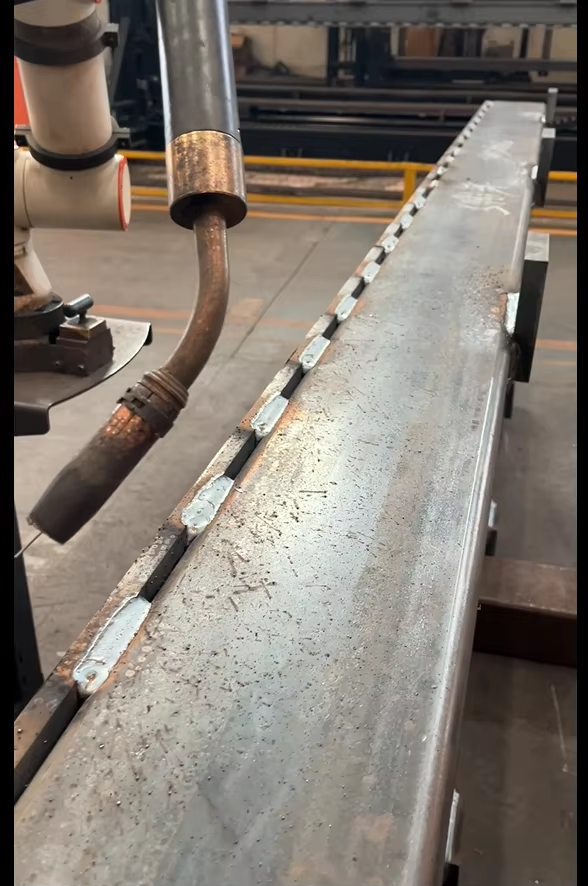
Furthermore, the system utilizes advanced “Follow-Up” sensors. In Hamburg’s shipyards, structural steel is rarely perfectly flat; it often has slight curvatures or “bowing” from the rolling mill. The ±45° head uses high-speed capacitive sensors to adjust its height and angle in real-time, maintaining a constant standoff distance. This ensures that the V-groove, X-groove, or K-groove weld preparations are uniform along the entire length of a 12-meter beam, allowing for automated welding robots to follow behind with perfect consistency.
The “Hamburg Advantage”: Efficiency and Logistics
Space in the Port of Hamburg is at a premium. By consolidating multiple fabrication steps—sawing, drilling, and beveling—into a single 30kW fiber laser cell, shipyards can significantly reduce their physical footprint.
The economic argument for 30kW is equally compelling. While the initial capital expenditure is higher than plasma systems, the operational cost per meter is lower due to the sheer speed of the process and the reduction in secondary labor. In the German labor market, where skilled manual grinders and welders are both expensive and in short supply, the ability to produce a “weld-ready” part straight off the laser bed is a massive competitive advantage.
Moreover, the 30kW fiber source is incredibly robust. Modern ytterbium-doped fiber lasers have an expected diode life of over 100,000 hours. For a shipyard operating on a 24/7 production cycle to meet a vessel delivery deadline, this reliability is the difference between profit and liquidated damages.
Addressing the Challenges of High-Power Photonics
Operating a 30kW system is not without its technical hurdles. As an expert, I emphasize the importance of “Optical Thermal Stability.” At 30kW, even the slightest dust particle on a protective window can lead to “thermal lensing,” where the lens heats up, expands, and shifts the focal point, ruining the cut.
In a shipyard environment—often humid and dusty—this machine must be equipped with a pressurized, climate-controlled laser cabinet and a sophisticated cutting head cooling system. The 30kW centers in Hamburg utilize “intelligent” heads that monitor the temperature of the internal optics and the cover glass in real-time. If the system detects a rise in temperature, it can alert the operator before a failure occurs.
Additionally, gas management is vital. To achieve the cleanest cuts in thick structural steel, high-purity oxygen or nitrogen is used. At 30kW, the flow rates are significant. The Hamburg facility likely employs a liquid gas farm with high-flow evaporators to ensure the laser never starves for assist gas during a deep bevel cut.
Environmental Impact and Industry 4.0 Integration
The transition to fiber laser technology also aligns with the “Green Port” initiatives of Hamburg. Fiber lasers are roughly 30% to 40% more electrically efficient than the CO2 lasers of the past. When compared to plasma cutting, the fiber laser produces far fewer fumes and metallic dust, which are captured by high-efficiency filtration systems, creating a safer and cleaner working environment for the shipyard’s employees.
Integration with Industry 4.0 is the final piece of the puzzle. The 30kW 3D processing center is not a standalone island; it is connected to the shipyard’s PLM (Product Lifecycle Management) software. Engineers can design a ship’s frame in a CAD environment, and the software automatically generates the nesting patterns and 5-axis toolpaths for the laser. This “digital twin” approach ensures that if a design change is made in the office, the 30kW laser in the yard is updated instantly, minimizing waste and ensuring that every rib and girder fits perfectly during the final assembly.
Conclusion: The Future of Maritime Fabrication
The 30kW Fiber Laser 3D Structural Steel Processing Center is more than just a cutting machine; it is a catalyst for a new era of maritime construction. In the shadow of Hamburg’s iconic cranes, this technology is proving that precision and power are not mutually exclusive. By mastering the ±45° bevel and the complexities of 3D structural geometry, Hamburg’s shipbuilders are setting a global standard for how the next generation of vessels—from hydrogen-powered ferries to massive container ships—will be built.
As we look forward, the trend toward even higher power (40kW and 60kW) is already on the horizon, but the 30kW mark currently represents the “sweet spot” of reliability, thickness capability, and beam quality. For the maritime industry, the message is clear: the future is fiber, the future is 3D, and it is being forged in the heart of Hamburg.