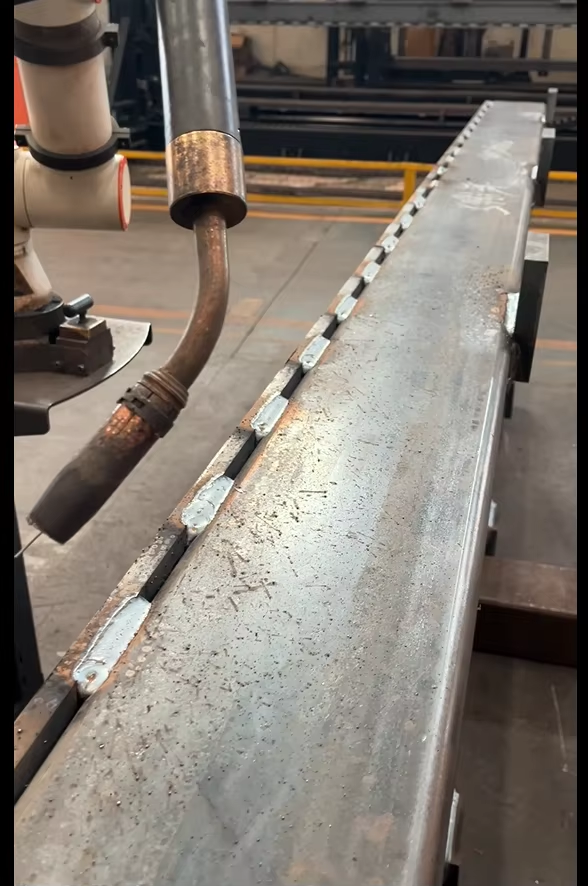
The Dawn of High-Power Fiber Lasers in Heavy Structural Fabrication
For decades, the structural steel industry relied heavily on plasma and oxy-fuel cutting for heavy-duty H-beams and thick-plate fabrication. While these methods were effective for the era, they lacked the precision and thermal control required for the increasingly stringent standards of the renewable energy sector. As a fiber laser expert, I have witnessed the transition from 4kW systems to the current 12kW standard, which has fundamentally changed the physics of what is possible in heavy-duty manufacturing.
A 12kW fiber laser is not merely “faster” than its predecessors; it offers a level of power density that allows for high-speed sublimation and melt-ejection even in thick-walled structural sections. In the context of Charlotte’s burgeoning industrial corridor, which serves as a logistics hub for the Southeastern United States, the deployment of 12kW H-Beam laser cutting Machines represents a strategic move toward “Industry 4.0.” These machines allow for the processing of massive structural members with the same delicacy and accuracy once reserved for thin-gauge sheet metal.
Understanding the Mechanics of ±45° Bevel Cutting
In wind turbine tower construction, the structural integrity of the joint is the single most important factor. Turbine towers must withstand immense dynamic loads, including high-speed winds and the rotational torque of the nacelle. This necessitates full-penetration welds, which can only be achieved through precise weld preparation—specifically, beveling.
The ±45° bevel cutting capability is the “crown jewel” of the 12kW H-beam laser. Traditional lasers cut perpendicular to the material surface. However, a 5-axis head allows the laser beam to tilt, creating V, Y, X, or K-shaped joints directly during the cutting process. By achieving a ±45° angle, the machine prepares the H-beam for immediate welding.
From a metallurgical perspective, the precision of a 12kW laser bevel is superior to plasma. Because the laser beam is so concentrated, the Heat Affected Zone (HAZ) is significantly smaller. This is critical for wind towers, where the grain structure of the steel must remain intact to prevent stress fractures over the 25-year lifespan of the turbine.
The 12kW Advantage: Speed, Penetration, and Beam Quality
Why 12kW? In the world of fiber lasers, the “sweet spot” for structural steel between 10mm and 30mm thickness currently sits at 12,000 watts. At this power level, the laser can achieve a high-quality “bright surface” cut on thick flanges of H-beams.
The beam quality (BPP) of a 12kW source ensures that even at a distance from the cutting head—necessary when navigating the geometry of an H-beam’s flanges and web—the focus remains sharp. In Charlotte-based facilities, where throughput is key to meeting federal renewable energy mandates, the 12kW system allows for cutting speeds that are 3 to 5 times faster than traditional mechanical sawing or plasma cutting. This efficiency is further enhanced by the use of nitrogen or high-pressure air as assist gases, which provide a clean, oxide-free edge that is paint-ready and weld-ready.
Precision Engineering for H-Beam Geometry
Cutting an H-beam is significantly more complex than cutting a flat plate. You are dealing with a three-dimensional object with varying thicknesses between the web (the center) and the flanges (the edges).
A dedicated H-beam laser machine utilizes a sophisticated 3D 5-axis cutting head and a specialized chuck system. The machine must rotate the beam or move the head around the profile to ensure that the laser can reach every surface. For wind turbine towers, which often utilize internal H-beam bracing and platform supports, the ability to cut bolt holes, notches, and bevels in a single pass is a massive logistical advantage. The software calculates the “nesting” of these cuts to minimize material waste, a critical factor when dealing with the high-grade structural steel required for energy infrastructure.
Wind Turbine Towers: The Ultimate Structural Challenge
The wind energy sector in the United States is moving toward larger, taller turbines to capture more consistent wind at higher altitudes. This shift demands stronger tower bases and more robust internal structural components. The H-beams processed on these 12kW machines serve as the backbone for internal maintenance platforms, ladder supports, and structural reinforcement within the tower sections.
In Charlotte, the proximity to both coastal offshore projects and Appalachian onshore sites makes it a primary fabrication point. The 12kW H-beam laser ensures that every component meets the “Zero Defect” tolerance required by global energy firms. When a tower section is 100 meters in the air, there is no room for a misaligned bolt hole or a poorly prepared weld joint. The laser’s ability to maintain a tolerance of ±0.1mm over a 12-meter H-beam is simply something that manual fabrication cannot match.
The Economic Impact on the Charlotte Manufacturing Sector
Charlotte has established itself as a hub for advanced manufacturing, and the introduction of 12kW bevel-capable lasers reinforces this reputation. The economic argument for these machines is built on the reduction of secondary operations.
In a traditional shop, an H-beam would be saw-cut to length, moved to a drilling station for bolt holes, and then manually ground by a technician to create a bevel for welding. Each movement of the heavy beam adds cost, time, and the potential for error. The 12kW laser machine performs all these tasks in a single workstation. This “All-in-One” processing can reduce the labor cost per ton of steel by as much as 40%. For Charlotte-based fabricators, this means they can compete more effectively with international suppliers while providing a higher-quality domestic product.
Environmental and Safety Benefits
As a fiber laser expert, I also emphasize the “green” aspects of this technology. Fiber lasers are significantly more energy-efficient than older CO2 lasers or plasma systems. They convert electrical energy into light with high efficiency, reducing the overall carbon footprint of the fabrication process—a fitting benefit for a machine dedicated to building wind turbines.
Furthermore, the safety of the Charlotte workforce is improved. Automated laser cutting reduces the need for manual torching and grinding, which are leading causes of respiratory issues and ergonomic injuries in heavy fabrication shops. The enclosed nature of modern 12kW H-beam machines ensures that the high-intensity light and fumes are contained and filtered, creating a cleaner, safer shop environment.
The Future: AI and Real-Time Monitoring in Charlotte
The 12kW H-beam laser machines being installed today are equipped with artificial intelligence and real-time sensor arrays. These systems monitor the “health” of the cut in real-time. If the machine detects a change in the spark pattern (indicating a potential slag buildup or a change in material purity), it can automatically adjust the feed rate or gas pressure.
For wind turbine tower manufacturers, this means every H-beam comes with a digital “birth certificate”—a data log proving that the part was cut to the exact specifications required. This level of traceability is becoming a requirement in the energy sector, and the 12kW fiber laser is the primary tool enabling this data-driven manufacturing.
Conclusion: Powering the Future of Energy
The 12kW H-beam laser cutting machine with ±45° beveling is more than just a piece of equipment; it is a foundational technology for the renewable energy era. In the industrial heart of Charlotte, these machines are transforming how we think about structural steel. By providing the power to cut through thick flanges, the flexibility to create complex bevels, and the precision to ensure every weld is perfect, this technology is ensuring that the wind turbine towers of tomorrow are safer, more efficient, and more cost-effective. As we continue to push the boundaries of fiber laser power, the synergy between high-kilowatt systems and structural engineering will remain the driving force behind the global transition to clean energy.