The Dawn of High-Power Fiber Laser Processing in the Middle East
Dubai has long been a global crossroads, but the “Dubai Industrial Strategy 2030” has recalibrated the city’s focus toward becoming a global platform for knowledge-based, sustainable, and innovation-focused businesses. For the structural steel industry, this means moving away from traditional oxy-fuel and plasma cutting toward high-power fiber laser technology. The introduction of the 12kW Heavy-Duty I-Beam Laser Profiler is a testament to this evolution.
A 12kW fiber laser source is a formidable tool. In the world of laser physics, the jump from 6kW to 12kW is not just a doubling of power; it is a fundamental shift in the material thickness-to-speed ratio. For heavy-duty I-beams—the skeletal framework of wind turbine foundations and internal support structures—the 12kW output allows for “vaporization cutting” on thicker gauges that previously required slow, heat-intensive thermal processes. This results in a Heat Affected Zone (HAZ) that is virtually non-existent, ensuring the structural integrity of the steel remains uncompromised—a critical factor for components that must withstand the cyclic loading of wind turbine blades.
Engineering the 12kW Heavy-Duty Profiler: Robustness Meets Precision
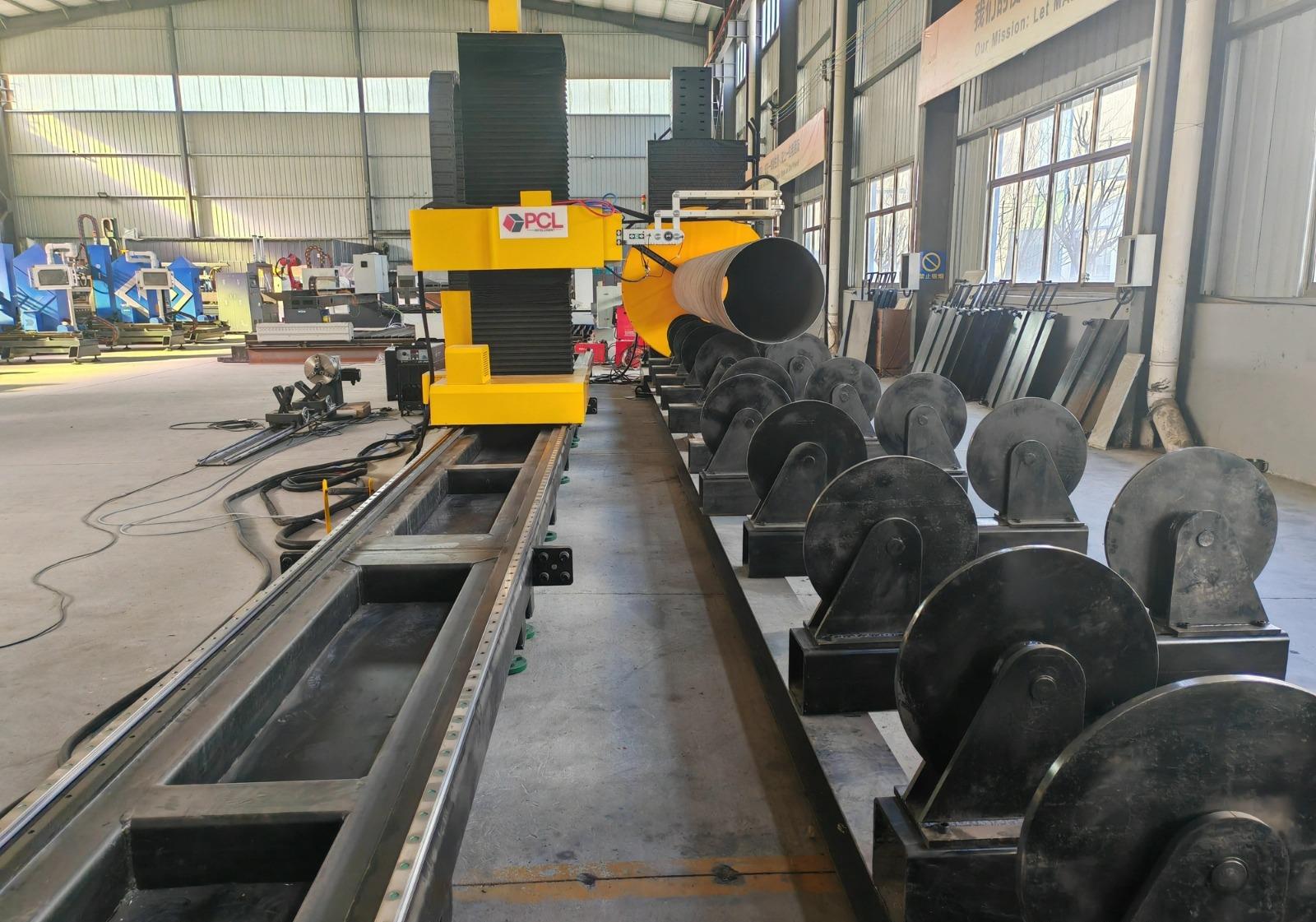
Processing an I-beam is significantly more complex than cutting a flat sheet. An I-beam possesses three dimensions of structural variability, including flanges and a web, which require the laser head to move with 3D spatial awareness. The “Heavy-Duty” designation of this profiler refers to its reinforced gantry and bed, designed to support beams that can weigh several tons and extend up to 12 meters in length.
The machine utilizes a specialized 3D cutting head capable of 45-degree beveling. For wind turbine towers, this is essential. The circular sections of a tower are supported by internal I-beam structures and flanges that require precise weld preparations. By performing the cut and the beveling in a single pass with the 12kW laser, fabricators eliminate the need for secondary grinding or edge preparation, cutting production time by as much as 70%. The precision of a fiber laser—typically within +/- 0.05mm—ensures that when these massive components are moved to the welding station, the fit-up is perfect, reducing the consumption of welding wire and improving the strength of the final joint.
The Critical Role of Automatic Unloading in Dubai’s Industrial Ecosystem
In Dubai’s high-cost industrial zones, efficiency per square meter is a vital KPI. Manual unloading of heavy I-beams is not only slow but poses significant safety risks. The integration of an Automatic Unloading system transforms the laser profiler from a standalone tool into a continuous production cell.
The automatic unloading mechanism uses a series of synchronized hydraulic lifters and lateral conveyors. Once the laser has finished its programmed path, the system detects the completion and automatically transitions the finished beam to a staging area while simultaneously preparing the chucks for the next raw beam. This “lights-out” capability is particularly valuable in the UAE, where companies are looking to maximize output during off-peak energy hours or across multiple shifts without proportional increases in labor costs. Furthermore, the automation reduces the physical footprint of the operation by organizing finished parts systematically, allowing for a cleaner, safer, and more organized shop floor.
Wind Turbine Towers: The Ultimate Structural Challenge
Wind turbine towers are marvels of modern engineering, often reaching heights of 100 to 160 meters. The base sections are composed of incredibly thick steel to support the weight of the nacelle and the aerodynamic forces of the rotors. While the outer shell is made of rolled plate, the internal architecture—the platforms, ladders, and reinforced mounting points—relies on I-beams and heavy structural profiles.
The 12kW laser profiler is specifically tuned for these materials. It can pierce 25mm carbon steel in a fraction of a second, whereas lower-power lasers would struggle with heat buildup, potentially warping the beam. In the context of Dubai’s contribution to regional wind projects (such as those in Saudi Arabia or Oman), the ability to produce these components locally reduces the carbon footprint associated with shipping massive steel structures from East Asia or Europe. The laser profiler allows Dubai-based firms to compete on a global scale, offering “Made in UAE” components that meet the stringent ISO and CE standards required for renewable energy infrastructure.
Environmental Adaptation: Operating High-Power Lasers in the UAE Climate
Operating a 12kW fiber laser in the unique climate of Dubai presents specific engineering challenges, primarily related to heat and airborne particulates. Fiber lasers are sensitive to temperature fluctuations; the diodes and the laser medium must be kept within a narrow thermal window to maintain beam stability.
The heavy-duty profilers deployed in this region feature “tropicalized” chiller systems. These are oversized cooling units designed to dissipate the immense heat generated by a 12kW source even when the ambient warehouse temperature exceeds 45°C. Additionally, the machine’s optical path is pressurized with filtered, dry air to prevent the ingress of the fine desert dust that is ubiquitous in the region. Without these localized adaptations, the precision of the I-beam profiling would degrade, leading to costly slag and dross on the underside of the cuts. As an expert, I emphasize that the “Dubai-spec” machine is a specialized breed of hardware, built to thrive where standard machines might falter.
Economic Impact and the Future of Sustainable Fabrication
The investment in a 12kW Heavy-Duty I-Beam Laser Profiler is a strategic economic move. While the initial capital expenditure (CAPEX) is higher than plasma alternatives, the operational expenditure (OPEX) is significantly lower. Fiber lasers boast a wall-plug efficiency of roughly 35-40%, compared to the 10% of CO2 lasers or the high gas consumption of plasma.
For Dubai, this technology fosters a new tier of highly skilled labor. Operating and maintaining a 12kW automated system requires technicians skilled in CNC programming, photonics, and mechatronics. This aligns perfectly with the UAE’s goal of human capital development. As the world moves toward a “Green Hydrogen” economy—a sector Dubai is aggressively pursuing—the demand for wind energy will skyrocket. The towers needed to harvest that wind will be built more efficiently, more safely, and more sustainably thanks to high-power fiber laser profiling.
Conclusion: Cutting a Path to a Greener Tomorrow
The 12kW Heavy-Duty I-Beam Laser Profiler with Automatic Unloading is more than a piece of machinery; it is a catalyst for industrial sovereignty in the renewable energy sector. By providing the power to slice through the toughest structural steels and the intelligence to handle them automatically, it positions Dubai as a manufacturing powerhouse capable of supporting the global transition to clean energy. In the hands of expert fabricators, this technology ensures that the wind towers of tomorrow are built on a foundation of precision, efficiency, and visionary engineering.