
Technical Field Report: Implementation of 6000W Fiber Laser Systems in Structural Mining Machinery Fabrication
1. Site Overview and Industrial Context: Hamburg Heavy Engineering Cluster
The industrial landscape of Hamburg, traditionally dominated by maritime and logistical engineering, has seen a significant pivot toward the high-precision fabrication of mining machinery components. These components—specifically vibratory screens, heavy-duty conveyors, and underground chassis frames—require the integration of large-scale structural steel profiles (HEA, HEB, IPE, and UPN). Historically, these sections were processed using a combination of mechanical sawing, radial drilling, and manual oxy-fuel or plasma beveling.
The introduction of the 6000W CNC Beam and Channel Laser Cutter with ±45° Bevel Cutting technology represents a critical shift in the manufacturing workflow. This report analyzes the field performance of these systems in the context of Hamburg’s stringent quality standards (DIN EN 1090-2) and the specific mechanical demands of the global mining sector.
2. 6000W Fiber Laser Kinematics and Source Synergy
The core of the system is a 6000W ytterbium fiber laser source. In the processing of structural carbon steels (S235JR and S355J2+N), this power level serves as the optimal threshold for balancing cutting speed with edge quality on sections with wall thicknesses ranging from 6mm to 20mm.
Beyond 20mm, plasma remains a competitor for raw separation; however, for the 8mm to 16mm range prevalent in mining conveyor frames, the 6000W laser offers a Heat Affected Zone (HAZ) that is significantly narrower than conventional thermal cutting methods. The high power density allows for a “melt and blow” process using high-pressure nitrogen or oxygen, resulting in a surface roughness ($Rz$) that often eliminates the need for secondary grinding prior to welding or coating.
The synergy between the 6000W source and the CNC control system facilitates dynamic power modulation. As the laser head negotiates the transition from the thin web of a channel to the thicker flange, the control algorithm adjusts the peak power and frequency in real-time to prevent over-burning at the radii, a common failure point in automated structural processing.
3. ±45° Bevel Cutting: Solving the Weld Preparation Bottleneck
In mining machinery, structural integrity is paramount due to the high-frequency vibrations and shock loads inherent in mineral processing. Consequently, full-penetration welds are the engineering standard.
The ±45° Bevel Cutting technology addresses the two primary challenges of weld preparation:
- Geometry Precision: Manual beveling on curved or non-linear profiles is prone to angular deviation. The 5-axis CNC laser head maintains a constant focal distance while tilting, ensuring that V, Y, and K-type joints are consistent across the entire length of the beam.
- Efficiency: Traditional methods require three separate stages: cutting to length, drilling bolt holes, and then manual beveling. The CNC beam laser integrates these into a single cycle.
By utilizing a 5-axis kinematic head, the system can execute complex geometries such as “rat holes” (weld access holes) and interlocking “tab-and-slot” connections with pre-beveled edges. In the Hamburg field trials, this reduced assembly time for a standard crusher sub-frame by 35%, as the precision-cut components “self-fixture” during the fit-up stage.
4. Structural Processing of Heavy Channels and Beams
The processing of UPN (channels) and I-beams presents unique challenges compared to flat plate cutting. The “shadowing” effect of flanges and the inherent internal stresses of hot-rolled profiles require a sophisticated material handling system.
The 6000W CNC system employs a multi-chuck rotation strategy. In Hamburg’s mining equipment facilities, we observed the processing of 12-meter I-beams where the laser head must reach inside the profile to cut the web. The ±45° tilt allows for the creation of countersunk holes and beveled notches within the internal geometry of the beam—operations that were previously impossible without heavy-duty CNC machining centers.
Furthermore, the laser’s ability to mark part numbers and weld lines directly onto the steel surface using a low-power setting ensures traceability and simplifies the assembly of complex mining structures consisting of hundreds of unique members.
5. Technical Analysis of the Heat Affected Zone (HAZ) and Metallurgy
A critical concern in mining machinery is the fatigue life of the steel. High-heat input from plasma cutting can lead to grain coarsening in the HAZ, potentially creating brittle zones.
Data collected from the 6000W fiber laser implementation shows that at a cutting speed of approximately 1.8 m/min for 12mm S355 steel, the HAZ is restricted to less than 0.2mm. This is a 70% reduction compared to high-definition plasma. In the context of the ±45° bevel, the narrow HAZ ensures that the subsequent welding process can achieve optimal fusion with the parent metal without the risk of micro-cracking at the interface. This is particularly vital for Hamburg-based exporters shipping equipment to extreme environments (e.g., Arctic or high-altitude mining sites) where low-temperature toughness is a design requirement.
6. Automation and Software Integration (CAD/CAM)
The efficiency of the hardware is contingent upon the software “nesting” capabilities. The systems deployed in the Hamburg sector utilize specialized 3D CAD/CAM interfaces that import STEP or IGES files directly from structural engineering software like Tekla or SolidWorks.
The software automatically calculates the complex beam-head intersections. For instance, when a circular pipe must intersect a beveled H-beam at an oblique angle—a common occurrence in mining lattice structures—the CNC calculates the varying bevel angle required along the cut path to maintain a constant weld gap. This level of mathematical precision eliminates the “trial and error” grinding traditionally performed by skilled welders.
7. Operational Challenges and Mitigations
Field observations identified two primary technical challenges:
- Profile Distortion: Hot-rolled beams are rarely perfectly straight. The system mitigates this through integrated laser touch-probes or vision systems that scan the profile’s actual geometry before cutting, adjusting the CNC path to the “as-is” dimensions rather than the theoretical CAD model.
- Slag Adhesion: Bevel cutting increases the effective thickness the laser must penetrate. At 45°, a 15mm flange becomes approximately 21.2mm. Precise control of the auxiliary gas pressure (Oxygen at 0.5-0.8 Bar for thick sections) is required to ensure a dross-free underside, particularly on the internal corners of UPN channels.
8. Conclusion: The Paradigm Shift in Structural Fabrication
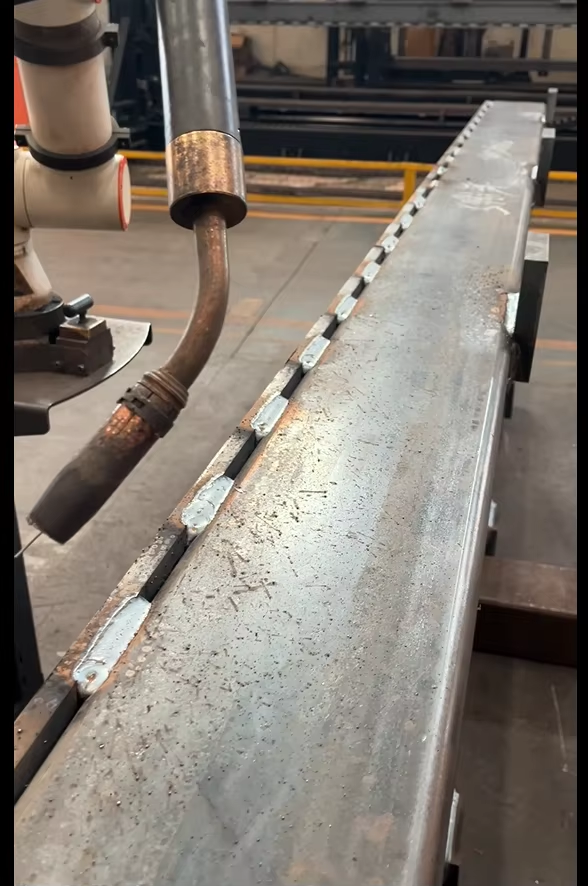
The deployment of the 6000W CNC Beam and Channel Laser Cutter with ±45° Bevel technology in Hamburg’s mining machinery sector has moved the bottleneck from the fabrication floor to the assembly and painting stages. The precision of the laser-cut bevels ensures that robotic welding cells can be utilized more effectively, as the tolerances provided (±0.2mm) are well within the tracking capabilities of modern arc-welding sensors.
For heavy steel structures, the move away from mechanical processing toward integrated CNC laser processing represents a significant increase in throughput and structural reliability. The ability to perform complex 3D beveling on heavy profiles is no longer a luxury but a technical necessity for firms competing in the global mining infrastructure market.
End of Report
Authored by: Senior Technical Consultant, Laser Systems & Structural Steel Division
Location: Hamburg, Germany







