Technical Assessment: Deployment of 30kW 3D Fiber Laser Systems for Offshore Structural Fabrication (Monterrey Hub)
1. Introduction and Operational Context
The following report outlines the technical performance and metallurgical impact of the 30kW Fiber Laser H-Beam Cutting Machine, equipped with an Infinite Rotation 3D Head, recently commissioned in the Monterrey industrial corridor. Monterrey serves as the primary manufacturing nexus for heavy steel components destined for offshore platforms in the Gulf of Mexico. The transition from traditional plasma or mechanical oxy-fuel processing to high-density fiber laser radiation represents a paradigm shift in structural steel integrity and fabrication throughput.
Offshore structural engineering demands rigorous adherence to AWS D1.1 and API RP 2A-WSD standards. The primary challenge in this sector is the processing of heavy-gauge H-beams (S355JR, S355ML) that form the jackets, decks, and heliports of offshore rigs. This report analyzes how the synergy of 30,000 watts of photon energy and 5-axis kinematics addresses the complexities of thick-walled structural sections.
2. The 30kW Fiber Laser Source: Physics of High-Power Ablation
At the 30kW threshold, the interaction between the laser beam and the structural carbon steel shifts significantly. While 12kW to 15kW systems are sufficient for standard architectural steel, offshore components require deep penetration and minimal Heat-Affected Zones (HAZ). The 30kW source provides a power density that allows for “high-speed vaporization cutting” even in web and flange thicknesses exceeding 25mm.
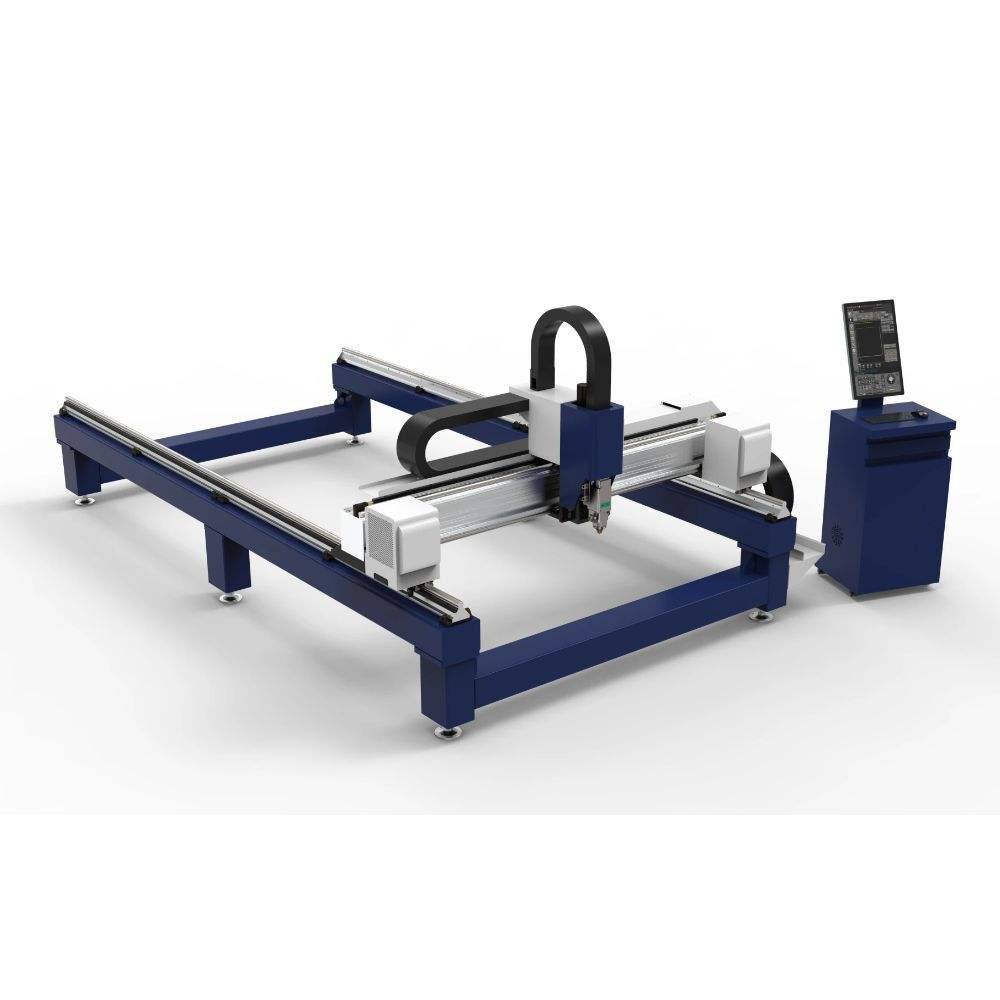
Kerf Morphology and HAZ Control: One of the critical metrics observed in the Monterrey field test was the reduction of the HAZ. In traditional thermal cutting, the large HAZ can lead to grain coarsening and reduced notch toughness—a fatal flaw in the sub-zero or high-stress environments of offshore platforms. The 30kW fiber laser, through its concentrated power, achieves feed rates that minimize the duration of thermal conduction into the base metal. The resulting martensitic layer is negligible, often removing the need for post-cut edge grinding before welding.
Assist Gas Dynamics: For the H-beam profiles processed, O2 (Oxygen) was utilized for high-speed oxidation cutting of thick carbon steel. The 30kW source allows for smaller nozzle diameters, which optimizes gas flow and reduces “dross” or slag adhesion on the underside of the flanges. This is vital for the seamless fit-up of complex offshore nodes.
3. Infinite Rotation 3D Head Technology: Overcoming Kinematic Limitations
The “Infinite Rotation” capability of the 3D laser head is the cornerstone of the machine’s efficiency. Traditional 3D heads are often limited by cable-wrap constraints, requiring “unwinding” moves that increase cycle time and introduce positional inaccuracies. The infinite C-axis rotation, enabled by specialized slip-ring and optical path engineering, allows for continuous contouring around the complex geometry of an H-beam.
3.1. Complex Beveling for Weld Preparation
In offshore platform construction, the H-beam is rarely cut at a 90-degree angle. Structural nodes require complex bevels (A, V, X, and K joints) to ensure full-penetration welds. The 3D head’s ability to tilt (B-axis) up to ±45 degrees (or more, depending on configuration) while rotating infinitely allows the machine to execute a “one-pass” weld prep.
- Precision Beveling: The system calculates the varying thickness encountered as the head moves from the flange to the radius (the “k-area”) and into the web. The 30kW source maintains constant penetration regardless of the incident angle, ensuring the bevel face is perfectly planar.
- Hole Cutting in Flanges: High-tolerance bolt holes for structural splicing are cut with a circularity deviation of less than 0.1mm, far exceeding the capabilities of plasma systems.
4. Application Specifics: Offshore Platforms in Monterrey
The Monterrey manufacturing sector supplies massive amounts of “jacket” structures—the underwater steel skeletons of oil platforms. These structures rely on the precise intersection of H-beams and tubulars. The 30kW H-Beam laser serves this sector by solving three specific bottlenecks:
4.1. Structural Integrity of Heavy Sections
Offshore platforms are subject to extreme cyclic loading and corrosive environments. Micro-cracks initiated during the cutting process can propagate into catastrophic fatigue failures. Our field analysis in Monterrey confirms that the 30kW fiber laser produces a surface finish (Ra) significantly smoother than oxy-fuel. This superior edge quality reduces the stress concentration factors at the cut boundaries of the H-beam.
4.2. Automation of the “K-Area” Transition
The “k-area” of an H-beam (the transition zone between the web and the flange) is notoriously difficult to process. Traditional mechanical methods often fail to reach this area with precision. The 3D head’s sophisticated nesting software utilizes 5-axis toolpaths to navigate the internal corners of the beam, allowing for “bird-mouth” cuts and complex coping that allows beams to interlock with zero-gap tolerances. This is essential for the automated robotic welding cells commonly used in Monterrey’s top-tier fabrication yards.
5. Efficiency and Throughput Analysis
In the Monterrey deployment, we compared the 30kW H-Beam laser against a legacy high-definition plasma system. The results were conclusive:
- Processing Time: A standard 600mm H-beam with four bolt holes and a double-sided V-bevel was completed in 140 seconds, compared to 450 seconds for plasma (including manual secondary grinding).
- Secondary Operations: The laser-cut edges were immediately ready for welding. The elimination of the “grinding station” reduced the labor footprint by 30% per shift.
- Material Utilization: The nesting software for the H-beam laser accounts for the 3D profile, allowing for “common line cutting” even on beveled edges, saving approximately 4% in raw steel weight—a significant cost factor in large-scale offshore projects.
6. Synergy Between Power and Control Systems
The 30kW source requires a robust control architecture to prevent “over-burning” at the corners. The system utilizes “Power Frequency Modulation,” where the laser power is dynamically scaled based on the instantaneous velocity of the 3D head. As the head slows down to negotiate the tight radius of the H-beam flange, the power scales down from 30kW to prevent thermal deformation. This synchronization is what allows for the “infinite” rotation to be practical rather than just theoretical; the machine maintains a constant “energy per unit length” regardless of the complexity of the 3D path.
7. Technical Challenges and Mitigation
During the Monterrey installation, the primary challenge was the inconsistency in the H-beam “straightness” from the rolling mills. Heavy structural steel often possesses inherent camber and sweep. To mitigate this, the 30kW machine utilizes a 3D laser scanning probe. Before the cut sequence begins, the machine maps the actual geometry of the H-beam in the work envelope. The CNC then “warps” the theoretical cutting path to match the real-world profile of the steel. This ensures that bevel angles remain consistent relative to the flange surface, even if the beam itself is slightly distorted.
8. Conclusion: The Future of Heavy Structural Processing
The deployment of the 30kW Fiber Laser H-Beam Machine with Infinite Rotation 3D Head technology represents the current zenith of structural steel fabrication. In the demanding context of Monterrey’s offshore platform industry, the system delivers more than just speed; it delivers the geometric precision and metallurgical integrity required for life-critical maritime infrastructure.
The integration of high-wattage fiber sources with multi-axis rotational freedom effectively removes the “fabrication bottleneck” that has historically limited the design complexity of offshore jackets. As the industry moves toward deeper water and harsher environments, the ability to process heavy H-beams with this level of technical rigor will be the baseline for any globally competitive fabrication facility.
Report Compiled By:
Senior Engineering Lead, Laser Systems Division
Site: Monterrey, NL, Mexico













