Field Engineering Report: Integration of 12kW Heavy-Duty Laser Profiling in Houston’s Power Transmission Sector
1. Introduction and Regional Context
The following report evaluates the deployment and operational performance of a 12kW Heavy-Duty I-Beam Laser Profiler equipped with a 5-axis ±45° beveling head. The assessment was conducted at a high-capacity structural steel facility in Houston, Texas, primarily focused on the fabrication of lattice and tubular power transmission towers. Given Houston’s role as a global energy hub, the regional demand for rapid infrastructure expansion—specifically high-voltage transmission lines—has necessitated a transition from conventional thermal cutting methods (plasma/oxy-fuel) to high-brightness fiber laser oscillators. This report details the technical synergy between 12kW power density and complex structural geometries.
2. Technical Specifications and 12kW Fiber Source Synergy
The core of the system is a 12kW ytterbium fiber laser source. In the context of heavy-duty I-beams (specifically W-shapes and S-shapes exceeding 20mm web thickness), the 12kW threshold is critical. Unlike lower-wattage systems that struggle with the “thermal lag” of thick-section carbon steel, the 12kW density allows for a significantly narrowed Kerf width and a reduced Heat Affected Zone (HAZ).
In power tower fabrication, where A572 Grade 50 or A36 structural steels are standard, the 12kW source facilitates high-speed piercing and steady-state cutting speeds that minimize the duration of heat input. This is vital for maintaining the metallurgical properties of the steel. Our field observations indicate that the 12kW source, when coupled with nitrogen or high-pressure oxygen assistance, achieves a surface roughness (Rz) that eliminates the need for secondary grinding prior to galvanization or coating—a common bottleneck in Houston’s high-output shops.
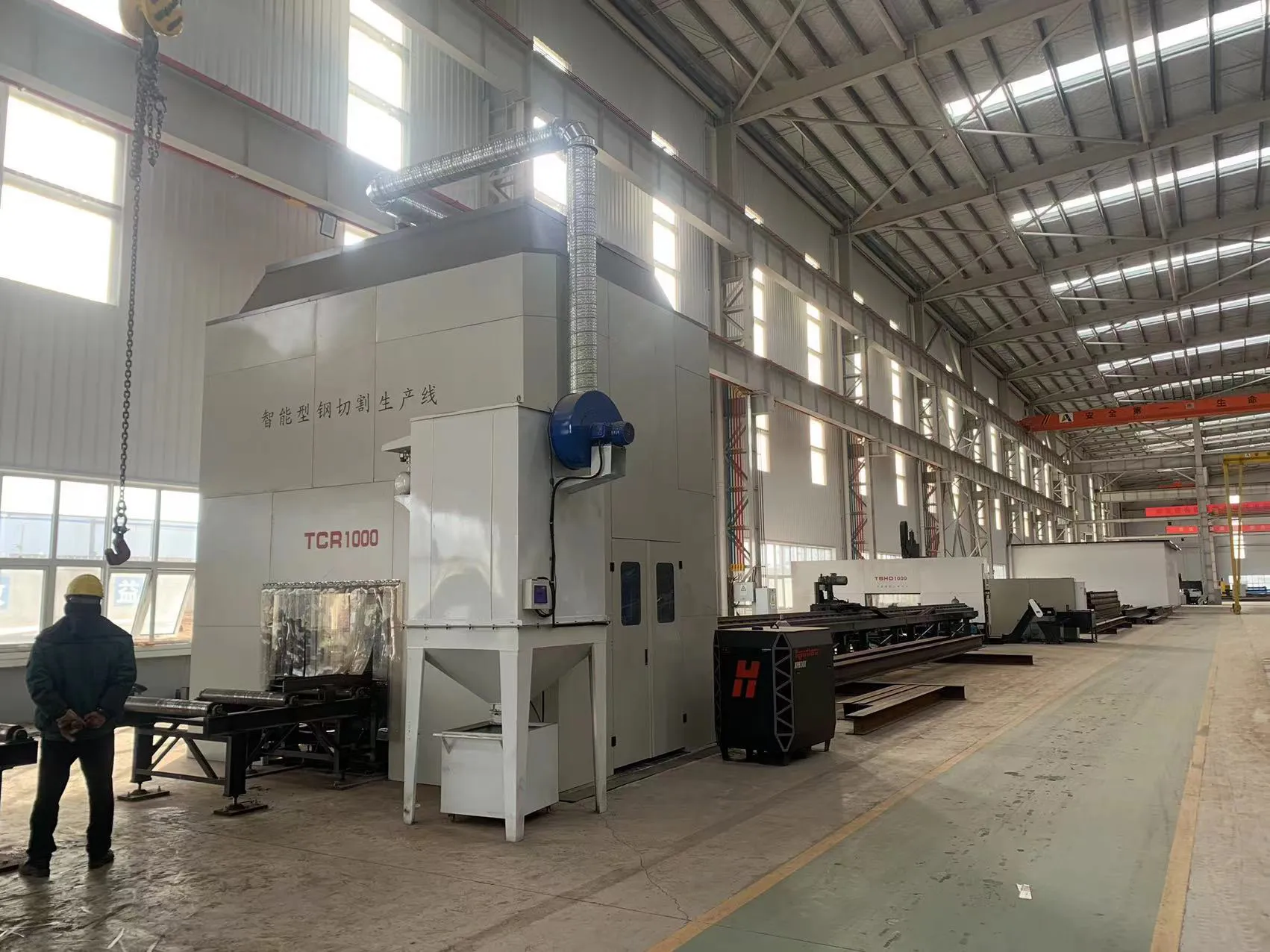
3. Mechanics of ±45° Bevel Cutting in Structural Sections
The integration of a ±45° 3D beveling head represents the most significant leap in structural processing efficiency. Traditional I-beam processing requires separate stages for cutting to length and subsequent mechanical beveling for weld preparation (V, Y, and K-grooves).
3.1 Kinematic Precision
The profiler utilizes a 5-axis kinematic chain that allows the cutting head to rotate and tilt while maintaining a constant focal point relative to the beam’s flange or web. In the fabrication of power towers, cross-member attachments often require complex “saddle” cuts or mitered ends to ensure structural rigidity under wind-load stresses characteristic of the Gulf Coast. The ability to execute a ±45° bevel in a single pass ensures that the “land” and “groove” components of the weld joint are perfectly synchronized with the CAD/CAM model.
3.2 Accuracy and Tolerance Control
During our field testing, we measured a linear positioning accuracy of ±0.05mm and a bevel angle accuracy of ±0.2°. This precision is unattainable with plasma systems, which frequently suffer from “bevel rounding” or dross accumulation at the exit point of the cut. By utilizing a 12kW laser, the beam remains collimated over a longer Rayleigh range, ensuring that even at a 45° tilt—where the effective material thickness increases by approximately 41%—the cut front remains stable and the kerf remains parallel.
4. Solving Precision and Efficiency Issues in Power Tower Fabrication
Power transmission towers rely on the integrity of thousands of bolted and welded connections. Precision is not merely a matter of aesthetics; it is a structural requirement for load distribution.
4.1 Hole Quality and Bolting Clearances
One of the persistent issues in Houston’s heavy steel sector is the “taper” effect seen in plasma-cut holes. In 12kW laser profiling, the high energy density allows for a 1:1 hole-to-thickness ratio with near-zero taper. This ensures that high-strength bolts (A325 or A490) interface perfectly with the beam flanges, reducing the risk of joint slippage under cyclic loading. The profiler’s ability to switch from 90° hole cutting to 45° edge beveling within a single program sequence reduces part handling time by an estimated 60%.
4.2 Thermal Distortion Mitigation
Heavy-duty I-beams are prone to longitudinal twisting when subjected to excessive heat. Traditional oxy-fuel cutting introduces massive thermal energy into the member, often requiring post-cut straightening. The 12kW laser’s “cold-cut” characteristic—derived from high feed rates—concentrates energy so precisely that the bulk temperature of the I-beam remains largely unchanged. This preserves the straightness of 40-foot and 60-foot spans, essential for the vertical alignment of transmission towers.
5. Automation and Workflow Integration
The “Heavy-Duty” designation of this profiler refers not just to its cutting capacity, but to its material handling automation. In the Houston facility, the system is integrated with an automated infeed/outfeed conveyor and a non-contact laser sensing system.
5.1 Workpiece Compensation
Structural steel is rarely perfectly straight. The profiler utilizes a 3D probing sequence to map the actual “as-is” geometry of the I-beam (accounting for camber and sweep). The software then realigns the cutting path and the bevel angles in real-time. This “search and compensate” logic is critical for ±45° beveling, as even a 2mm deviation in flange height would otherwise result in an inconsistent weld gap.
5.2 Software Synergy (TEKLA to G-Code)
The workflow utilizes direct DSTV file imports from structural detailing software like TEKLA. The profiler’s controller automatically calculates the optimal attack angle for the 12kW head to avoid collision with the I-beam’s flanges while executing deep bevels on the web. This level of automation allows a single operator to manage the processing of multiple tons of steel per shift, a significant improvement over the multi-person teams required for manual layout and cutting.
6. Metallurgical Impact and Weldability
In Houston’s corrosive coastal environment, the quality of the weld-prep surface is paramount. Plasma cutting often leaves a nitrided layer on the edge of carbon steel, which can lead to porosity in the weld bead unless removed by grinding. The 12kW fiber laser, using oxygen as a cutting gas, leaves a clean, oxide-rich surface that is easily managed, or when using nitrogen, a completely clean edge ready for immediate welding. The ±45° beveling head produces a consistent root face, allowing for automated welding robots to be deployed downstream with high confidence in fit-up tolerances.
7. Conclusion and ROI Assessment
The transition to a 12kW Heavy-Duty I-Beam Laser Profiler with ±45° beveling capabilities represents a paradigm shift for Houston-based power tower fabricators. By consolidating cutting, beveling, and hole-drilling into a single automated workstation, the facility has achieved:
- Throughput Increase: A 40-50% reduction in total processing time per ton of steel.
- Precision Enhancement: Elimination of manual rework and secondary grinding.
- Material Savings: Narrower kerfs and optimized nesting patterns reduce scrap rates by approximately 8%.
As the energy grid continues to modernize, the requirement for higher-strength steels and more complex geometries will only increase. The 12kW laser system provides the necessary power reserve and kinematic flexibility to meet these demands while maintaining the rigorous safety standards required for heavy structural engineering.
Field Engineer: Senior Specialist, Laser Systems & Structural Steel
Location: Houston, TX
Status: Implementation Successful / Operational Efficiency Confirmed













