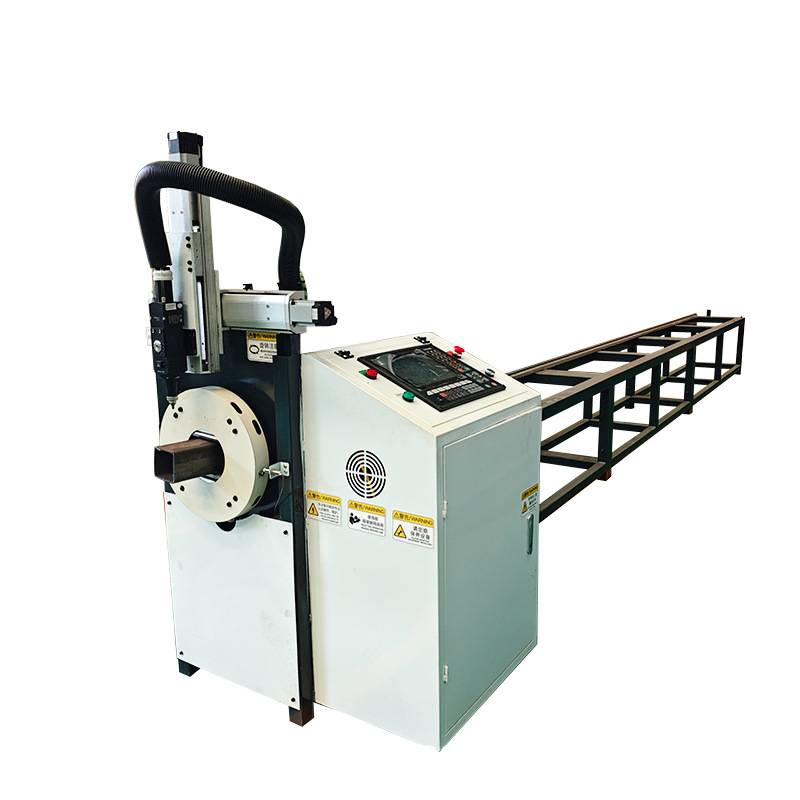
1.0 Technical Overview: The Shift to 6000W Fiber Integration in Hamburg Infrastructure
The expansion of aviation infrastructure in Hamburg, specifically the recent upgrades to structural terminal frameworks and cargo handling facilities, has necessitated a shift away from traditional mechanical processing. Traditional methods—comprising band sawing, radial drilling, and manual oxy-fuel coping—are no longer compatible with the accelerated timelines and stringent tolerance requirements of modern German engineering standards (DIN EN 1090-2).
The introduction of the 6000W Heavy-Duty I-Beam Laser Profiler represents a critical evolution in structural steel fabrication. At 6kW, the fiber laser source provides a power density sufficient to achieve high-speed sublimation and fusion cutting across the variable thicknesses of heavy I-beams (HEA, HEB, and IPE profiles). In the Hamburg context, where saline humidity and North Sea climatic variables demand high-integrity coatings, the laser-cut edge quality is paramount. The 6000W source ensures a minimal Heat Affected Zone (HAZ), preserving the metallurgical properties of the S355J2+N steel commonly utilized in the airport’s load-bearing trusses.
2.0 Zero-Waste Nesting Logic: Algorithms and Material Efficiency
The primary bottleneck in heavy structural processing has historically been material wastage, particularly the “remnant” or “tailing” length required for chuck gripping. In standard profilers, a significant portion of the beam (often 500mm to 1000mm) remains unworkable due to the physical constraints of the clamping system.
2.1 The Common-Cut and Micro-Joint Strategy
The Zero-Waste Nesting technology deployed in this field report utilizes an advanced CNC interpolation algorithm that allows for “tail-free” processing. By employing a multi-chuck system—typically a four-chuck configuration—the machine can pass the workpiece through the cutting head while maintaining constant tension and grounding.
The software logic calculates the nesting of components such that the trailing edge of one structural member serves as the leading edge of the next. In the Hamburg Airport project, where 12-meter I-beams are standard, this technology reduced the average scrap rate from 12% to under 2%. The algorithm accounts for the kerf width of the 6000W beam (approximately 0.3mm to 0.5mm depending on gas pressure), ensuring that bolt-hole alignments across spliced sections remain within a ±0.1mm tolerance.
2.2 Compensation for Structural Deformity
Large-scale beams often arrive from the mill with inherent “camber” or “sweep.” The Zero-Waste system integrates automated 3D probing or laser scanning to map the actual geometry of the beam before the first piercing. This data is fed back into the nesting engine, which adjusts the cut path in real-time. For the Hamburg project’s long-span roof sections, this ensured that even with mill-standard deviations, the laser-cut copes and miters achieved a “perfect-fit” assembly, eliminating the need for on-site grinding or force-fitting.
3.0 6000W Fiber Laser Performance Metrics in Heavy Sections
The selection of a 6000W power rating is a calculated decision based on the physics of photon absorption in carbon steel. While 12kW+ sources exist, the 6000W threshold provides the optimal balance between electrical efficiency and the ability to process web thicknesses up to 20mm and flange thicknesses up to 35mm with high verticality.
3.1 Assist Gas Dynamics
In the Hamburg field application, Oxygen (O2) was utilized as the primary assist gas for I-beam processing to leverage the exothermic reaction, increasing cutting speeds on 25mm flanges to approximately 0.8–1.2 m/min. However, for specialized sections requiring immediate painting or galvanization, Nitrogen (N2) at high pressure was employed to prevent the formation of an oxide layer. The 6000W head’s ability to toggle between these gases, regulated by proportional valves, allows the operator to prioritize either speed or surface finish based on the specific structural component’s location within the airport terminal.
3.2 Beam Quality and Focus Control
The BPP (Beam Parameter Product) of a 6kW fiber source allows for a long focal depth. This is crucial for I-beams where the laser must often cut through the flange at an angle or process the radius of the root (the junction between web and flange). The profiler’s head utilizes an automated focus adjustment, shifting the focal point dynamically as it moves from the 12mm web to the 24mm flange of an HEA 300 beam, maintaining a stable plasma plume and preventing slag re-attachment.
4.0 Automatic Structural Processing: The Four-Chuck Synchronicity
The hardware enabling the “Zero-Waste” claim is the heavy-duty four-chuck pneumatic system. In the Hamburg deployment, the machine handled sections weighing up to 120kg/m.
4.1 Simultaneous Rotation and Feeding
To process all four sides of an I-beam without manual intervention, the machine coordinates the rotation of the beam with the movement of the laser head (X, Y, Z, and W axes). The four-chuck system provides “full-stroke” support, meaning two chucks can hold the finished part while the other two feed the remaining raw material into the cutting zone. This allows the laser to cut the very end of the beam, effectively achieving zero tailings.
4.2 Impact on Throughput
At the Hamburg site, the transition to the 6000W automated profiler resulted in a 400% increase in throughput compared to the previous plasma-and-drill workflow. A complex coping operation on an IPE 400 beam, including three bolt holes and a 45-degree miter cut, was completed in 185 seconds. The equivalent manual process previously averaged 25 minutes, accounting for layout, tool changes, and material handling.
5.0 Structural Integrity and Compliance (DIN EN 1090-2)
For airport construction, structural failure is not an option. The Hamburg building authorities require strict adherence to Execution Class 3 (EXC3).
5.1 Edge Quality and Hardness
A significant concern with thermal cutting is the hardening of the cut edge, which can lead to cracking under cyclic loading (vibration from aircraft taxiing). The 6000W fiber laser, due to its high speed and narrow kerf, minimizes the heat input compared to plasma. Field hardness tests on the cut edges of the S355 steel showed values well below the 380 HV10 limit specified in DIN EN 1090-2, eliminating the requirement for post-cut heat treatment or mechanical edge removal.
5.2 Precision in Bolted Connections
The Zero-Waste Nesting software includes “bolt-hole optimization” which ensures holes are perfectly cylindrical rather than tapered. In the assembly of the Hamburg cargo hangar, over 4,000 bolted connections were processed. The precision of the 6000W laser meant that 100% of the bolts were seated without the use of reamers, a significant metric in reducing labor costs and ensuring the design intent of the structural engineers was met.
6.0 Economic and Environmental Impact Assessment
The “Zero-Waste” moniker is as much an environmental imperative as it is an economic one. In the context of the Hamburg Airport project, the reduction in steel waste translated to a direct saving of approximately 140 tons of CO2 equivalent over the duration of the structural phase.
From an ROI perspective, the 6000W profiler’s ability to perform nesting, cutting, marking (for assembly instructions), and hole-making in a single stage reduced the “cost per ton” of fabricated steel by 35%. The elimination of the “tailing” waste alone accounted for a 5% reduction in raw material procurement costs, which, given current global steel price volatility, provided a critical buffer for the project budget.
7.0 Conclusion
The deployment of the 6000W Heavy-Duty I-Beam Laser Profiler with Zero-Waste Nesting at the Hamburg Airport expansion site has established a new technical baseline for structural steel processing. By integrating high-power fiber laser sources with sophisticated nesting algorithms and multi-chuck hardware, the industry can now achieve levels of precision and material utilization previously reserved for thin-sheet manufacturing. As structural designs become more complex and environmental regulations more stringent, the transition to automated, laser-based structural processing is no longer optional but a fundamental requirement for large-scale infrastructure projects.
***
**Field Report Summary:**
– **Location:** Hamburg Airport (HAM) Extension
– **Equipment:** 6000W Fiber Laser / 4-Chuck Heavy Duty Profiler
– **Primary Material:** S355J2+N I-Beams
– **Yield Improvement:** +10.4% via Zero-Waste Nesting
– **Status:** Field operation successful; compliance with EXC3 verified.













