
1.0 Technical Overview: The Proliferation of High-Power Fiber Lasers in Heavy Infrastructure
In the evolving landscape of renewable energy infrastructure within Southeast Asia, specifically the industrial hubs surrounding Ho Chi Minh City, the demand for high-integrity structural components has necessitated a shift from traditional thermal cutting methods to high-wattage fiber laser systems. This field report analyzes the deployment of a 6000W CNC Beam and Channel Laser Cutter equipped with Infinite Rotation 3D Head technology. The focus is strictly on its application in the fabrication of internal structural reinforcements and secondary steel for wind turbine towers.
The transition to a 6000W fiber source represents a strategic equilibrium between energy consumption and material throughput. While higher wattages exist, the 6000W threshold provides the optimal power density required to achieve high-speed nitrogen-assisted cutting on 10mm to 25mm carbon steel—the primary thickness range for internal ladders, platforms, and flange supports within a turbine mast. In the HCMC region, where power stability and thermal management are operational variables, the efficiency of the 6000W resonator provides a stable Heat Affected Zone (HAZ) profile, critical for maintaining the fatigue resistance required in offshore and onshore wind environments.
2.0 Infinite Rotation 3D Head: Mechanics and Kinematic Advantages
The defining technical bottleneck in beam and channel processing has historically been the limitation of the cutting head’s range of motion. Traditional 5-axis heads often suffer from “cable wrap” limitations, requiring the CNC to “unwind” the head after a specific degree of rotation. In the context of complex structural shapes like C-channels or I-beams used in wind turbine internals, this leads to significant air-cut time and potential inconsistencies at the lead-in points.
2.1 Continuous C-Axis Pathing
The “Infinite Rotation” technology utilizes a specialized fiber-optic rotary joint combined with advanced slip-ring assemblies for auxiliary gases and cooling lines. This allows the cutting head to rotate indefinitely around the Z-axis. From an engineering perspective, this results in continuous pathing during the processing of complex bevels (K, V, Y, and X joints). When cutting a circular access port into a curved C-channel, the infinite rotation ensures that the nozzle perpendicularity is maintained relative to the material surface without a reset move, reducing cycle times by an estimated 22% compared to standard 3D heads.
2.2 Bevel Precision and Weld Preparation
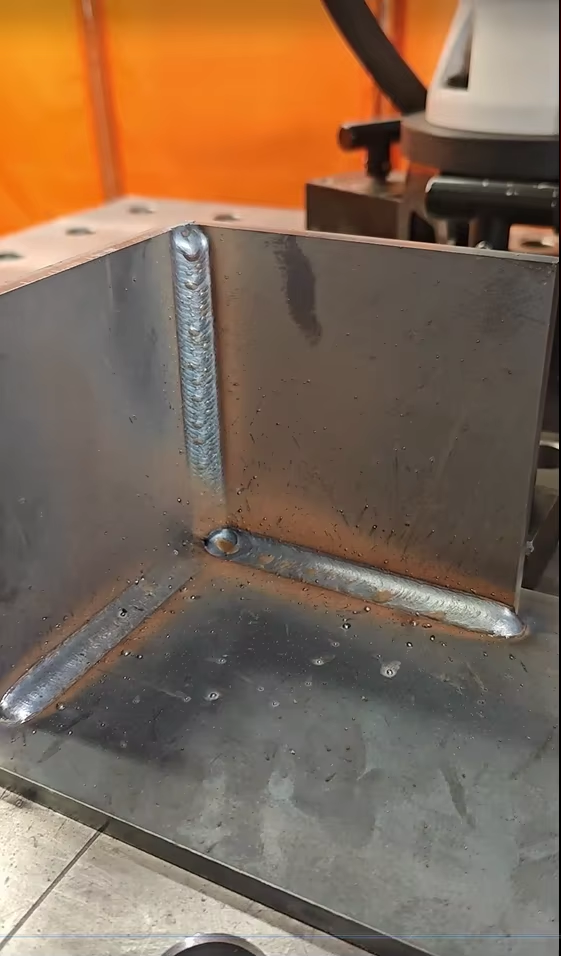
Wind turbine tower components demand rigorous weld preparation. The 3D head’s ability to execute ±45-degree bevels with micron-level repeatability (±0.03mm) eliminates the need for secondary grinding operations. By utilizing the 6000W source, the system achieves a “knife-edge” finish on thick-walled channels. This precision ensures that when components are moved to the welding stations—often automated robotic cells in modern HCMC facilities—the fit-up is near-perfect, reducing the volume of filler wire required and minimizing the risk of hydrogen cracking in the weld root.
3.0 Application Dynamics in Wind Turbine Tower Fabrication
A wind turbine tower is more than a hollow frustum; it is a complex assembly of internal structural steel that must withstand decades of harmonic vibration and corrosive environments. The 6000W CNC Beam Laser is utilized here for three primary sub-assemblies.
3.1 Internal Platform Support Brackets
These components are typically fabricated from heavy-duty U-profile channels. The laser system’s ability to penetrate both the flange and the web of the channel in a single setup—utilizing the 3D head to reach around the geometry—replaces the legacy workflow of drilling and manual plasma cutting. The CNC software compensates for the structural deviations common in hot-rolled steel, using touch-probing or laser sensors to recalibrate the cutting path in real-time, ensuring bolt-hole patterns for internal platforms remain within a ±0.1mm tolerance across a 12-meter beam.
3.2 Cable Tray and Ladder Integration
The verticality of wind towers requires kilometers of cabling and safety ladders. The CNC Beam Laser facilitates “tab-and-slot” architecture for these components. By cutting precise slots into the main tower channels, ladder rungs and cable tray supports can be self-fixtured. This reduces the reliance on expensive jigs and minimizes human error during the assembly phase in the HCMC shipyards or fabrication yards.
4.0 Regional Operational Factors: Ho Chi Minh City Field Analysis
Deploying 6000W laser technology in Ho Chi Minh City presents unique environmental and logistical challenges that the Infinite Rotation 3D system is uniquely suited to address.
4.1 Thermal Management and Humidity
HCMC’s tropical climate, characterized by high humidity and ambient temperatures frequently exceeding 30°C, poses a risk to optical integrity. The 6000W systems deployed here are equipped with dual-circuit industrial chillers and pressurized, filtered optical paths. The 3D head design incorporates enhanced sealing to prevent moisture ingress into the collimation and focusing lens chambers, which is vital for maintaining the beam’s BPP (Beam Parameter Product) during long-shift operations typical of the wind sector’s “peak-demand” cycles.
4.2 Integration with Local Structural Standards
The Vietnamese wind market often adheres to Eurocode 3 or AWS D1.1 standards for structural steel. The 6000W fiber laser’s ability to produce a narrow kerf with a minimal HAZ ensures that the base metal’s mechanical properties—specifically yield strength and ductility—are not compromised during the cutting process. This is a significant upgrade over plasma cutting, where the wider HAZ often requires the removal of 2-3mm of material via machining to meet code-compliant weld prep requirements.
5.0 Synergy Between Power and Automation
The 6000W fiber source is not merely about raw power; it is about the “speed-to-quality” ratio. In beam and channel processing, the CNC system must manage the dynamic fluctuation of the laser’s focal point as the 3D head maneuvers around the structural radii of the profiles.
5.1 Real-Time Height Sensing
The Infinite Rotation head is equipped with high-speed capacitive sensing. As the head rotates around the corner of a heavy I-beam, the sensor must respond at millisecond intervals to maintain a constant stand-off distance. At 6000W, even a 0.5mm deviation in focal position can result in dross formation or “lost cuts.” The integration of the CNC’s look-ahead logic with the 3D head’s motion ensures that the feed rate is automatically attenuated based on the instantaneous angular velocity of the A and B axes.
5.2 Nesting and Material Utilization
Advanced nesting algorithms specifically designed for 3D beam cutting allow HCMC fabricators to minimize scrap on expensive S355JR or S355NL grade steel. The CNC software can nest parts across the flanges and webs of the channel, utilizing the 3D head’s reach to cut features that were previously inaccessible. This results in a material utilization increase of approximately 15% compared to manual layout and cutting methods.
6.0 Conclusion: The Future of Heavy Steel Processing
The implementation of 6000W CNC Beam and Channel Laser Cutters with Infinite Rotation 3D Heads marks a paradigm shift for the wind energy supply chain in Ho Chi Minh City. By condensing multiple processes—marking, drilling, sawing, and beveling—into a single workstation, fabricators are achieving unprecedented levels of throughput.
The technical superiority of the infinite rotation capability cannot be overstated; it is the key to unlocking the full potential of 5-axis laser processing by removing the physical constraints of cable management. For the wind turbine sector, where structural integrity and precision are the primary metrics of success, this technology provides a robust solution to the challenges of heavy steel fabrication, ensuring that Vietnam remains a competitive hub for renewable energy manufacturing in the Asia-Pacific region. The data suggests that for any facility processing over 500 tons of structural steel per month, the transition to 6000W 3D laser technology is no longer an optional upgrade, but a fundamental requirement for industrial viability.
















